
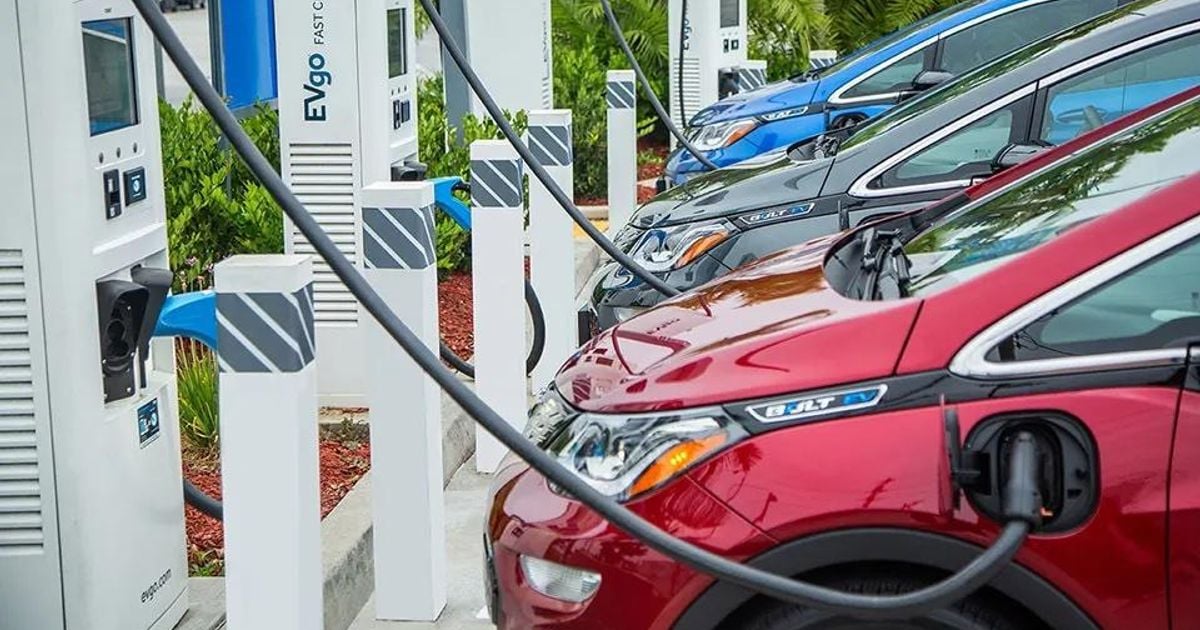
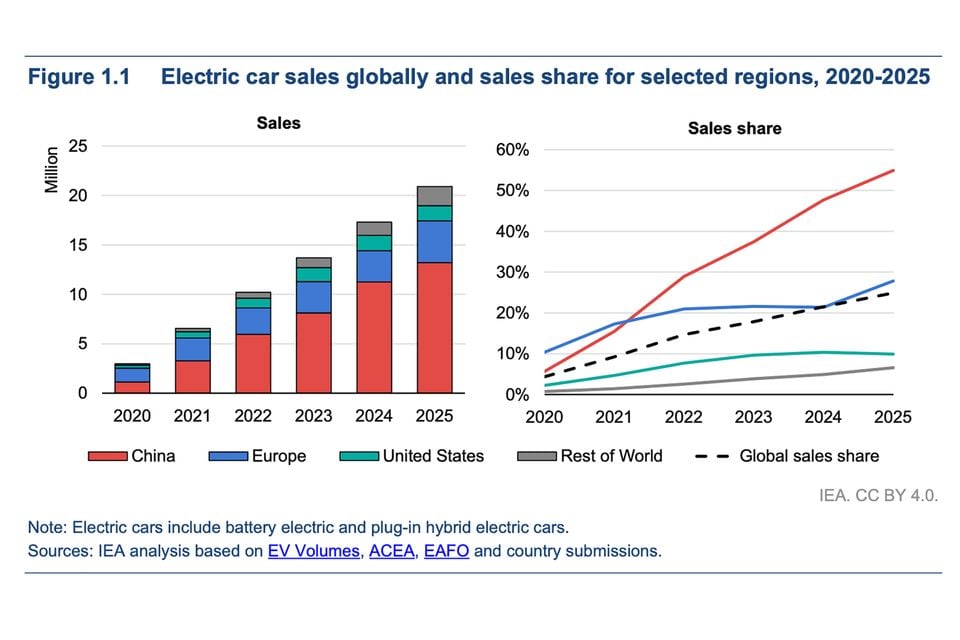
The International Energy Agency (IEA) estimates electric vehicle (EV) sales – including not only EVs but also plug-in hybrids (PHEVs) and extended-range EVs (EREVs) – will hit 23 million this year, and account for around 28 per cent of all new cars sold.
In a report released this week, the IEA used recent trends and sales data from the first quarter of this year, and forecast EV sales to rise from 20 million last year.
For simplicity’s sake in this article, as in the IEA report, we’ll use the term ‘EV’ to refer to pure EVs as well as PHEVs and EREVs, unless otherwise noted.
According to the IEA’s numbers, 3.9 million EVs were sold in the first three months of 2026 – down eight per cent from the same time last year. This is primarily due to falling sales in China, the world’s largest EV market, and the US.
Looking for your next car? We’ll help you research and compare so you choose with confidence.
These falls hide a surge in EV sales in March, with 30 countries breaking EV sales records.
This rise was driven by higher petrol prices following strikes on Iran initiated by the US and Israel, which led to Iran’s closure of the Strait of Hormuz. Preliminary April data shows Chinese EV sales recovering, and hitting a record market share of over 60 per cent.
Should the IEA’s prediction prove to be accurate, it will mean EV sales continue their ascent up the global sales charts.
Thanks to its sales tax exemption and other benefits, Norway remains the world leader for EV market share with pure EVs accounting for 95 per cent of sales in 2025, and plug-in hybrids at under two per cent.
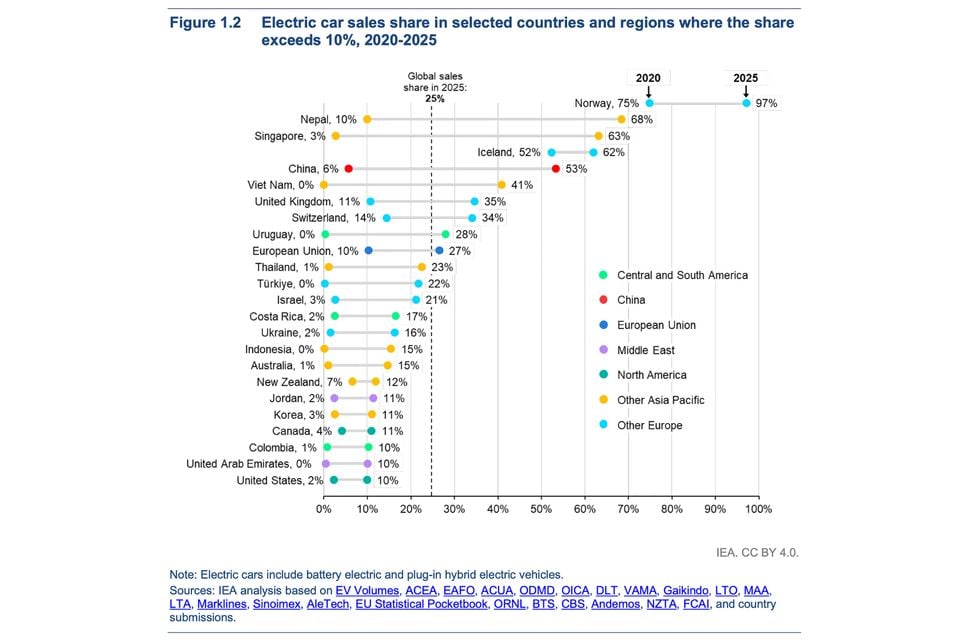
Cheap EV imports from China have helped to propel Nepal into the number two position, while Singapore and Vietnam (third and sixth, respectively) saw their EV shares rise considerably thanks to significantly reduced annual road taxes. Vietnamese manufacturer Vinfast has captured nearly all of the local EV market with its VF3 and VF5 models.
While China is only fifth on the EV market share list, it’s by far the largest market for EVs. Thanks to high levels of competition among local automakers, prices that are competitive with combustion-powered counterparts, and a (now ended) government trade-in scheme, China accounted for around 60 per cent of all global EV sales.
On top of this, 80 per cent of all EV battery cells and nearly three quarters of the world’s EVs were made in China.
Despite having large car manufacturing operations, Thailand and Indonesia allowed EV market share to grow by previously relaxing import duties. Both countries are now prioritising local EV production, which could see sales fall in 2026.
While the US has gained plenty of headlines for ending tax credits for EV purchases, the developed nation with the lowest EV take-up is Japan where sales remained flat at around 100,000 units or less than three per cent of the market, even though hybrids made up a third of all sales.
The report’s authors speculate the EV take-up rate in Japan might be down to apartment living and the lack of charging infrastructure.
MORE: Australia’s best-selling PHEVs in 2025 revealed
MORE: Australia’s best-selling EVs in 2025 revealed