
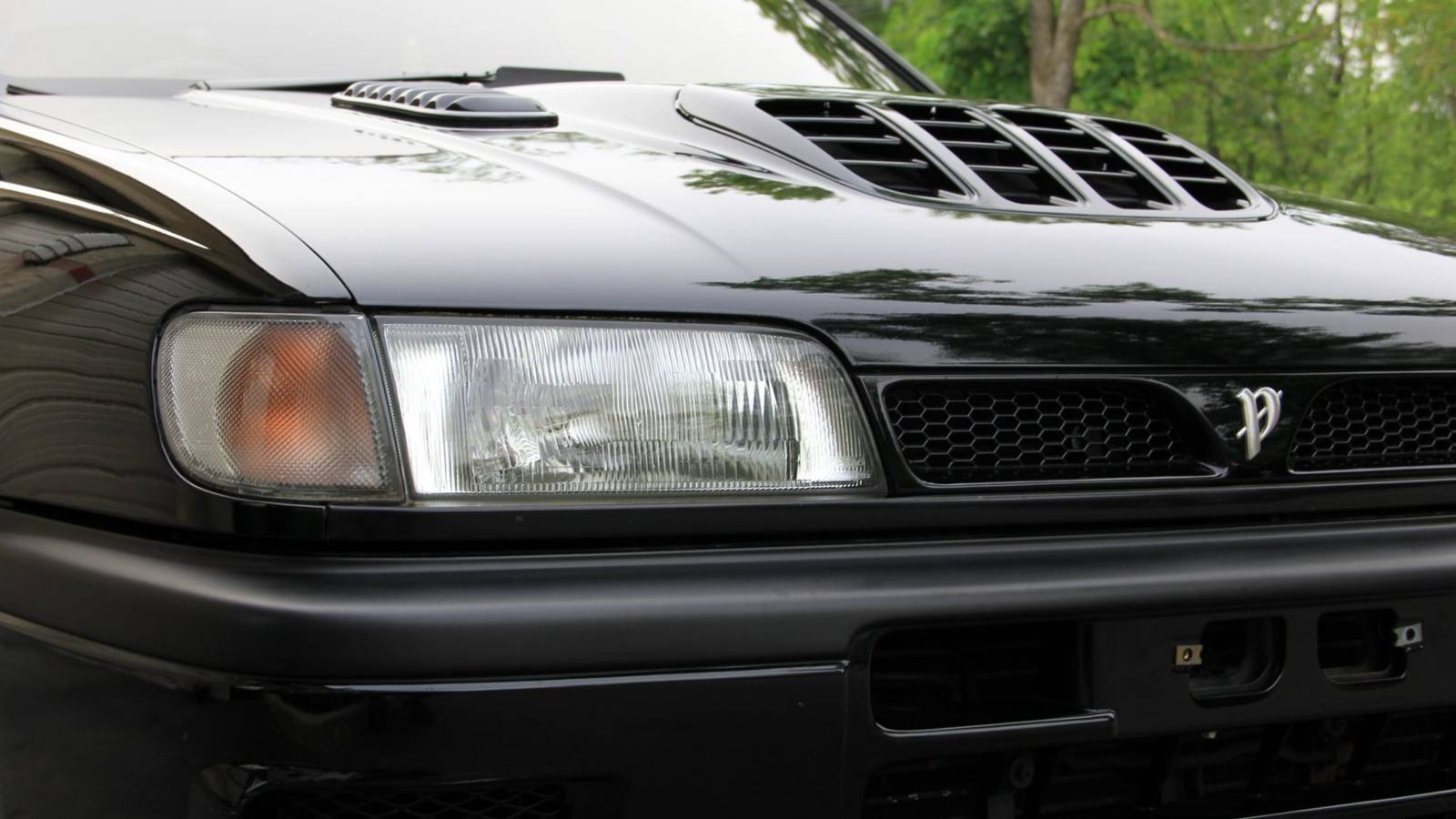
Nissan has a storied history with performance cars, and the “GT-R” moniker best defines them. From the iconic “Godzilla” wielding R32 Skyline GT-R to the recently bowed out “supercar-slaying” R35 GT-R, this is a nameplate that has single-handedly humbled a lot of V10 and V12 supercars over the years. However, there is a lesser-known sibling to this icon that many are unaware of. It is a homologation special, three-door hot hatch born so that Nissan could participate in the World Rally Championship under the Group A category.
According to the rules, manufacturers needed to produce at least 5,000 examples of the car to enter Group A races. It is safe to say that this capable AWD hot hatch with an impressive power-to-weight ratio surpassed expectations and sold nearly three times as many units over four years, from 1990 to 1994. This was a Nissan Pulsar on steroids, able to squeeze in and use a famed Nissan Skyline GT-R mechanical feature despite its compact form factor. The parallels with its impressive power-to-weight ratio and underdog character are what aptly give it the “Baby GT-R” tag.
Nissan Pulsar GTI-R: A Forgotten Homologation Special Hot Hatch
The Godzilla’s Little Brother

The standard Nissan Pulsar is actually a bread-and-butter car with no inclination towards adrenaline-pumping performance. In its lifespan, the Pulsar was offered in a variety of body styles, ranging from a three-door hatchback to a five-door station wagon. The engine choices were not that inspiring either, with the Pulsar range getting base 1.2-liter engines with only 50 horsepower. Some got bigger 1.4-liter four-cylinders that could do urban duties. Performance levels increased in the late 80s, but it still didn’t stand out. This is also one of the primary reasons the Pulsar GTI-R is less popular: it is overshadowed by mundane, mass-produced versions.

Things took a drastic turn with Nissan’s decision to beef up the N14 Series’ three-door hatchback model into a homologation special and create the Pulsar GTI-R. It was a clever evolution of the standard run-of-the-mill hatch. A lot of parts were shared with the standard model. But the GTI-R stood out for its sportier exterior design, particularly its famed hood bulge. It also got a redesigned front fascia and a large rear spoiler to assert its sportiness. But the aspects that gave it the “Mini GT-R” tag were a shared technology feature with the mighty Godzilla (more on this below). However, only 5,000 Pulsar GTI-Rs were slated for production.

Nissan saw the growing popularity of its hot hatch and ended up building just under 15,000 units during its production run. The GTI-R was not sold in America. But since it’s over 25 years old now, a few specimens are being actively imported into the States. Also, its true potential is now evident from the used market prices, with a 1991 model selling for $25,455 as per Bring a Trailer. There was also a very special 1990 Nissan Pulsar GTI-R that sold for a whopping $88,500. This is a Nismo-modified version and is reportedly #13 of 21 examples modified by Nissan’s Motorsports Division.

10 Old School Hot Hatches That Still Make Modern Ones Look Slow
While modern hot hatches are undoubtedly quick, many have lost some of the raw, untamed spirit that made their predecessors so exhilarating.
Grin-Worthy Power-To-Weight Ratio
230 Horsepower And Curb Weight Of 2,690 Pounds

At the heart is a unique version of the SR20DET 2.0-liter turbocharged four-cylinder engine. This mill is famed for its application on the likes of the 1990s 180SX and the S13, S14, and S15 Silvias. However, the Pulsar GTI-R’s mill has been extensively tweaked for its application. It produces 227 horsepower and 210 pound-feet of torque. It was coupled to an engaging five-speed manual gearbox. These numbers were impressive on a sports car in the 90s. This engine is designed for maximum performance. Some notable features include its aluminum-alloy block and cylinder heads, dual-overhead camshafts, four valves per cylinder, a Garrett turbocharger, and Bosch’s L-Jetronic fuel-injection system.

The GTI-R enhanced its performance appeal with an impressive power-to-weight ratio, thanks to its low curb weight of 2,690 pounds. The result of all these features is swift acceleration and quarter-mile times that are enough to make even the likes of 1990s Porsche 911s sweat. The Nissan Pulsar GTI-R did 0–62 mph in sub-five seconds and ran a standard quarter-mile in sub-14 seconds, according to extensive road tests by Best Motoring magazine.

The Forgotten Sports Coupe That Paved The Way For Legendary JDM Icons
This legendary JDM model is woefully overlooked, but it changed the face of JDM and inspired some of the most iconic JDM models that followed it.
Sophisticated Underpinnings For The Time
Even Shared The Famed ATTESA System With The GT-R

The chassis setup was well-balanced. The Pulsar GTI-R has the same galvanized steel chassis as its normal N14-Series stablemates. The wheelbase was compact, and an independent suspension setup allowed more dynamic freedom. The front got MacPherson struts, and the rear was a multi-link setup. Nissan gave its sportiest Pulsar anti-roll bars at both ends. However, the coolest and most sophisticated component it hides is the famed ATTESA four-wheel-drive system. This system used a viscous-coupling rear and center differential, with an open differential for the front axle.

This innovative AWD system was way ahead of its time. ATTESA (Advanced Total Traction Engineering System for All-Terrain) primarily operated as an RWD system but would instantly send power to the front wheels when it detected rear-wheel slip. This was done using an array of G- and wheel-speed sensors, controlled by a hydraulic clutch. Its adaptive nature helps ATTESA offer AWD grip and fun RWD handling characteristics in one package.

10 Turbocharged Cars That Became Legends In The Tuning Scene
These are the standout platforms that revolutionized turbo power potential.
Sporty And Driver-Centric Interior
Packs Just The Right Amount Of Comfort Features

The interior was driver-focused, packing the essential features to make the drive engaging and non-distracting. Nissan, however, did put in extra effort to cater to different types of drivers with variations of the GTI-R. The most common one is the Pulsar GTI-RA, which was also the coziest of them all. It packed a handful of bits, including two-tone sports seats, a leather-wrapped steering wheel, a leather gear shift, fabric-trimmed door panels, and an air-conditioning system. For those craving for a more hardcore version, there was the GTI-RB. It was designed primarily for motorsport use and was hence stripped of many comfort features.

The air-con system, electric windows, and rear wiper were removed to save weight. Leather and fabric trimmings were swapped for plastic and rubber. All of these helped Nissan shave off about 66 pounds. Another name that would sound familiar is the Sunny GTI-R. This is technically the Pulsar GTI-R, but was renamed to Sunny for the European market. While it was mostly identical, stringent rules and performance restrictions made the Sunny GTI-R weaker with a revised ECU and lower power output.

The Nissan Sports Car That Outsold The Toyota Supra, But Nobody Talks About
The 2024 Toyota GR Supra may be a heck of a sports car, but Nissan’s rival sports coupe outsold it last year, yet no one is talking about it.
A Modern-Day Nissan Pulsar Nismo Would Excite
Has The Power To Rekindle The Dying Hot Hatch Segment

The Pulsar GTI-R’s legacy was short-lived, as Nissan withdrew from the WRC in 1992. But that hasn’t stopped us from imagining the potential of a modern-day Nissan Pulsar. In fact, even Nissan explored this idea with the last-gen Nissan Pulsar Nismo concept that was showcased at the 2014 Paris Motor Show. It previewed a possible Volkswagen Golf GTI rival, and the idea had potential, with a 1.6-liter turbocharged four-cylinder engine from the Nissan Juke that produces 247 horsepower.

While it would miss out on the AWD magic for a FWD setup, this shift wasn’t a let-down, as the modern likes of the Honda Civic Type R and the sporty Acura Integra Type S prove otherwise. Sadly, the concept didn’t take off. But we bet that now would be a good time for Nissan to explore this idea once again and make a splash in the dwindling yet still heated hot-hatch segment. Who knows; they can even surprise by making a clever hybrid powertrain that brings AWD finesse, elevated performance, and daily-drivable efficiency to the table, similar to the 2026 Honda Prelude sports car. The possibilities are endless if Nissan innovates.
Sources: Nissan Pressroom, Bring a Trailer