
Today, there are many motorcycles you can buy brand new that have been on sale for years with little to no updates along the way. Some examples include the Suzuki SV650, Honda Shadow Phantom, or the Kawasaki KLR650. On the surface, it may seem like manufacturers have just forgotten to turn off the assembly lines, but the reality is far from it.
Manufacturers know exactly what they are doing by keeping these old motorcycles alive in 2026. Most of them have a proven reliability track record and a dedicated fan base that doesn’t want anything more. It’s a sign that the model simply works and doesn’t need any fiddling around. And here’s one Japanese tourer that belongs in that category.
The Best Touring Bike Is The One That Never Leaves You Stranded

Motorcycles you can tour on come in all varieties, starting from touring-ready cruisers, like the Indian Springfield or the Harley-Davidson Heritage Classic. These bikes offer a classic cruiser experience while adding some long-distance comfort features. Then there are sports tourers, which bridge the gap between performance bikes and long-distance tourers, and these are ideal for those who like to have fun along the way.

At the top of this touring pyramid sit baggers and full-dress tourers, or bikes that don’t hold back when it comes to comfort and features. This segment is dominated by the likes of the Honda Gold Wing, BMW K 1600 series, and Harley-Davidson’s Grand American Tourers. But not all touring bikes are made the same, and while some may scratch the itch for performance or tech-savvy comfort, that still doesn’t mean they won’t leave you stranded.

For long-distance tourers, how good a touring bike is depends on two things: comfort and reliability. Everything else is secondary, because what good is 150 horsepower if the bike keeps breaking down every thousand miles? So to really see the world, you need a motorcycle that not only keeps you relaxed on 500-mile days but also gives you the sense of security that it won’t leave you stranded on the side of the road 500 miles from the nearest service center.

Why The Kawasaki Vulcan Is The Japanese Mile-Muncher Flying Under Everyone’s Radar
This is the most affordable full dresser available in 2025.
The Kawasaki Vulcan 1700 Gives You That Sense Of Security And Comfort

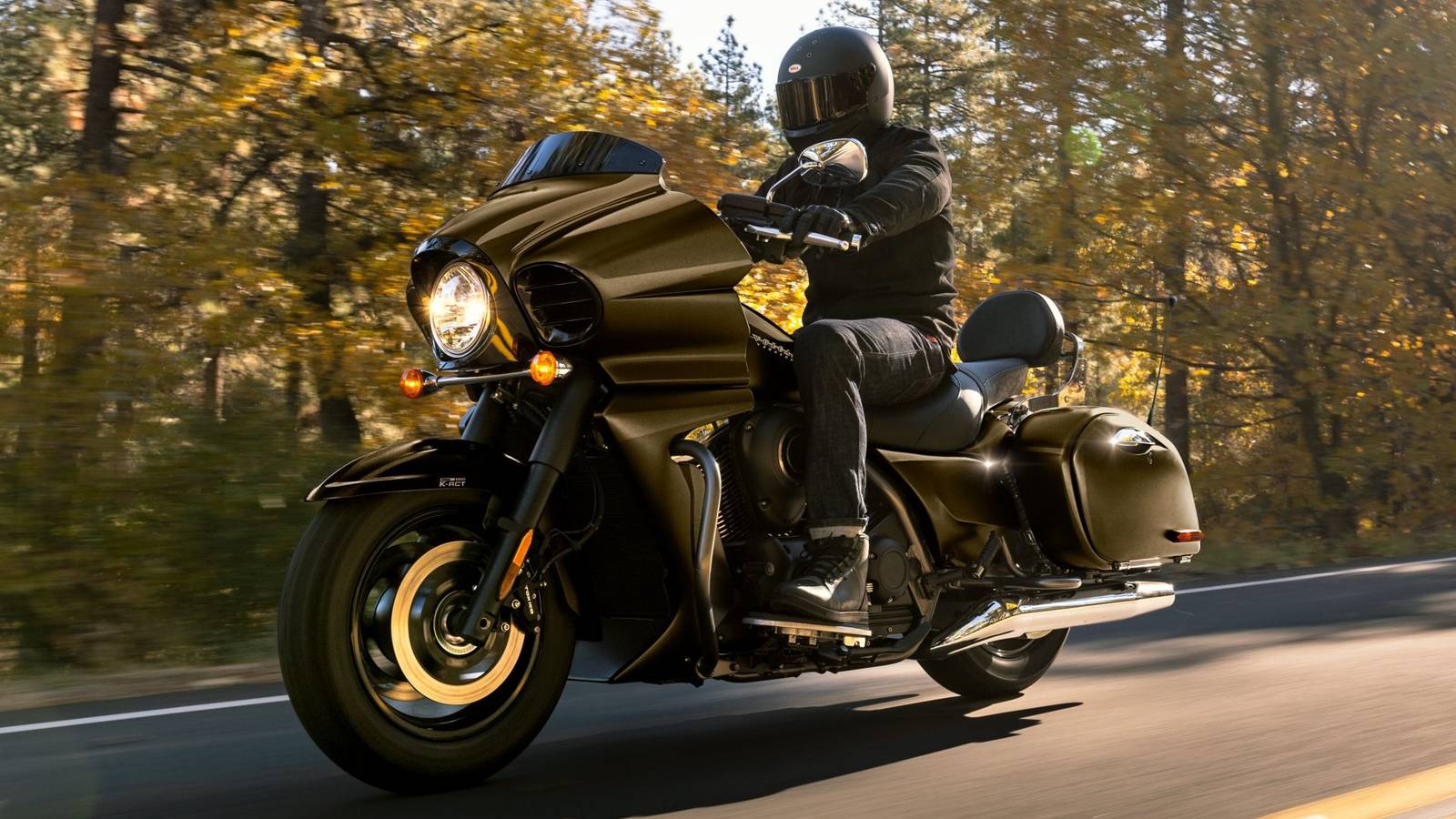
There’s one touring cruiser that gives you the best balance of comfort and reliability, and it’s an age-old Kawasaki model that goes by the name of Vulcan 1700. This Vulcan name, by the way, dates all the way back to 1984, with the 699cc Vulcan that featured Kawasaki’s first-ever V-twin engine. Over the years, the Vulcan has evolved through several iterations and powerplants until turning into the bike in question: the Vulcan 1700.

This is not a new motorcycle, though. It was introduced back in 2009 as the Vulcan 1700 Voyager, a full-dress tourer, complete with panniers, top box, and a frame-mounted fairing. The Voyager was soon joined by the Vulcan 1700 Vanquero, a trunkless bagger version of the same bike. Since then, the two Vulcans have hardly seen any updates. Many even criticize the bikes for being stuck in time, but for us, this very thing is what makes the Vulcan 1700 so special today.
The Luxury Land Yacht That Was Ahead Of Its Time

The Vulcan 1700 may look dated today, but when it was new, it was the bleeding edge of touring cruisers. It featured a liquid-cooled big twin engine that was notably refined compared to Harley’s big twins of the era. It even came with ride-by-wire. Owners also praise the bike as being one of the most comfortable Japanese bikes you can buy today, and its charming design has a commanding road presence and a timeless appeal.

Today, it may feel like it’s forgotten among the crowd of new-age tourers and cruisers. Even Harley-Davidson has come a long way in terms of refinement and features. But that doesn’t mean the Vulcan 1700 is obsolete; it’s an old motorcycle that still holds up well 15 years later, and it refuses to die. The fact that Kawasaki refuses to change this platform only goes to show just how confident the green giant is in the Vulcan 1700’s relevance and reliability today. It’s a classic example of why to fix what isn’t broken.
Proven Big Twin Powertrain That Won’t Betray You On The Road

The Vulcan 1700 features the biggest Kawasaki engine available in 2026, displacing 1,700cc. This V-twin is a liquid-cooled mill with a distinctive 52-degree layout, which Kawasaki claims gives it a unique rumble. It produces 82 horsepower, and thanks to its marginally longer stroke, it delivers a meaty 107.6 pound-feet of torque at just 2,750 RPM, with the surge starting from as low as 1,500 RPM. This meaty torque delivery should make this hefty cruiser light on its feet and completely relaxed on the blacktop.

The big twin engine is mated to a six-speed transmission, with the fifth and sixth gears being overdrive. This should further make the bike feel understressed at highway cruising speeds. Power is sent to the rear wheel via a carbon fiber belt, which demands much less maintenance than a conventional chain drive. A cool inclusion here is ride-by-wire technology, which should help smooth out the throttle input.
A Reliable Powerplant With 36-Month Warranty Protection

Relaxed highway performance is one thing, but can the Voyager 1700 keep going for days on end? Yes, it can. The big twin engine has been around long enough for Kawasaki to iron out the issues, and it is generally considered one of the most reliable cruisers you can buy today. It’s not uncommon to find Vulcan 1700 owners reporting six-digit mileage on their bikes with nothing but routine maintenance. Kawasaki also offers a 36-month factory warranty on the motorcycle, which further shows the brand’s confidence in the bike’s reliability.

10 Cruisers That Will Run Forever With Basic Care
These bikes will give the Energizer Bunny a run for its money – and all they need is basic preventive maintenance done on time.
Comfort And Simplicity In Design Is Also A Priority

The Vulcan 1700 also doesn’t try to woo you with fancy underpinnings; instead, it features components that have been tried and tested for years and just work. The frame is a sturdy double downtube cradle steel frame, which may be heavier but ensures the longevity of this mule-muncher’s backbone. Suspension comprises 43 mm telescopic forks up front and twin rebound-adjustable air-assisted shocks at the rear, with 5.5 inches and 3.1 inches of travel on either end.

Braking duties are taken care of by dual 300 mm rotors gripped by two-piston floating calipers up front and a single 300 mm rotor with a two-piston floating caliper at the rear. There’s also Kawasaki’s Coactive-Braking Technology (K-ACT), which essentially is dual-channel ABS with linked braking. Everything rides on chunky tires wrapped around 16-inch alloy wheels. All put together, the Voyager 1600 is a proper heavyweight motorcycle.
Laidback Ergonomics

Both the Vulcan 1700 Vanquero and Voyager feature a relaxed riding triangle with pullback handlebars, floorboards, and a seemingly large saddle that should be comfortable for long hours on the road. The Vanquero builds on that with a large fairing and lowers that should be good enough for highway tours; the Voyager dials that wind protection to eleven with a much taller windscreen atop the fairing and more pronounced lowers. The Vanquero features two large saddlebags, and the Voyager adds a large trunk to the package that doubles up as a backrest for the pillion.

Apart from that, the Vulcan 1700 is pretty barebones for a tourer in 2026. It features a slim LCD below the semi-digital instrument cluster, along with a standard audio system with fairing-mounted speakers. Electronics are limited to ABS and electronic cruise control. While tech-savvy buyers may find this too limited, we think it adds to the Vulcan 1700’s timeless charm and reliability. There are fewer systems to fail, avoiding electrical gremlins and high maintenance costs that usually come with too many bells and whistles.

10 Japanese Motorcycles That Last Forever
These ten Japanese have the simplest maintenance plan: don’t require one
Undercuts The Competition By A Margin

Both the Vulcan 1700 models undercut much of the competition. For example, the 2026 Kawasaki Vulcan 1700 Vanquero ABS starts at $19,999. Its closest rival is the BMW R 18 B, powered by a massive boxer twin engine, which starts at $21,770. Meanwhile, American baggers, like the Indian Challenger and Chieftain, and Harley-Davidson Street Glide and Road Glide, are a lot more expensive. The Vanquero also undercuts the BMW K 1600 and Honda Gold Wing.

Similarly, the 2026 Kawasaki Vulcan 1700 Voyager ABS’s additional luggage and wind protection only comes for a premium of $200 over the Vaquero, which makes it an absolute bargain of a full-dresser. Its closest rival, the BMW R 18 Transcontinental, starts at $24,395, and unsurprisingly, Harley and Indian full-dressers are significantly more expensive.

While some of its rivals, like the Honda Gold Wing or the BMW K 1600 series, may be leaps and bounds ahead in terms of technology and performance, there’s no denying just how bang for the buck the Vulcan 1700 is. This Kawasaki touring cruiser offers what long-distance travel is when you boil it down to the essentials and do away with frills: simplicity and reliability balanced with relaxed comfort. It offers a distraction-free, pure touring experience that, for many, is priceless in the era of screens everywhere.
Source: Kawasaki