
Cruiser bikes are best known for their laid-back riding stance and style. However, this also requires the motorcycle to be stretched out in length and to pack a sizable engine, preferably a big V-twin, which has been the norm for quite some time. But the formula changes when we look at sub-$10,000, affordable cruiser bikes, as automakers manage to transform the OG cruiser bike formula into a much more compact and beginner-friendly package. Well, the iconic V-twin has been largely replaced by more compact parallel-twins and even single-cylinders, but the essence of a cruiser bike remains unchanged. While a lot of compromises often characterize this segment, there exists a Kawasaki cruiser bike that manages to offer a well-rounded, do-it-all experience, including Honda-grade reliability and BMW-level handling.

10 Affordable Cruisers That Refuse To Break Down
These cruisers are unflappable, and you can be sure they’ll get you there AND home!
The Appeal Of Affordable Cruiser Motorcycles
There Are Some Very Cool Cruiser Bikes Under $10,000

Affordable cruiser bikes are all the craze because this segment offers iconic and stylish aesthetics without compromising on comfort, nimbleness, and everyday usability. As we mentioned above, there are a few sacrifices, including the omission of a “big” V-twin engine in most cases, but this actually helps the cause of making affordable cruiser bikes comfortable and accessible. Features such as a low seat height, relaxed ergonomics, and linear torque delivery make affordable cruiser bikes the perfect companion for new riders.

The popularity of this segment is also what pushed Harley-Davidson to offer its first-ever sub-$10,000 motorcycle for America—the urban-friendly Nightster. Even Indian Motorcycle follows suit with the $9,999 Scout Sixty Bobber. The sub-$10,000 cruiser bike segment is fierce and vibrant with the premium-looking Royal Enfield Super Meteor 650, the tech-loaded CFMoto 450CL-C, the sporty Kawasaki Eliminator, the underrated 68-horsepower Moto Morini Calibro 700, and the brand-new Benda Chinchilla 500 with a peppy sub-500cc V-twin engine, to name a few.
The Tale Of Reliable Honda Motorcycles

Honda, like most of its Japanese counterparts, is popular for its reliability. Their motorcycles are designed to run for extended miles without breaking a sweat thanks to a focus on understressed mechanical components, decades of experience, extensive R&D, and rock-solid after-sales support. This combination helps reduce service costs while also extending the lifespan of powertrain components. Also notable is the consistent reliability quotient on all Honda motorcycles, ranging from the humble and urban-only Monkey to the wicked-fast track-ready CBR line-up of sports bikes.
BMW Motorcycles Stand Out With Handling Features

This is not just because of a clever suspension system, but also because of a calculated chassis design and engine formats. The BMW bikes powered by boxer engines have a lower center of gravity, which enhances their handling and nimble riding. Furthermore, BMW’s proprietary suspension setup on specific motorcycles, comprising Telelever front and Paralever rear setup, is known to offer exceptional comfort and stability by isolating the suspension, steering, and braking forces.

10 Cruisers That Balance Fuel Economy With Good Performance
The most efficient cruiser here returns over 60 miles per gallon
The front Telelever suspension eliminates braking dive and improves handling by separating damping from the wheel guidance. The rear Paralever suspension eliminates shaft-drive “jacking” effects, ensuring smooth and stable performance too. Interestingly, the first-ever BMW cruiser bike with a telelever front suspension setup is also BMW’s first-ever proper touring motorcycle—the R 1200 C that broke cover in 1997.
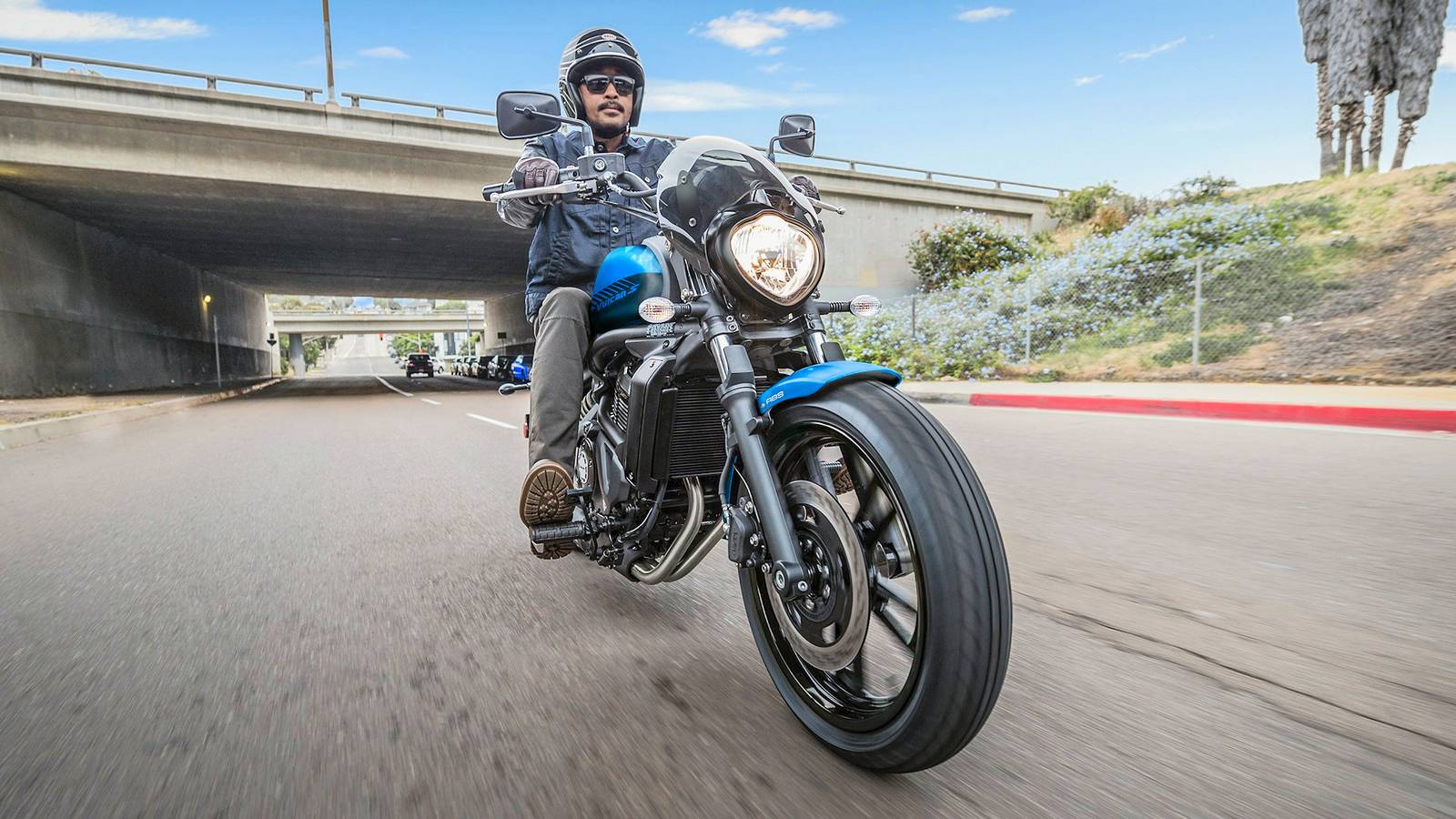
The 2026 Kawasaki Vulcan S Offers Honda Reliability And BMW-Grade Handling
Price: $7,649

The 2026 Kawasaki Vulcan S offers commendable performance and handling dynamics for under $8,000. The Vulcan nameplate has been around since 1984. However, the Vulcan S was introduced in 2015 as the sportiest offering in the “Vulcan” line-up. This is mostly because of its sports-bike-shared engine and chassis, which is derived from the likes of the Ninja 650 and Z650. This is what mostly contributes to its BMW-grade handling.
As for the Honda-grade reliability, Kawasaki has been refining the Vulcan S since 2015. Also, the parallel-twin engine and main frame have been in existence since 2006 on Kawasaki performance bikes. Hence, Kawasaki has been honing the refinement levels on the Vulcan S’s underpinnings for a long time now. This has helped reduce maintenance costs by eliminating common problems.
How Does The Vulcan S Differ From The Vulcan S Cafe

The 2026 Kawasaki Vulcan S is offered in two variants. The base model starts at $7,649. The other is a cafe-racer-inspired trim that is priced at $8,749. The price bump comes with only elevated aesthetic appeal. The underpinnings and powertrain remain unchanged.
The 2026 Vulcan S Cafe gets a two-tone paint job, signature tank badging, sporty stripes, and a dark-tinted wind deflector. Also, while the standard model is available as a non-ABS variant, the Cafe is only offered with ABS integration. Apart from these visual tweaks and added standard features, the standard Vulcan S and Vulcan S Cafe models are essentially the same.
What Makes The Kawasaki Vulcan S So Reliable
Its Versatile Engine Plays A Vital Role

The primary reason for the Vulcan S’s proven reliability is its bulletproof 649 cc parallel-twin engine. This mill has proven its worth since 2006, making it a solid performer for over 20 years. It started life as a sporty heart on the Kawasaki 650R and the ER-6n models. Today, this engine’s versatility is why it is utilized not just on the Vulcan S cruiser bike but also on the track-ready Ninja 650 sports bike, the street-focused Z650 streetfighter, and the do-it-all Versys 650 touring bike.
Given this engine’s extended lifespan, Kawasaki has refined the mill over the years to be as durable as possible. The performance curve is laid out linearly, and it gets liquid-cooling for composed and stress-free endurance runs. Furthermore, all its components are designed to help with a simpler maintenance schedule. All of these features help this engine run problem-free for more than 100,000 miles (as many owners claim), with just proper annual care. Despite being such an old powertrain, the 649 cc parallel-twin on the Vulcan S still packs a punch in 2026. It produces 60 horsepower and 46.5 pound-feet of torque, sending power to the rear wheel via a six-speed manual gearbox.

10 Cruisers That Will Run Forever With Basic Care
These bikes will give the Energizer Bunny a run for its money – and all they need is basic preventive maintenance done on time.
The chassis is also derived from its 649 cc stablemates, highlighting the rigidity and flexible nature of the underpinnings. Kawasaki has also utilized a simple hardware setup for its suspension and braking. The 41 mm telescopic front forks with 5.1 inches of travel and a preload-adjustable rear monoshock with 3.2 inches of travel are on the simpler side of components that we currently see on modern 650 cc offerings. This helps reduce the cost of spare parts and makes the Vulcan S easier to work on.
What Contributes To The Vulcan S’s Flexible Handling

Despite having the silhouette of a laid-back and stretched-out cruiser bike, the Vulcan S enjoys nimble riding dynamics due to its relatively compact form factor, low weight, and some clever adjustable features unique to Kawasaki. The rider sits relaxed on the Vulcan S that has a wheelbase of 62.0 inches. A sportsbike-derived double pipe diamond frame made of high-tensile steel, and the parallel-twin engine sits snug in this space. Simple, flexible underpinnings, a relatively low curb weight of 483 pounds, and a low seat height of 27.8 inches further help with the Vulcan S’s nimble dynamics.

However, the party trick that truly sets the Vulcan S apart from its rivals in adaptive dynamics is its Ergo-Fit feature. This is essentially Kawasaki’s fancy name for an adjustable rider triangle, in which the seat, handlebars, and footpegs can be adjusted to better suit the rider based on their height. With 18 possible configurations between Reduced Reach, Mid Reach, and Extended Reach, the Vulcan S’s Ergo-Fit feature can help riders, ranging from those shorter than 5 feet 7 inches to over 6 feet 1 inch, fit like a glove on this middleweight cruiser bike. This shift in the rider triangle, along with the rider’s weight and height, contributes to varied riding dynamics and handling precision.
Sources: Kawasaki, Honda Powersports, and BMW Motorrad.