
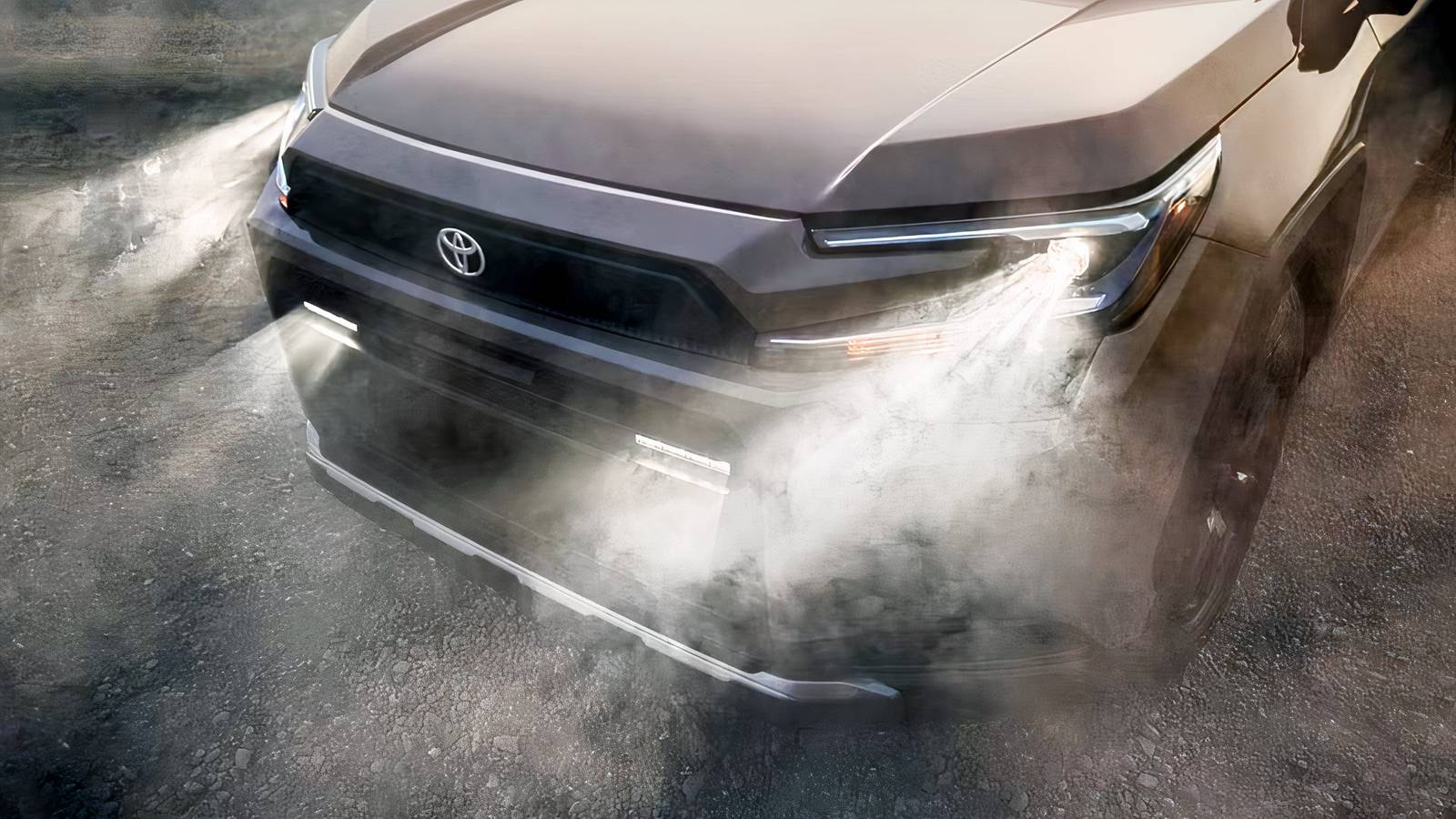
Cars have become more technologically advanced over the past 10 years, and sometimes, this leads to overly complex vehicles. That’s especially true with the need to electrify the internal combustion engine (ICE) so that it can survive stricter emissions regulations. Newer cars—particularly with ICEs—need to juggle between emissions regulations and consumer preferences, which is why, most of the time, pure electric vehicles (EVs) end up a lot more mechanically simple.
But not all electrified technologies are complex. Some automakers have decades of experience with electrified vehicles. Hybrids, in particular, have been sold en masse for more than two decades now, and that has led one automaker and the model in today’s article to be mechanically simplified versus past iterations. If you want to buy a new hybrid SUV today that can be kept for the next 20 years or so, this is the model that you should go for.

The Toyota Hybrid That’s Suddenly Becoming A Sales Dud
Toyota’s hybrid poster child isn’t achieving the best sales results in 2026.
Toyota’s Hybrid Durability Legacy

Maybe you expected this, or maybe you didn’t, because if there’s one company that’s synonymous with reliable hybrid SUVs, that would be Toyota. Being in the hybrid game since 1997 has its perks because experience is often your best teacher.
Mechanically Simple

Toyota has optimized its already simple hybrid system across generations, removing certain traditional components for simplicity. For instance, you no longer need a starter motor for ignition because Motor Generator 1 (MG1) already takes care of starting the engine, generating power to charge the battery, and even managing how the planetary gear e-CVT delivers power. Despite the name, it isn’t a traditional belt-and-pulley CVT. It’s something more robust than that. Motor Generator 1 is connected to the sun gear, the ICE is connected to the pinion gear and planetary carrier, while Motor Generator 2 (MG2)—which is the electric motor that propels the wheels—is connected to the ring gear.
Since the second-generation 2004 Prius and its second-generation Toyota Hybrid System (THS II), a Toyota hybrid no longer has a mechanical air compressor. Instead, this has been switched to an electronic one, which means it no longer needs the engine to cool the cabin, and you no longer have to worry about belts and pulleys from a mechanical unit. There’s also no alternator, because a DC-to-DC converter was introduced in THS II. The DC-to-DC converter uses the main hybrid battery to power the vehicle’s 12V battery and its electrical systems. Simpler systems and fewer complications mean fewer things to go wrong, and that’s exactly why you have million-mile Toyota hybrids in existence.
How About A Million Miles?

Ladies and gentlemen, the Toyota hybrid that will reassure you and your longevity concerns is this million-mile 2006 Highlander Hybrid. The owner, Mark Miller, says that the 2006 Highlander Hybrid was his first-ever Toyota and the first vehicle he ever owned brand new. Taking care of it was a priority, which is why he had a go-to mechanic at Germain Toyota of Naples, not that mechanical concerns surrounding the vehicle were frequent in the first place. It was so reliable that he says only a catastrophic flood could stop it.
Unfortunately, that’s what happened in September 2022 when Hurricane Ian struck his home in Bonita Springs, Florida. Storm surges so high and so deep eventually destroyed the 17-year-old Highlander Hybrid. By the time the water receded, someone else’s floating dock was in their backyard. To his surprise, Richard Germain, the owner of Germain Toyota of Naples, gave him a brand-new 2023 Highlander Hybrid Bronze Edition. Miller was already set to retire, so it’s unlikely the new Highlander will hit a million miles.

How Much It Costs To Replace A Toyota RAV4 Hybrid Battery In 2026
Having a new battery fitted to your 2026 RAV4 may command a steep price.
What A RAVelation

Specifically, the vehicle we’re going to focus on in this article is the RAV4, which has been the best-selling crossover SUV in the United States for a couple of years now. In 2024, it became America’s outright bestseller, and key to its appeal is its hybrid drivetrain that’s both efficient and extremely durable.
Carefully Evolved

At the heart of the 2026 Toyota RAV4 is the fifth-generation Toyota Hybrid System (THS V). The biggest leap of THS happened in the introduction of THS II, and ever since then, Toyota has mostly focused on refining and simplifying the hybrid system. Perhaps the transition from the previous THS IV to the current THS V is the most incremental yet, as these are focused on more energy-dense lithium-ion batteries, a smarter power control unit (PCU), and stronger yet smaller electric motors.
The result is a Toyota hybrid whose driving experience isn’t radically different from older models. Instead, these improvements have resulted in overall better refinement and performance. The new 2026 RAV4’s power output increased from the previous generation to 226 horsepower for the front-wheel-drive (FWD) and a whopping 236 horsepower for the AWD.
An Average Lifespan Of 14.4 Years

Since THS V isn’t drastically different from past versions, you can expect the new RAV4 to maintain its reputation for durability even with this more modern and more refined generation. iSeeCars has determined that the Toyota RAV4 with its hybrid drivetrain has an average lifespan of 14.4 years, or 172,258 miles, along with a high 30.7 percent chance of reaching 200,000 miles. This rating, however, is for the previous-generation RAV4, which still uses the previous THS IV, so let’s take a look at the current Camry, which has been on the market for two years already with the latest THS V.
The Toyota Camry and its THS V drivetrain have been determined by iSeeCars to have an average lifespan of 13.1 years, or 171,924 miles, and an even higher 31.8 percent chance of reaching 200,000 miles. On paper, the Camry’s THS V, which is already in the new RAV4, is just as reliable as THS IV, with only minor variances separating the ratings of the two cars.

The Sales Of This Three-Row Hybrid SUV Have Nearly Doubled In 2026
This midsize Toyota SUV continues to hit new sales records, with nearly 100-percent increase compared to Q1 2025.
What Else The RAV4 Offers In 2026

Reliability is guaranteed in the 2026 Toyota RAV4, but you wouldn’t keep a car for 20 years if it wasn’t a joy to own, right? Here’s everything else you need to know about this vehicle apart from its strong reliability.
Designed With Character

Toyota has leaned on the RAV4’s rugged image in recent generations, and this new version continues to build upon that aspect. Interestingly, the new RAV4’s combination of boxy lines and blunt edges makes it easily distinct on the road—at least until everyone else gets theirs, and suddenly, you’ll see this crossover everywhere. In isolation, the RAV4’s design is full of character. Whether you go for the standard look, the rugged Woodland, or the sporty GR Sport, the new RAV4 looks great, whatever the design theme.
It’s also the same story inside, wherein squared-off edges and boxy shapes dominate the cabin. Toyota has cleverly carved out numerous storage areas around the cabin, which also become design elements as well. This boxy design is common across all variants, and so is a generous serving of tech. A 12.3-inch digital gauge cluster is standard even on the base variant, while a 10.5-inch or 12.9-inch touchscreen is fitted, depending on the variant. These screens run Toyota’s Arene OS, which is the Japanese automaker’s first true effort in creating a software-defined vehicle (SDV) architecture. This SDV architecture is in line with Toyotaextending the production life of its vehicles. The focus on adding new features and value through over-the-air updates will help keep upcoming Toyotas updated and interesting to consumers, even as the car ages.
Fundamentally, A Nice Drive

Critics may think that Toyota’s latest RAV4 and its THS V hybrid system aren’t pushing the goal post very far, but the incremental improvements to the hybrid system result in a RAV4 that is now closing in on the refinement advantage that the Lexus NX has. The more powerful electric motors, particularly with the AWD version, mean that the RAV4 drives at a higher percentage in pure electric mode than before. The added engine bay insulation means that the RAV4 is also quieter than before, while the improved TNGA-K platform has made the RAV4’s handling sharper than before. No, it’s not yet to the level of a Mazda CX-5 or Honda CR-V in terms of sharpness, but even that gap is narrower than before.
|
Engine |
2.5-liter four-cylinder series-parallel hybrid |
|
|
Drivetrain |
Front engine, FWD |
Front engine, AWD |
|
Horsepower |
226 hp |
236 hp |
|
Torque |
N/A |
|
|
Transmission |
e-CVT |
|
|
EPA Combined MPG |
43 MPG |
41 MPG 38 MPG (Woodland) |
|
Max Towing |
1,750 lbs |
Up to 3,500 lbs |
|
Base MSRP |
$31,900 |
|
But perhaps the main motivator for Toyota to not yet fully reinvent its hybrid system is just how efficient this new RAV4 is. If it does the job, then what’s the need to reinvent, right? I mean, any crossover SUV, let alone something similarly sized to a RAV4, that achieves 43 MPG combined is very impressive. Opt for models with AWD or the larger 20-inch wheels that reduce the combined efficiency rating to 41 MPG or, in the case of the Woodland’s more rugged tires, 38 MPG, which is still impressive. For reference, the CR-V Hybrid has a combined efficiency rating of around 40 MPG, which varies by configuration since Honda opted for a mechanical AWD system.
Sources: Toyota, iSeeCars,