
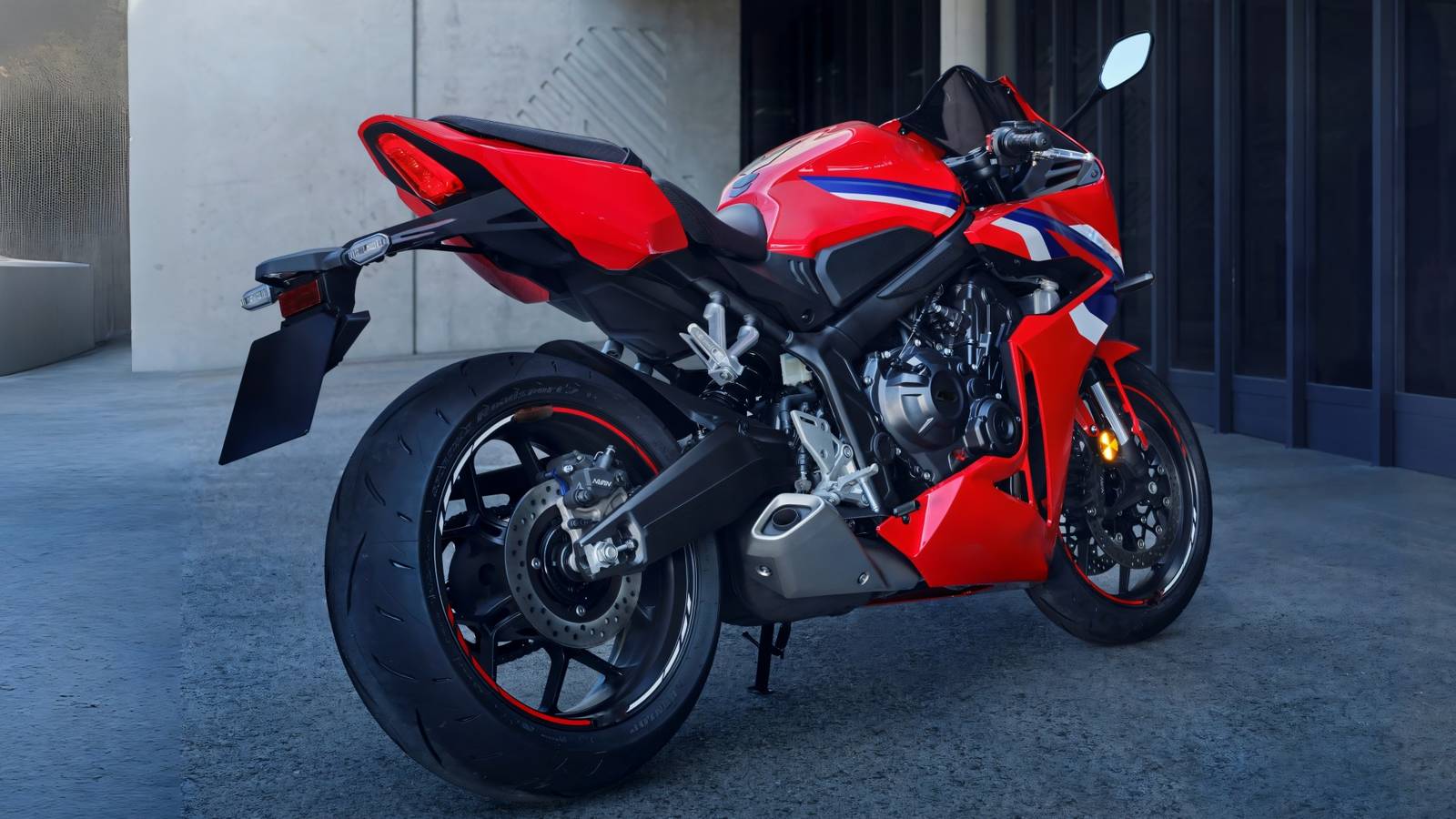
Sport bikes focus on an immersive riding experience, with performance and sharp handling as highlights. Often, though, the heightened experience comes at the expense of comfort and convenience. This is why these fully-faired track-ready motorcycles are not cut out for daily rideability. Things are changing, however. Thanks to riders demanding a balanced experience, we now have sport bikes from almost every major motorcycle maker that offer an everyday side. A particular Honda middleweight tops this list with a special feature that none of its rivals have.
Sport Bikes Are Generally Impractical For Daily Use
Fun Comes At An Expense

Sport bikes are primarily designed for performance, speed, and nimble handling. These features rob the rider of practicality, making these performance machines unsuitable for daily use. The rider triangle is aggressive, with a forward-leaning posture that, if not properly monitored, can cause significant wrist and back pain. Likewise, the limited steering lock makes U-turns, filtering through traffic, and maneuvering at slow speeds difficult.

Furthermore, sport bikes tend to get very hot, especially in stop-and-go traffic, given their high-performance engines and tight, aerodynamic fairings. Sport bike engines are designed to deliver peak power and torque at high RPMs, making it difficult and frustrating to use them smoothly and safely on public roads. Lastly, some do offer a pillion seat, but it is highly uncomfortable due to its tiny surface area.
However, There Are Practical Sports Bikes Exceptions

In fact, almost all major motorcycle makers, even those who we never anticipated making “practical” sports bikes, have entered the picture. Prime examples include the new Ducati Panigale V2 and the Triumph Daytona 660. The Panigale V2, for the first time, has been toned down with a more linear engine performance that focuses on road-friendly torque and high-RPM power, and it features a fairly relaxed rider triangle to aid daily rideability.

The Daytona 660 is nothing like the track-focused Daytona 675R. Triumph has softened its famed middleweight nameplate to be more practical and urban-friendly. Moving on, there’s Aprilia’s first-ever middleweight—the RS 660—with a similar approach. Other notable exceptions that make for the ever-growing practical sportbike lot include the Yamaha R7 and the Suzuki GSX-8R, among others.

10 Sports Bikes That Are Fast, Fun, And Surprisingly Reliable
From entry-level to liter-class sports bikes, these blend speed, excitement, and reliability, making them ideal for both track days and daily rides
The 2026 Honda CBR650R E-Clutch Does Not Demand Sacrifice

In the 2026 lineup of practical sport bikes, the Honda CBR650R clearly takes the spotlight. It offers unmatched balance and practicality thanks to a refined engine, comfortable ergonomics, and its highlighting e-clutch system. Despite its practical side, Honda has still infused a fun, head-turning character into the CBR650R thanks to its sharp design language, which makes it look like a mini Fireblade. It draws many design inspirations from the mighty CBR1000RR-R Fireblade SP.

To sweeten the deal, Honda has dialed up the middleweight CBR’s value proposition by pricing it at $9,199 (down from $9,899 for the 2025 model). This makes the CBR650R the most affordable of its class, undercutting the likes of the $9,395 Triumph Daytona 660, the $9,399 Yamaha R7, and the $9,699 Suzuki GSX-8R.
Powered By A Daily-Rideable Four-Cylinder Engine

The 2026 Honda CBR650R continues to be powered by a proven 649 cc four-cylinder engine that prioritizes rideability over outright power. Also noteworthy is that this is one of the last surviving four-cylinder middleweight sports bikes today. It produces 93.8 horsepower at 12,000 RPM and 46.4 pound-feet of torque at 9,500 RPM.

Power is sent to the rear wheel via a six-speed transmission. Its peak RPM of 10,000+ clearly shows that the CBR650R is a certified screamer. However, Honda has cleverly spread out the power curve to be less explosive. Perfectly assisting in its practical packaging is a unique clutch system that none of its rivals can match.

10 Sports Bikes That Nail The Sweet Spot Between Speed And Comfort
These sports bikes can be either Dr Jekyll or Mr Hyde, depending on what you want in the moment
Its E-Clutch Feature Unlocks An Effortless Riding Experience

Honda’s E-clutch is an automated clutch that uses two electric motors to engage the clutch as needed. The rider has to shift gears manually, but also gets the option to go clutchless. This also allows the CBR650R to get rolling from a standstill without using the clutch.

Honda offers an “off” switch to disable the e-clutch, allowing the CBR650R to be used like a regular manual gearbox-equipped sports bike. Additionally, the electronic clutch system serves as a parking brake as the clutch is automatically engaged when the motorcycle is switched off. Advantages of Honda’s E-Clutch include:
- No stalling
- Reduced rider fatigue
- Doubles up as a quickshifter
- Smooth, precise, and assisted gearshifts
- Makes it breezy for a new rider on the CBR650R
Underpinnings Are Designed For Predictable Handling

The CBR650R is underpinned by a steel diamond main frame that balances weight and rigidity. The chassis is suspended on 41 mm inverted front forks with 4.7 inches of travel and a preload-adjustable rear monoshock with 5.0 inches of travel. The front uses Showa’s Separate Function Fork Big Pistons, which separate spring and damper functions between the two fork legs for versatile handling.

Braking duties are taken care of by dual 310 mm discs coupled to radial-mounted four-piston fixed calipers up front. The rear gets a single 240 mm disc coupled to a single-piston floating caliper. Grip duties are taken care of by 120-section front and 180-section rear tubeless tires wrapped around 17-inch alloy wheels.
Relaxed Ergonomics And Low Seat Height

The CBR650R is one of the heaviest in its class, with a curb weight of 466 pounds. In fact, it’s heavier than the liter-class CBR1000RR that has a curb weight of 432 pounds. However, Honda makes up for this with a relaxed, flexible rider triangle and a relatively low seat height of 31.9 inches. Furthermore, elevating its practical side are a slew of accessories, including a tank bag, a rear seat bag, tank pads, and knee pads.
A Crisp TFT Display And Essential Electronics

The cockpit is adorned by a bright TFT color display that gets Bluetooth and Honda RoadSync connectivity. This helps the rider access calls, music, messages, and navigation via buttons on the handlebars. On the safety front, it gets features like traction control and dual-channel ABS.

It also gets LED lighting all around. The dual-lens LED headlamp design is sleek and compact, complementing the CBR650R’s sharp design language. Honda has not compromised on the light intensity by offering brighter yet smaller internals than a conventional design.
Source: Honda Powersports