
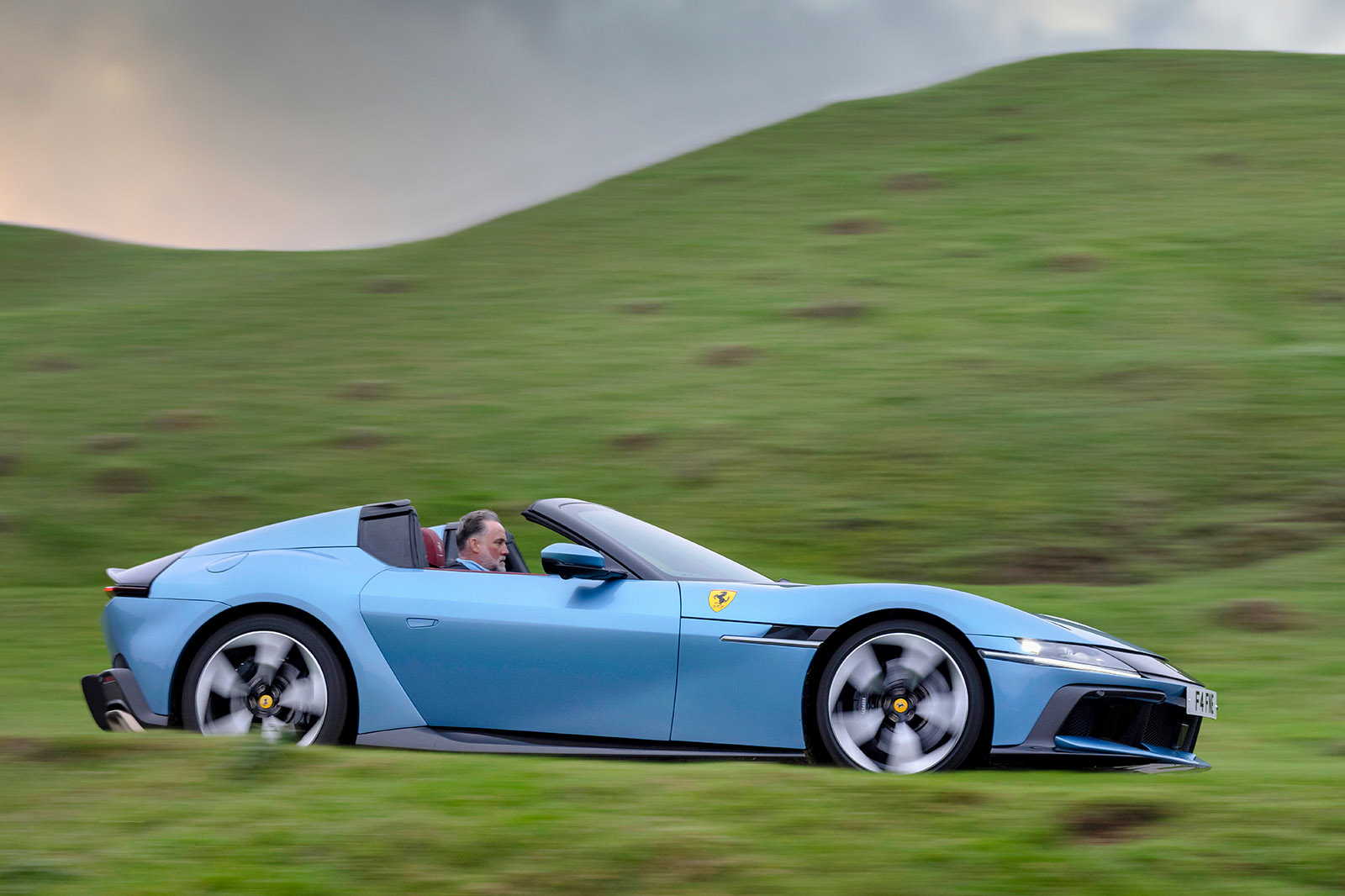
Dropping the roof lets you better hear one of the world’s great engines, of course. The 6.5-litre, naturally aspirated V12 only shouts really loudly at high revs and in the racier drive modes. But even above 9000rpm, it’s smoothly noisy rather than raucous.
It’s easy to understand why, despite the rigidity (and, to my eyes, aesthetic) drawbacks, half of all 12Cilindris sold will be Spiders.
That, as in the coupé, the engine response is calmed down in third and fourth gears, to be more linear, less hyper – and that those are the predominant driving gears on nice back roads – just enhances the experience.
While Ferrari’s dual-clutch transmission doesn’t always engage at low speeds faultlessly smoothly, it’s fast-shifting and obedient at other times, and feels well matched to the car’s principal attraction.
The way that V12 recedes into the background during cruising, spinning beautifully smoothly and revving with wonderful linearity – and only raising its voice when you let it work beyond 6000rpm, when it opens its soprano lungs to virtuoso effect – might, as il Commendatore used to suggest, almost be worth the price of admission all on its own (though, of course, it’s some price).
Also – even though this car has been chilled down a little over its predecessor, it’s still incredibly fast (they called the one that came before it the Superfast and that had 30 fewer horsepower than this). Peak power is 819bhp at more than 9000rpm, and peak torque – 500lb ft – arrives at 7250rpm, beyond the point where most engines have since given up.
Outright performance in the Spider is down a smidgeon on the coupé, but these things are relative: we’re still talking about a car that can go from 0-62mph in 3.0sec, and go on to 211mph.
Likewise, brake pedal feel is strong and consistent: by-wire braking means the pedal always feels the same, with good weighting to lean against and progressive feel as the car comes to a stop.