
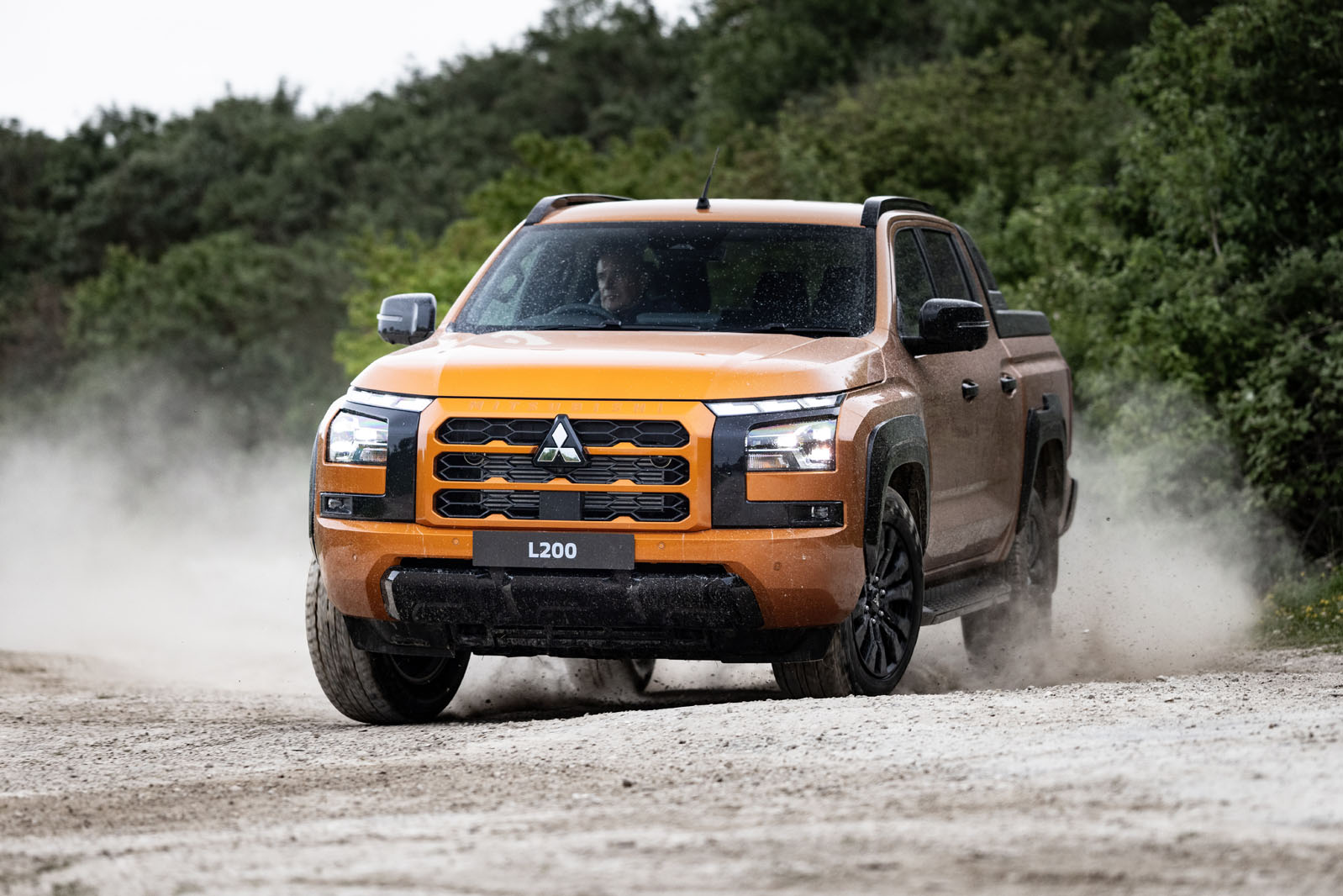
On test, Mitsubishi’s people were keen to emphasise its versatility, so they demonstrated it first as a tow vehicle (by hooking it up to a trailer laden with another L200 and letting us loose on a short, tight course defined by cones), then letting me loose on a damp, chalky and extremely undulating off-road course, followed by an hour-long road route.
The versatility was well proven. Towing a six-wheeled trailer with another 2175kg vehicle loaded up, admittedly slowly, the L200 felt stable and capable, getting off the mark without effort and stopping and turning with ease.
On the 4×4 course, wearing only regular road tyres, the L200 showed surprising traction on wet chalk, demonstrating an especially handy hill descent control that maintains whatever speed you choose when you set off down a steep gradient.
There’s plenty of ground clearance, so I failed to brush the underside anywhere, and there was only one moment of wheelspin – when one of the rear wheels was already a foot in the air.
The L200 Barbarian is one of those 4x4s with far more built-in capability than a driver expects.
The road trip, on frequently rutted roads in lower Wiltshire and Hampshire, was a bit of an anticlimax. As a typically tall double-cab truck with a leaf-sprung live rear axle, the L200 bucked about a bit where more sophisticated vehicles with lower-seated passengers would ride a good deal flatter, and its steering is only about on par for sensitivity at the straight-ahead.
On the other hand, the L200 showed a cheerful lack of concern for potholes – an increasingly significant advantage – and turned well, with a right-sized steering wheel, decently contained body roll and not too much understeer even when pressed on damp bitumen.