
Beale had to explain the suspension to me twice before I totally got it, but here goes: in the standard ride height there are two drive modes available – Comfort and Sport. The only difference is between them is damper stiffness.
There is a blank section within the spring/damper unit which gets compressed when the ride height is dropped. It doesn’t affect the coil spring, whose rate is unchanged. However, McLaren wanted the spring rate to increase when Race mode/ height was engaged. So there are what look like anti-roll bars and what McLaren calls ‘heave bars’ front and rear.
At the front, the bar is telescopic and attaches to the suspension via thin torsion rods. When the suspension moves, in high ride mode, the bar is free to slide, unlocked, so its ends move entirely freely, and only the main springs are doing any resisting.
In low ride height mode, however, that bar is locked in position, which brings the torsion rods to which it is attached into play: suspension forces not only have to overcome the regular springs, but now they also have the resistance of these wee torsion bars, thus significantly increasing the spring rate.
At the rear the theory is the same, but the application is slightly different: a transverse heave bar, mounted high, is not engaged until its drop links are made rigid, as they are in Race mode. Otherwise they slide.
That sounds easier to explain than at the front, but they work on the same principle – and it’s packaging that means they’re different front to rear. At the back there’s a lot of engine and transmission stuff to lift the heave bar over.
Pushrods also keep the unsprung mass down, while at the front those and the inboard bar also help clear space around the wheel well, which is used to channel air through to the sides of the car to cool the brakes along the way.
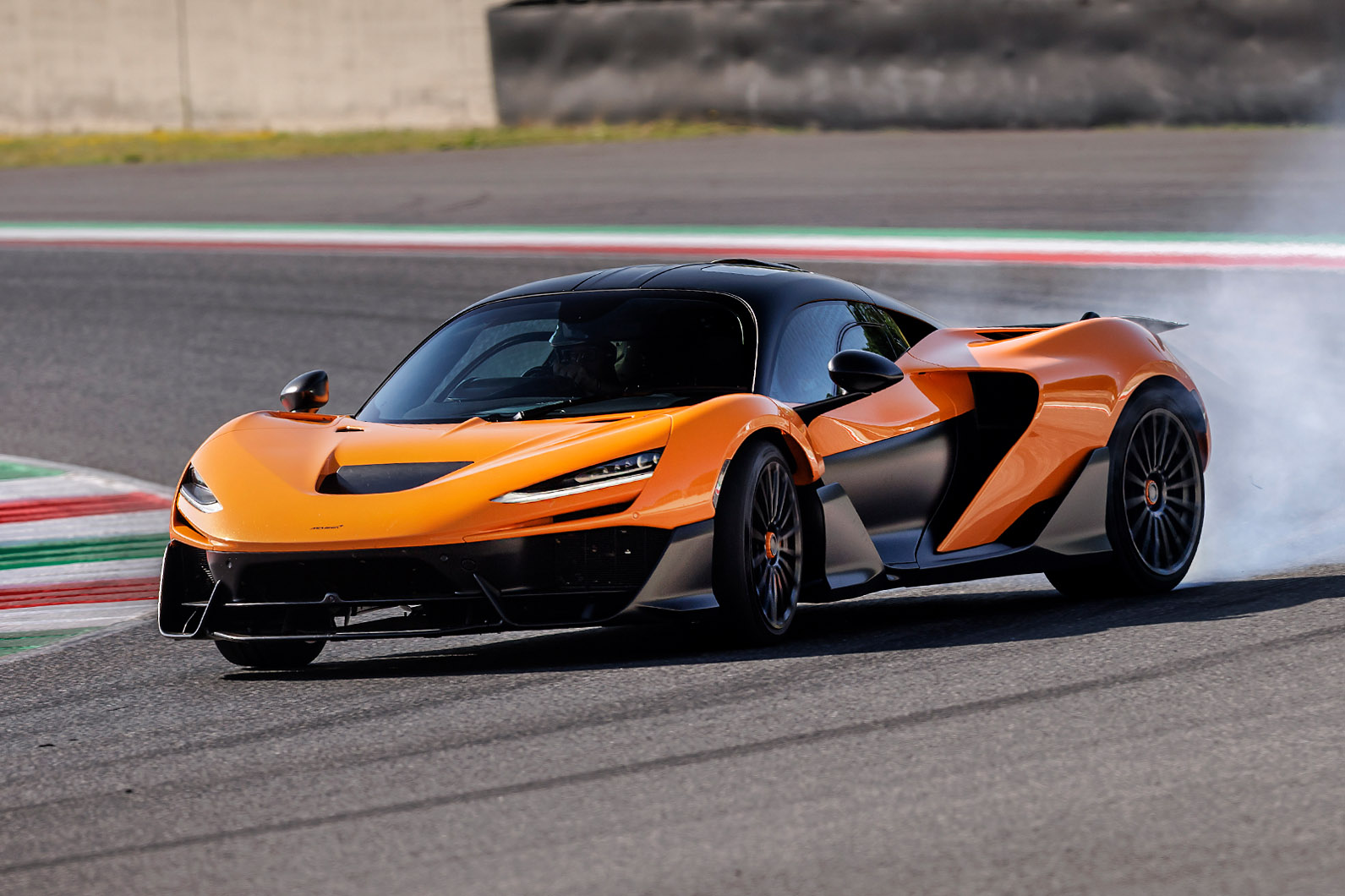
For this same aero reason McLaren’s trademark dihedral-opening doors aren’t here: their hinges would be in a high airflow area because McLaren directs it out from the front splitter and onto the bodywork. So there are gullwing doors.
There’s a movable front splitter and a big active rear spoiler, whose full extension sees the rear wing move 300mm backwards, where its underside takes up some of the flow from the diff user (and in which form it’s not road-legal, so its use is geofenced for circuits or static display). Overall downforce is 1000kg; that figure is capped, so its effect bleeds off at speed.
The W1 is 4635mm long and 2191mm wide across the mirrors (2074mm with them folded, which is one gnat wider than body width).