

As of 2026, more car buyers in the U.S. are prioritizing daily drivers, specifically in the SUV and crossover segment. The need for a weekend car has essentially become redundant due to much more significant financial constraints, prompting mainstream brands to make their products more emotive and luxurious.
As a result, the new vehicle market is filled with well-rounded crossovers that can do it all. The best of the lot is a typically overlooked model by mass-market standards, despite it being one of the most balanced options out there. The Japanese brand offers it in an array of accommodating trims and two powerful and reliable engine options.
BMW’s Rough SUV Design Direction

BMW’s current design philosophy for its SUV lineup is defined by a bold and monolithic exterior presence. The brand achieves this by applying sharper body lines, reimagined kidney grilles, and expansive surfaces, which stand in stark contrast to previous-generation models that pursued a minimalist aesthetic. This interior design direction prioritizes a decluttered cabin environment where traditional switchgear is largely replaced by digital surfaces centered on the curved infotainment display and subtle ambient lighting.
While this polarizing aesthetic has generated significant debate, the brand’s overall sales momentum in the U.S. has remained resilient, consistently achieving record-breaking years. However, the impact of this design pivot has been uneven across segments, most notably seen in the recent sharp decline of the iX, which, despite its experimental design, has struggled with a 50 percent year-over-year sales drop in early 2026, signaling a shift in consumer appetite as the market awaits the more integrated Neue Klasse design language.
Mazda’s Premium Approach Is More Tasteful

Mazda’s strategic pivot toward a crossover-heavy portfolio has transformed the brand from a niche Japanese automaker into a serious premium contender in the North American market. This strategy focuses on a calculated premium push that utilizes sophisticated engineering, such as new longitudinal platforms and smooth inline-six engines. In doing so, it has bridged the gap between mainstream and luxury brands.
The results are evident in the company’s financial health and market perception, as their high-margin utility vehicles now represent nearly 90 percent of their total U.S. sales volume. By consistently earning top safety accolades across their entire elevated lineup and maintaining a reputation for driving dynamics that rival European counterparts, the brand has successfully captured a more affluent demographic that prioritizes both versatility and a refined, upscale experience.

The Mazda CX-70 Makes German SUVs Look Overpriced
This premium Japanese SUV is more than capable of throwing punches at BMW for a fraction of the price.
The Mazda CX-70 Is A Budget-Beating BMW Rival

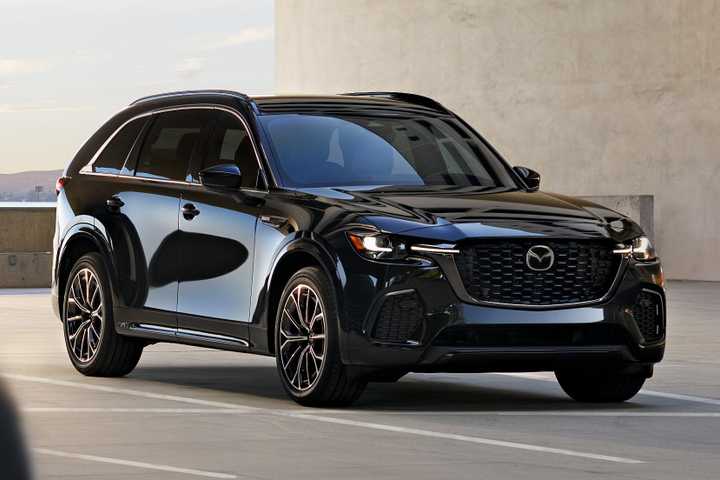
The Mazda CX-70 is one of the best affordable premium SUV options that you can consider in the segment. The Japanese brand starts pricing off at $42,250 for the base model, which is substantially cheaper than the $67,600 MSRP BMW applies to its equally sized X5 SUV.
According to J.D. Power, the 2026 Mazda CX-70 holds a consumer-verified overall score of 77/100, which includes 83/100 for the driving experience, 82/100 for resale, and 82/100 for the dealership experience. Interestingly, it only earns 69/100 for quality and reliability. The model holds an outstanding 4.6/5 average rating on the Edmunds consumer review portal, with reliability and manufacturing quality, ride quality, and value being its strongest positives.
The BMW X5’s scoring is admittedly a bit more competitive. J.D. Power gives the 2026 model year with an 80/100 consumer-verified overall score, which includes 81/100 for quality and reliability, 83/100 for the driving experience, 74/100 for resale, and 80/100 for the dealership experience.
The CX-70’s Troublesome Launch

The Mazda CX-70’s reliability reputation has been heavily influenced by its status as a new model sharing a complex platform with the CX-90. While Mazda is generally known for high build quality, the initial rollout for the CX-70 and CX-90 has been marked by several significant software-related recalls. These have predominantly affected the electrical systems, powertrain control modules, and hybrid drivetrain components.
Owners have reported hybrid system malfunction warnings that trigger alarming dashboard alerts and leave vehicles in limp mode, necessitating dealership visits. Because Mazda does not utilize over-the-air updates for many of these critical systems, owners have been required to visit service centers frequently for software patches, which has been a primary driver of customer frustration, resulting in the model’s poorer reliability perception.
Addressing The CX-90’s Initial Faults

The CX-90’s earlier launch effectively made it the initial testbed for Mazda’s new architecture and has faced a broader spectrum of teething issues. Beyond the widespread software-driven recalls for drive power loss and inverter faults, early CX-90 models experienced reports of squealing brakes, suspension squeaks that were often traced to bushings, and occasional transmission behavior that some users found less refined than expected for a premium-positioned vehicle.
While many of these are viewed as quirks rather than catastrophic mechanical failures, the variance in ownership experiences has been wide, with early build dates showing a higher concentration of issues compared to later production runs that have incorporated rolling production updates.

2026 Mazda CX-70 Interior And Exterior Picture Gallery
For 2026, the CX-70 has been updated with refined design, premium interiors, advanced tech, three electrified powertrains, and enhanced performance.
Comprehensive Specification Across The Range

The 2026 Mazda CX-70 is offered in seven distinct configurations for the U.S. market, with base MSRPs starting at $42,250 for the 3.3 Turbo Preferred and scaling up to $56,670 for the 3.3 Turbo S Premium Plus. The electrified PHEV SC and SC Plus models occupy the middle bracket at $44,250 and $47,250, respectively, while all models require a $1,455 destination and delivery fee. Standard comfort and convenience features across the line include a 12.3-inch center display with Alexa Built-in, wireless Apple CarPlay and Android Auto, a power sunroof, and heated front seats.

The Premium and Premium Plus trims add upscale amenities like a 12-speaker Bose Centerpoint surround system, a 360-degree view monitor, a hands-free power tailgate, and ventilated front seats with Nappa leather. The high-output S trims further elevate the experience with a 12.3-inch fully digital gauge cluster, driver seat memory, and signature LED lighting, while the flagship Turbo S Premium Plus features exclusive tan quilted Nappa leather, a suede-wrapped dashboard, and a 150-Watt cargo area power outlet. While most features are grouped by trim, standalone options are largely limited to premium paint colors such as Soul Red Crystal Metallic, Rhodium White, Polymetal Gray, Zircon Sand, or Melting Copper Metallic, each costing $595.
Mazda’s Competitive Warranty Offering

Regarding maintenance and coverage, Mazda supports the CX-70 and CX-90 with a standard new-vehicle limited warranty, typically encompassing a three-year or 36,000-mile bumper-to-bumper coverage and a five-year/60,000-mile powertrain warranty. Servicing intervals are managed by an intelligent Maintenance Monitor in the vehicle, which tracks driving conditions and engine data to signal service needs.
Under normal conditions, Mazda recommends oil and filter changes every 10,000 miles or 12 months, whichever comes first. However, this interval drops to 5,000 miles or 6 months for severe driving, which includes frequent short trips, idle-heavy usage, or operation in extreme climates. Regular maintenance also includes tire rotations every 7,500 to 10,000 miles, with more comprehensive inspections, including cabin air filters and fluid checks, occurring at 15,000 to 30,000-mile milestones.

Hot Take: You Know, The Mazda CX-70 Is Quite The Looker
The Mazda CX-70, the CX-90’s little brother, puts the emphasis on design and refinement. It truly feels like a premium product.
Effective Powertrain Options

The 2026 Mazda CX-70 features a rear-biased i-Activ all-wheel-drive architecture paired exclusively with an eight-speed automatic transmission, though its performance profile varies significantly across three distinct powertrain calibrations. The entry-level 3.3 Turbo models feature a 48-volt mild-hybrid straight-six producing 280 horsepower and 332 pound-feet of torque. If you prioritize performance, the high-output 3.3 Turbo S variants utilize a more aggressive version of the same engine to produce a robust 340 hp and 369 lb-ft of torque on premium fuel, enabling a 0 to 60 mph sprint in 6.5 seconds.

- Base Trim Engine
-
3.3L Turbo SKYACTIV-G I6
- Base Trim Transmission
-
8-speed automatic
- Base Trim Drivetrain
-
All-Wheel Drive
- Base Trim Horsepower
-
280 HP @5000 RPM
- Base Trim Torque
-
332 lb.-ft. @ 2000 RPM
- Base Trim Fuel Economy (city/highway/combined)
-
24/28/25 MPG
- Make
-
Mazda
- Model
-
CX-70
- Segment
-
Midsize SUV
Alternatively, the PHEV model pairs a 2.5-liter four-cylinder engine with a 68-kW electric motor for a total system output of 323 hp and 369 lb-ft of torque. Thanks to the immediate delivery of electric torque, the PHEV is the quickest off the line with a 0 to 60 mph time of 5.9 seconds. Mazda electronically limits the top speed of these utility vehicles to 130 MPH.
Impressive Fuel Consumption Returns
Opting for the entry-level turbocharged variant yields an EPA-estimated fuel consumption of 24/28/25 MPG on the city/highway/combined cycle. Upgrading to the Turbo S only changes the city consumption to 23 MPG. With an 18.5-gallon fuel tank for the Turbo and a 19.6-gallon tank for the Turbo S, range estimates come in at 462 miles for both engines.
The EPA indicates that the base Turbo will have you spending $1,000 more on fuel compared to the average new vehicle sold in the U.S., together with a $1,700 annual fuel cost and a $2.81 cost to drive 25 miles.
The Turbo S model will cost you $3,750 more in fuel over five years, $2,250 in fuel for the year, and $3.76 to drive 25 miles, with a $70 estimate to fill the tank.
The CX-70 PHEV is the model to go for if fuel savings are a priority. This earns an estimated 56 MPGe combined rating from the EPA, together with an all-electric range of 26 miles, transitioning to 25 MPG combined once the battery is depleted. This model features an 18.4-gallon tank and a total gas-electric range of 490 miles. You’ll still spend $1,250 more on fuel over five years and $1,750 on gas and electricity over a year. You can also expect to spend $2.23 to charge the battery, $3.76 to drive 25 miles on gasoline, and $69 to fill the tank up.
Sources: EPA, Edmunds, J.D. Power, and iSeeCars.