
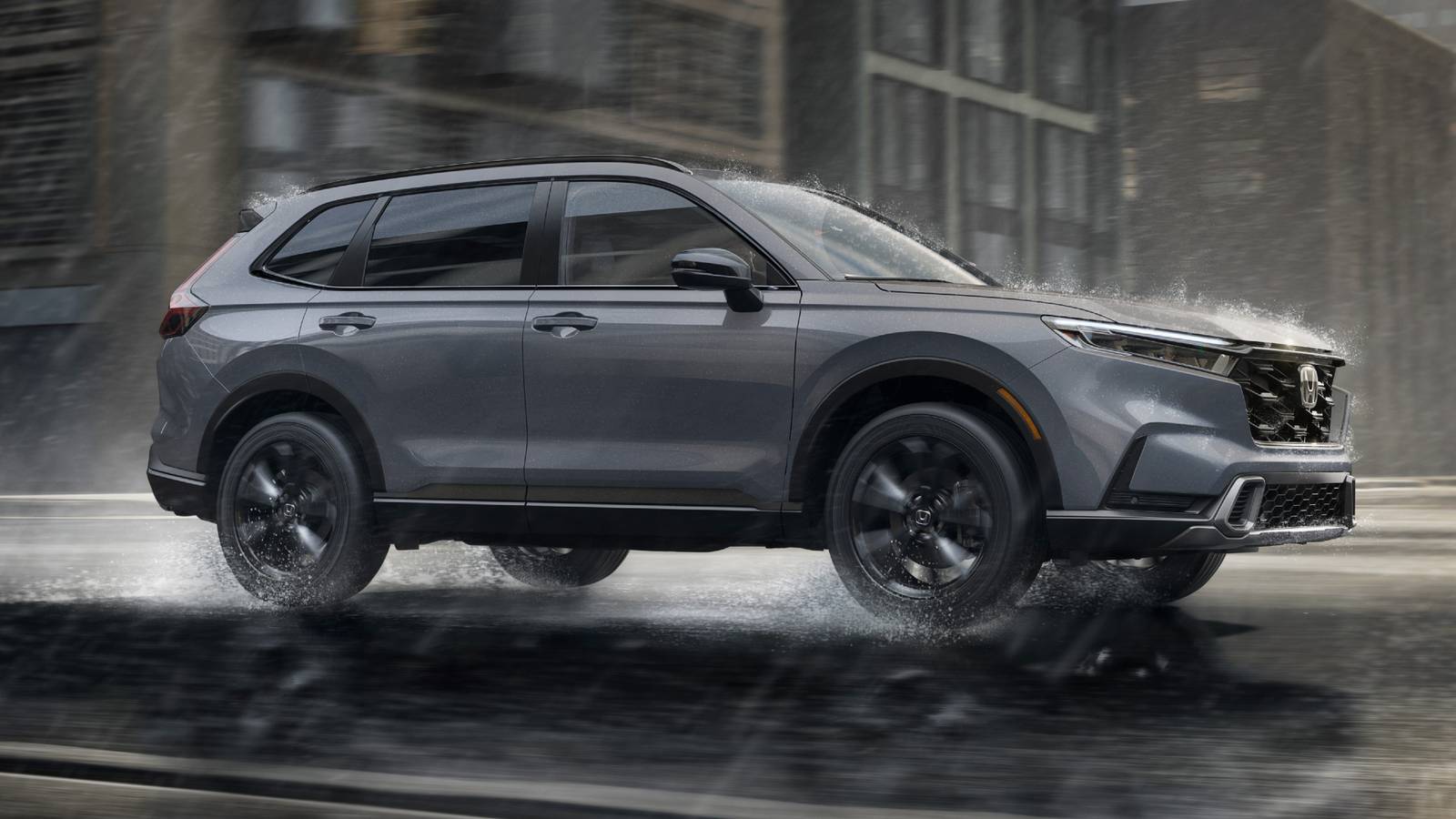
Luxury cars are becoming less accessible in the U.S. market. There are many reasons for this, some of which include more expensive development and distribution costs, driving up prices for new cars across the board. Brands have noted that luxury products yield higher margins, leading to MSRPs that are higher relative to production costs.
Many new-car buyers are demanding luxury, resulting in conventional mass-market brands investing more time and resources to make previously mundane sedans and SUVs feel more special and upmarket. For 2026, one Japanese hybrid SUV benefits from a well-rounded specification that focuses on premium features without an expensive price tag.
The State Of Hybrid SUVs In 2026

Hybrid SUVs in the U.S. have transitioned from a niche efficiency play into the dominant force of the automotive market, with sales significantly outpacing those of fully electric vehicles as consumers seek a balance between range security and lower emissions. As of 2026, these vehicles capture nearly 30 percent of the market share, driven by a surge in popularity that saw registrations jump from three percent to over 16 percent in just five years.
This shift has been accompanied by a dramatic elevation in cabin quality, as the latest hybrid SUV models from leading mainstream brands move away from the utilitarian plastics of the past in favor of truly premium environments. Modern interiors now frequently feature sustainable luxury textiles, expansive digital displays, and advanced comfort technologies that were once reserved for high-end flagship sedans.
Honda’s Resilient Approach To Gasoline-Hybrid Efficiency

Honda pioneered the American hybrid landscape with the 1999 launch of the original Insight. This two-door liftback leveraged a lightweight aluminum body and a compact Integrated Motor Assist system to achieve record-breaking fuel efficiency that even modern hybrids fail to match. Over the decades, the company’s engineering focus shifted from this early parallel hybrid setup toward more sophisticated multi-motor architectures, specifically the evolution into the current e:HEV two-motor system that first made its appearance in the 2014 Accord Hybrid.
This modern approach uses a traction motor to drive the wheels directly in most scenarios, while a second motor acts as a generator, creating a driving feel that mirrors the smooth, instantaneous torque of an electric vehicle. Beyond these mechanical strides, the brand has undergone a significant premiumization of its cabin experience, moving away from the hard plastics and utilitarian layouts of the early 2000s toward a more premium design philosophy.

Why This Underdog SUV Could Outsell The Honda CR-V
This Kia isn’t just competing — it’s positioning itself to challenge and potentially outsell one of America’s best-selling SUVs.
Honda’s Competitive Entry Price Point

The 2026 model year CR-V Hybrid range starts at $35,630 for a base Sport derivative in front-wheel drive guise. The $38,800 Trailsport Hybrid, available exclusively with all-wheel drive, is based on the entry-level model, but with a more adventurous aesthetic to appease would-be adventurers. The Sport-L is essentially a more premium extension of the base model, increasing the price to $38,725. The Sport Touring sits at the very top of the range with a $42,250 starting price before options. These prices exclude Honda’s $1,450 destination fee.
A Comprehensively Fitted Interior

The base model comes standard with 18-inch gloss black alloy wheels, roof rails, full LED headlights, and dual exhaust finishers. Within the cabin, you’ll find cloth upholstery with orange stitching for the seats, front seat heating, electronic adjustments for the driver’s seat, a one-touch electronic sunroof, and dual-zone climate control. You also get a nine-inch touchscreen infotainment system connected to a 240-Watt six-speaker audio system, with the added benefit of wireless Apple CarPlay and Android Auto.
The Trailsport adds all-season floor mats, all-terrain tires, an electronic-lifting tailgate, a 10.2-inch digital instrument cluster, a heated steering wheel, and an eight-speaker 320-Watt audio system, together with bespoke 18-inch alloy wheels.
Flagship Trims Set A High Standard

The Sport-L adds leather seat upholstery with orange stitching, memory functions for the driver’s seat, and a wireless smartphone charger. The Sport Touring includes a hands-free function for the tailgate, a Google-based operating system, and additional driving modes, including Snow, Sport, Economy, and individual. You also get 19-inch gloss black alloy wheels, a Bose premium audio system, and satellite navigation. Standard color options include Canyon River Blue Metallic, Crystal Black Pearl, Meteorite Gray Metallic, and Solar Silver Metallic. For $455, you can specify Platinum White Pearl, Radiant Red Metallic, or Urban Gray Pearl.

Pre-Owned Luxury SUVs You Can Get For Honda CR-V Money
The Honda CR-V is one of the better SUVs in the market, but there are options. Step back just a few years and you have a choice of these luxury SUVs.
Efficient And Capable Drivetrains

Honda offers the CR-V Hybrid with a choice of front- or all-wheel drivetrains, both of which produce a combined 204 horsepower and 247 pound-feet to the wheels via a direct-drive eCVT. The brand claims an eight-second 0-60 MPH time for the front-wheel drive model and a 7.6-second time for the all-wheel drive variant.
Honda limits both drivetrains to a 111 MPH top speed. The brand opts for a conventional driveline to the rear wheels for its all-wheel drive system. This is opposed to applying an additional electric motor to the rear axle, and explains why the model’s output remains the same, regardless of your preferred setup. In terms of towing, it’s not necessarily the best option that you can consider, as the brand limits its capacity to just 1,000 pounds.
Honda’s Efficient Drivetrain System

The Honda CR-V’s hybrid system employs a supplementary 1.1-kWh lithium-ion battery pack, resulting in a pretty impressive 43/36/40 MPG EPA consumption estimate on the city/highway/combined cycle for the front-wheel drive option. The all-wheel drive model returns a slightly worse 40/34/37 MPG result.
The 14-gallon gasoline tank gets you 560 miles of range in front-wheel drive guise, which the all-wheel drive system lowers to 518 miles. Honda’s hybrid system is a series-parallel variation, which means it allows the operation of the electric motor independently. The eCVT runs on a clutch-based system, allowing the motor to act as a generator for auxiliary functions, including the starter and climate control.

The 2026 Honda CR-V offers a practically spacious interior design that lets you make the most of its passenger and cargo utility. Occupants in the front enjoy 41.3 inches of legroom, 40.0 inches of headroom, which decreases to 38.2 inches if you specify the sunroof. You also get 55.6 inches of hip room, and 57.9 inches of shoulder room. Rear passengers benefit from a generous 41.0 inches of legroom, 38.2 inches of headroom, 52.6 inches of hip room, and 55.9 inches of shoulder room. For storage, the CR-V features 39.3 cubic feet of trunk space, which expands to a massive 76.5 cubic feet with the rear seats folded flat.

Why The Honda CR-V Hybrid Is The Perfect Blend Of Comfort And Value
The Honda CR-V Hybrid proves that a family SUV can be comfortable, efficient, and smartly engineered without forcing buyers to overspend.
Appealing Long-Term Cost Factor

The Honda CR-V maintains a strong reputation in the U.S. market thanks to its longstanding and consistent performance as a cost-effective and dependable family SUV that suits both urban and active lifestyles. Thanks to this, it benefits from impressive value retention, making it a viable investment for those only needing one for less than a decade.
According to Edmunds, the base Honda CR-V Sport Hybrid loses $10,941 of its $35,630 base MSRP over the course of five years and 60,000 miles, which is an incredible value retention rate by midsize SUV standards. Additional costs include spending $5,580 on maintenance, $601 on repairs, and $5,814 on fuel.
Using the same metrics, CarEdge indicates that the very same model loses 34 percent of its value, resulting in it being worth $23,507. It also might cost you $5,580 in maintenance, $601 on repairs, and $5,814 on fuel.
Exceptional Value Retention Rates

iSeeCars holds a similar sentiment with the CR-V Hybrid, highlighting that it will lose 43 percent or $14,755 of its value after five years, resulting in the Japanese HEV SUV earning an 8.0/10 retained value score. J.D. Power gives the same model an 85/100 score for resale. Joining this is an 83/100 driving experience, 84/100 quality and reliability, and 81/100 dealership experience score, bringing its overall consumer-verified rating up to 83/100.
No Shortage Of Safety Functions

The 2026 Honda CR-V prioritizes occupant protection with the Honda Sensing suite standard across all trims. This ADAS package includes the collision mitigation braking system, road departure mitigation, adaptive cruise control with low-speed follow, lane keeping assist, and traffic sign recognition. While the LX provides these essentials alongside a multi-angle rearview camera, the EX and EX-L add crucial active safety layers with the blind spot information system and cross-traffic monitor. The EX-L further distinguishes itself with front and rear parking sensors and low-speed braking control.
Passive safety is anchored by the Advanced Compatibility Engineering body structure, designed to redirect crash energy. All models feature an advanced 10-airbag system, including standard knee airbags and rear-passenger side-impact airbags. This is a high standard for the class. Additional active features include vehicle stability assist with traction control, electronic brake distribution, and a driver attention monitor. For families, every trim includes rear seatbelt reminder and anchors.
Sources: Edmunds, iSeeCars, CarEdge, the EPA, and J.D. Power