
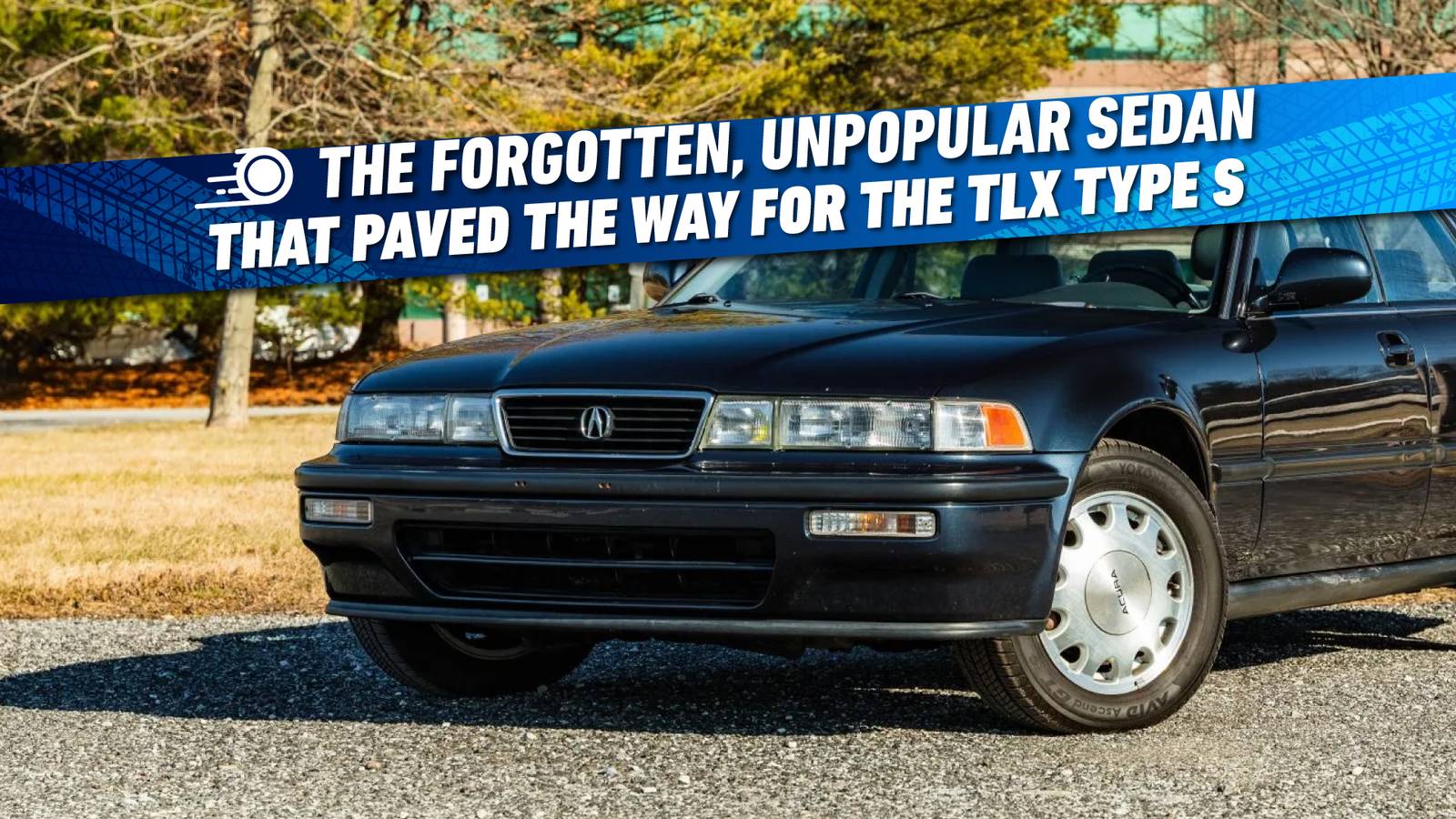
Acura did not stumble into the TLX Type S by accident. That car did not simply appear one day with a turbocharged V6, rear-biased all-wheel drive, and a mandate to remind people that Acura still knows how to build a proper driver’s sedan. It was the end of a long, occasionally awkward, often underrated lineage of performance-leaning four-door cars that began decades earlier with something far stranger. That car was the Acura Vigor.
Before Acura had Type S badges, before torque vectoring and adaptive dampers, before anyone expected Honda’s luxury arm to build something with real attitude, the Vigor showed up with an inline-five engine mounted longitudinally, front-wheel drive, and proportions that looked nothing like an Accord. It was weird. It was subtle. And it mattered far more than history usually gives it credit for.
The Acura Vigor Arrived Before Acura Knew What It Wanted To Be

The early 1990s were a confusing time for Acura. The brand had launched strongly with the Legend and Integra, but it was still figuring out how far it wanted to push beyond Honda’s shadow. The Vigor, introduced for the 1992 model year, was an experiment in identity more than a clean-sheet performance sedan.

Slotting between the Integra and Legend, the Vigor was supposed to be a premium sport sedan for buyers who wanted something more distinctive than a Honda Accord but less formal than a Lexus ES. Instead of borrowing heavily from existing platforms, Acura took a swing. The Vigor might not look like much, but it rode on a unique chassis and featured a longitudinally mounted inline-five engine driving the front wheels. That layout alone set it apart from nearly everything else in its segment. It was an engineering flex that made very little sense on paper and yet defined the car’s character.
That Inline-Five Engine Was The Vigor’s Entire Personality

At the heart of the Acura Vigor was a 2.5-liter inline-five engine, a configuration rarely seen in Japanese sedans of the era. It produced around 176 horsepower, which does not sound impressive today, but the delivery was smooth, linear, and unusually refined for its time. More importantly, it sounded different. The odd-cylinder layout gave the Vigor a warbly, mechanical soundtrack that set it apart from the anonymous four-cylinders and muted V6s of its competitors. It did not roar, but it spoke with confidence.

The longitudinal layout also allowed for near-perfect weight distribution by front-wheel-drive standards. The engine sat mostly behind the front axle, reducing torque steer and improving steering feel. Acura engineers were clearly chasing balance rather than brute force, a theme that would later define the brand’s best performance cars.

10 Reasons Why The Acura TLX Type S Is Still A Top ICE Sports Sedan In 2025
With a lower price than competitors from German brands, the TLX Type S has some major selling points.
A Chassis Tuned For Drivers Who Paid Attention

The Acura Vigor was never marketed as a sports sedan, but it behaved like one when pushed. The suspension tuning favored control over comfort, and the steering offered genuine feedback at a time when many luxury sedans felt numb. This was a car that rewarded smooth inputs. It did not overpower its front tires or overwhelm drivers with torque. Instead, it encouraged momentum driving, precision, and restraint. Those qualities may sound familiar to anyone who has driven a modern Acura Type S product.

Even the automatic transmission, which was common in Vigor models, was tuned to keep the engine in its sweet spot rather than chase early upshifts. Acura was quietly building a sedan for people who cared about how cars felt, even if they never said it out loud.
Styling That Chose Restraint Over Flash

The Vigor’s design was understated to the point of anonymity, and that was intentional. Acura avoided sharp creases or dramatic flourishes, opting instead for clean lines and balanced proportions. The long hood and short front overhang hinted at the unusual engine placement, giving the car a stance that felt more European than Japanese.

Inside, the cabin was driver-centric without being aggressive. The dash wrapped slightly around the driver, controls were logically placed, and visibility was excellent. Materials were high-quality but not ostentatious, reinforcing Acura’s early reputation for quiet competence. This restraint would become a core Acura trait, one that later Type S models would evolve rather than abandon.
Why The Acura Vigor Failed And Why That Matters

The Vigor did not sell well. Buyers were confused by its positioning, and Acura struggled to explain why it existed. It was more expensive than an Accord but not more luxurious in any way that was easy to tell without a spec sheet. It handled better than most rivals but did not advertise that fact loudly enough. In short, it was a car built for enthusiasts who were not yet looking at Acura for thrills.

The Vigor’s failure taught Acura a crucial lesson. Performance needed to be explicit. You could not hide engineering ambition under a conservative badge and expect people to notice. That realization would shape everything that followed.

Enter The Acura TL And The First Hint Of Type S Attitude

When Acura replaced the Vigor with the TL in the mid-1990s, the message became clearer. The TL leaned harder into power, space, and presence, adopting V6 engines and a more traditional luxury sedan layout. The real turning point came with the early TL 3.2 Type S. This was Acura finally saying the quiet part out loud.

The Type S badge meant more power, firmer suspension tuning, larger wheels, and a sharper edge. The TL 3.2 Type S did not reinvent the segment, but it signaled a shift. Acura was no longer content with being the sensible choice. It wanted to be the interesting one.
How The Vigor’s DNA Shows Up In The TLX Type S

Fast-forward to the modern TLX Type S, and the Vigor’s influence becomes surprisingly clear. The emphasis on balance over brute force. The prioritization of steering feel and chassis composure. The belief that a sedan can be engaging without being exhausting. The TLX Type S uses a turbocharged V6 and advanced all-wheel drive to deliver performance the Vigor could only hint at, but the philosophy is the same. This is not a car built to dominate drag races or chase Nürburgring lap times. It is built to feel right on real roads.
Demonstrating the TLX Type S’s expert-tuned bones, chassis, and handling, yielding an excellent behind-the-wheel experience as a sports sedan and performance vehicle.
– Chris Chin for TopSpeed

Even the restraint remains. The TLX Type S looks aggressive, but it is not cartoonish. The interior is driver-focused without being overwhelming. Acura learned how to turn its early subtlety into a strength rather than a liability.

Why The 2025 Acura TLX Type S Still Matters In An EV World
Acura’s take on the luxury sports sedan feels outdated in 2025, but that’s what makes it fun.
The Vigor’s Legacy In Acura Performance History

The Acura Vigor rarely gets mentioned in discussions about great sport sedans, and that is unfair. It was not a hit, but it was honest. It tried something different, learned from its mistakes, and laid the groundwork for a clearer performance identity. Without the Vigor, Acura may never have pursued balance as aggressively as it did. It may not have developed the confidence to create Type S models that emphasize feel over flash. It also taught Acura to fail with grace and come back with a banger.
Does The Acura Vigor Deserve A Second Look Today?

Today, the Acura Vigor is a curiosity. It is rare, but affordable due to being largely forgotten. For enthusiasts who appreciate engineering oddities and early attempts at greatness, it offers something special. It represents a moment when Acura took a risk without knowing where it would land. It reminds us that great cars are rarely born fully formed. They are shaped by experiments, missteps, and hard lessons learned along the way. The TLX Type S clearly benefits from Acura’s history, but that doesn’t mean we need to relive it. Maybe the Vigor is best left in the past.
Sources: Acura, Bring a Trailer