
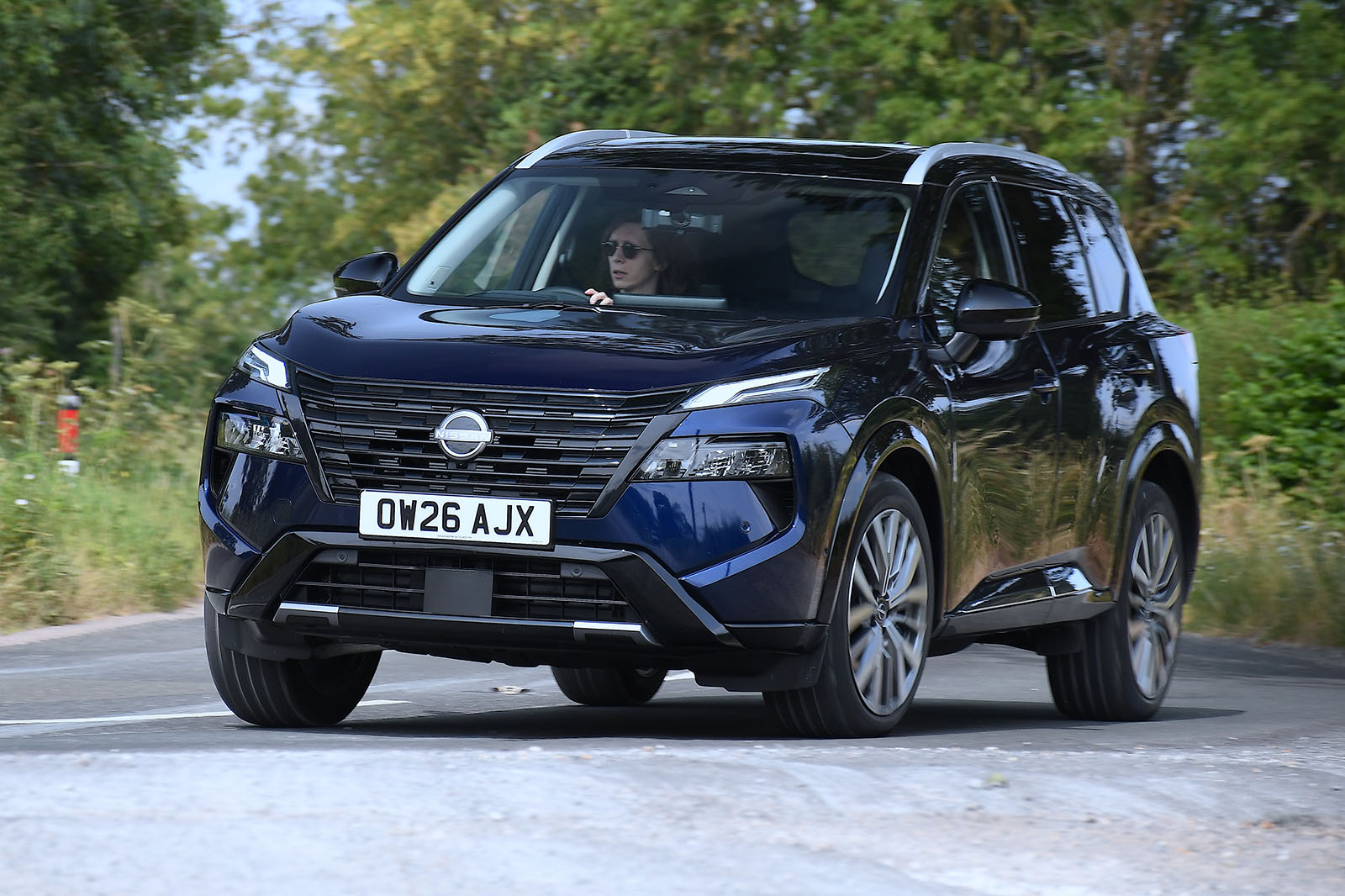
Up front, it’s mostly Nissan Qashqai. Save for some different colours and a new pattern for the piece of trim on the passenger side, the dashboard is the same as in Nissan’s smaller SUV. You might hope to get a bit more for the price premium over the Qashqai, but frankly there is very little to genuinely complain about.
Other cars have a more avant-garde style, but the X-Trail hardly looks dated. There are soft-touch materials as far as the eye can see, and the practical usability is far more carefully considered than in most modern cars. The climate control panel uses all chunky, physical buttons and there’s very little fingerprint-attracting glossy black plastic.
The centre console is the biggest change from the Qashqai. It is a floating design with space beneath. On top, there are generous cupholders, a wireless phone charger, a 12V socket, a USB-A port and a USB-C port. The rear seats also get a USB-A and USB-C port.
Low-end trims on early cars got a simpler infotainment system and analogue gauges, but the vast majority of X-Trails come with the same 12.3in infotainment system and 12.3in driver display. The latter isn’t hugely configurable but it makes good use of space and is very clear.
The X-Trail is a brilliant place to be if you’re in the front because the seats are outstandingly comfortable, at least on the high-spec Tekna trim cars we’ve tested. They’re soft but supportive, with lots of adjustment. However, things are less rosy for rear passengers, which is a little disappointing for a family SUV. Those in the second row have more than enough leg- and headroom, but because the hybrid battery is under the cabin, the floor is pushed up and rear passengers will find themselves sitting with their knees up, like in some EVs. They do at least get their own zone for the climate control.
A third row of seats is available as a £1000 option, but those rearmost places should be viewed as emergency seating at best. If you want to make the rearmost seats in the X-Trail usable, even for small children, you have to slide the second row forwards quite a lot. It is worth reiterating that the X-Trail is a smaller car overall than a Kia Sorento or Skoda Kodiaq and is more comparable with the Toyota RAV4 and Kia Sportage, so it might be unreasonable to expect it to offer seven proper seats. It might be best not just stick with the five-seat version and enjoy its 575 litres of boot space (485 in the seven-seat version with the third row down).
Multimedia system
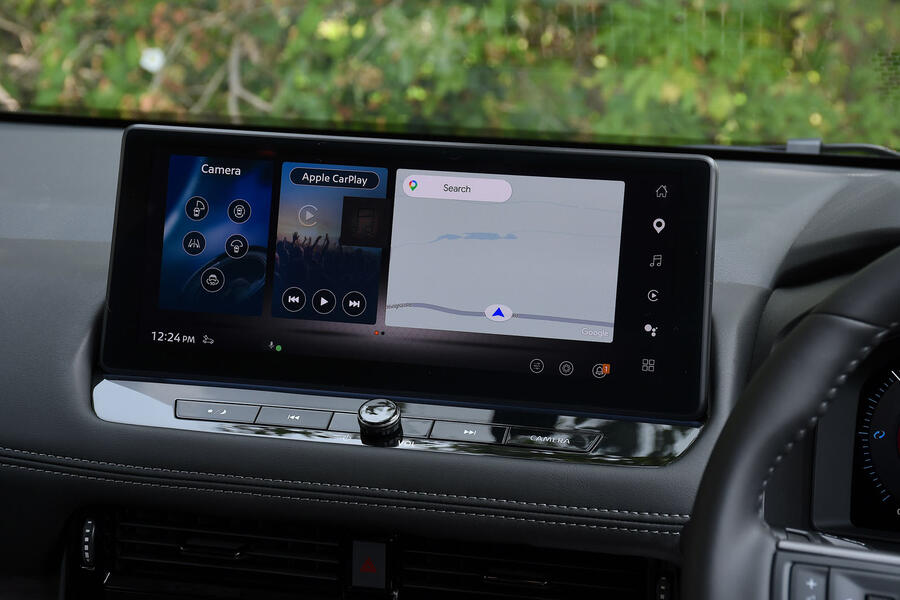
The X-Trail’s infotainment system isn’t the fanciest or graphically modern interface around, but it actually works very well. The graphics are sharp and the screen boots up and responds quickly. There’s a permanent bar of shortcuts on the right side of the screen as well as a physical volume knob and buttons for the tuning and for switching between day and night mode.
The software is logical and you can customise the home screen. The navigation is the original version was decent, but for the 2026 facelift, it was upgraded to Google Maps, which is very hard to beat. Nevertheless, there is still wireless Apple CarPlay and wired Android Auto.
One strange quirk is that the most of the vehicle settings have to be adjusted through the gauge cluster, using the steering wheel buttons, rather than the touchscreen.