

To drive, the Model Y remains a car whose lack of physical controls and conventional instrumentation does seem to gaslight you a little bit about what actually constitutes ease of operation. Well rehearsed as it may sound, given that Tesla is now more of a generalist brand than one for technophiles, the argument certainly bears repeating.
You do get a physical indicator stalk here, as well as actual buttons for headlight flash and wash-wipe. Unlike in other Model Ys, you also get manual steering column adjustment (whoopee). And yet adjusting the seat position and door mirrors, and activating the demister/adjusting the climate control, is all through the 15in touchscreen. Selecting drive or reverse is likewise via a fiddly touchscreen slider, rather than via a physical thing you can easily locate and grab at a glance. It’s annoying; and, for one tester in particular, didn’t become much less so over time.
Sometimes the Model Y seems to be able to use its parking sensors to recognise automatically when, departing a parking bay or making a three-point turn, you might want drive or reverse – and will select it for you. When it works, it’s quite clever; but, annoyingly, it doesn’t always. And so what you’re left with is a car that, at a fundamental level, just isn’t as simple to control as it ought to be; and that has something of a variously obliging or disobliging mind of its own.
In the context of an everyday family EV, there’s absolutely nothing wrong with the car’s level of performance. A 0-60mph time of 5.7sec, and 4.3sec for the dash from 30-70mph, made our Long Range Rear-Wheel Drive test car almost identically quick as the last generation of Honda Civic Type R.
The calibration is reasonably good too. You either lounge about in Chill mode, during which the accelerator pick-up is notably muted; or remain in the standard setting, which is more binary if you’re clumsy, but mostly gives a sensibly bright response when you’re pulling away – what most people like to have in an EV.
There are still no paddles for toggling regen, however – your only options for adjustment come through the touchscreen. Standard mode is close to a one-pedal setting, but isn’t quite strong enough to reassure you to fully leave the brake pedal alone; and Reduced mode isn’t quite a full-on coasting setting. In Tesla world, as with the control layout, that’s just how things are done; like it or lump it.
One lesser-reported change for the Juniper update, and that makes quite a difference, is the addition of brake-by-wire. Tesla used to be one of the only EV makers that didn’t have a blended brake pedal, whereby regenerative force and physical pad-on-disc retardation both unfold during the travel of the pedal. Instead, you got heavy one-pedal driving with lots of lift-off regenerative force, while the brake pedal only acted on the discs.
Now, you have to regulate either a little, or most, of the regen through the brake pedal. That makes the Model Y more like other EVs to drive; though it’s driving regimes are still not quite as adjustable or controllable as many rivals are.
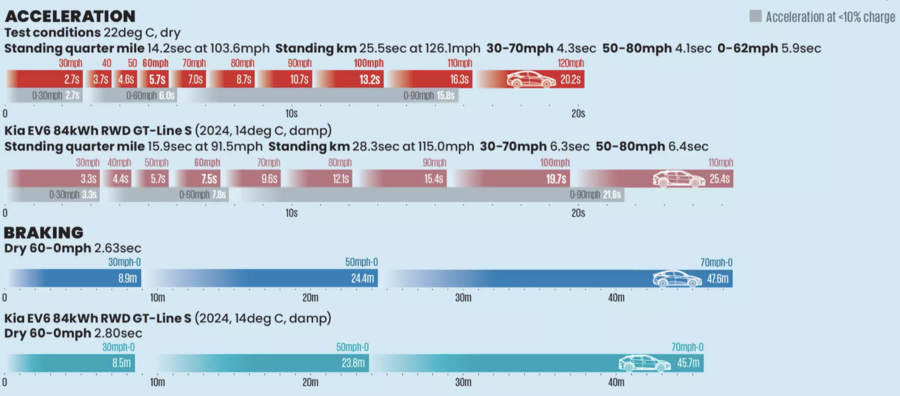
The Model Y Standard, meanwhile has a performance level that may be gentler than that of its rangemates, but still feels assertive enough whether you’re around town or out of it. It’s agreeable enough to drive – except for when the car’s various ADAS systems decline to come to heel. The assisted cruise control has an especially irritating habit of dropping out every time you change lanes on the motorway (which may explain why you see so many Tesla middle-lane hoggers), and its various other systems are harder to find and control through the touchscreen than they would be – if there were, you know, buttons for them.
As for the Long Range AWD – well, it is very quick indeed – considerably more so that the Long Range RWD version to which the above chart relates. It’s the only one to have it you want to go super-saloon baiting.