

American supercar maker Hennessey has revealed the wild Blackbird as its third all-new model, replacing the Venom F5 with a clear and rather different mandate: “maximum man-machine connection”.
Although it places a greater emphasis on driver engagement, its targeted statistics pitch it at the top of the supercar set: 800-850bhp, 0-60mph in less than 3.0sec and a 220mph top speed.
Hennessey has touted a dry weight below 1360kg (3000lb) with the help of a bespoke carbonfibre tub and carbonfibre bodywork.
At its heart is a high-revving, naturally aspirated V8 engine developed alongside Ilmor Engineering of Nascar fame and with a targeted red line of 9000rpm.
It sends its reserves to the rear axle via an open-gate, exposed-linkage, six-speed manual gearbox.
While there are electronic aids including active suspension, anti-lock braking and traction control, Hennessey pledges that the driver will be placed in the thick of the action.
As well as offering a more analogue alternative to the similarly priced McLaren W1, the supercar has been conceived as a tribute to the 1960s Lockheed SR-71 Blackbird spy plane, not only in its design cues and name – Hennessey has acquired the rights to use the latter – but via its long range.
It’s first and foremost as a road car, with its development programme prioritising refinement, visibility and luggage space to “comfortably cover more than 800 miles in a single day”.
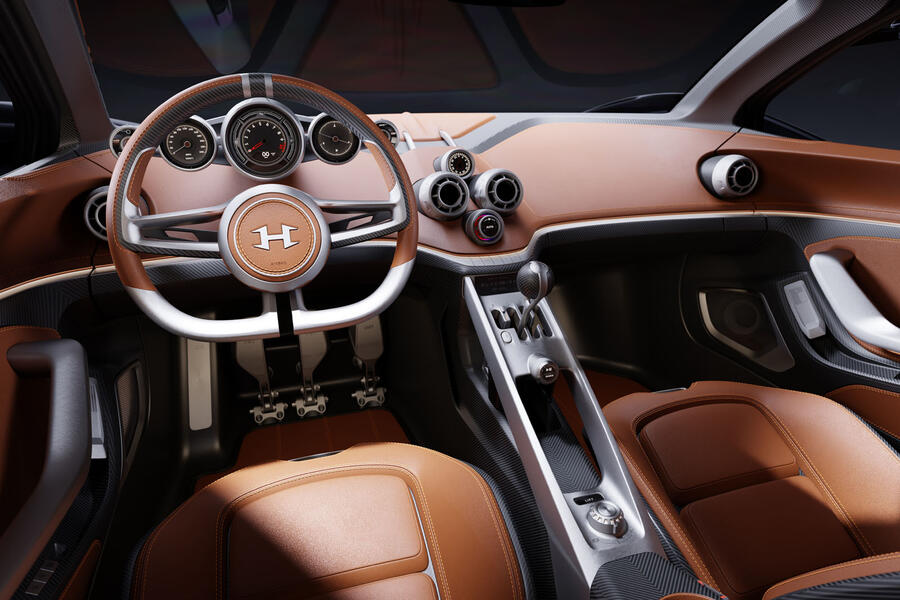
There’s more cabin space than its Venom F5 forebear and enough luggage capacity for “two full-size carry-on bags”, Hennessey said.
Aerodynamics still play a significant role: the active rear stabilisers, modelled on the SR-71’s tail fins, tilt up to 71deg at speeds above 71mph to maintain downforce and the creases alongside the sidepods are an obvious link to its airborne inspiration.
The quad exhaust layout is a nod to the rocket-engined Bell X-1, the first aircraft to break the sound barrier back in 1947.
The aviation theme carries over to the functional, driver-focused cabin, which features an abundance of exposed carbonfibre, visible pedal linkages and a suite of clearly presented dials and clocks in place of a digital driver display.
The focus on simplicity extends to the use of a smartphone mount for infotainment, rather than a central touchscreen, and the eradication of any buttons or switches from the steering wheel.