
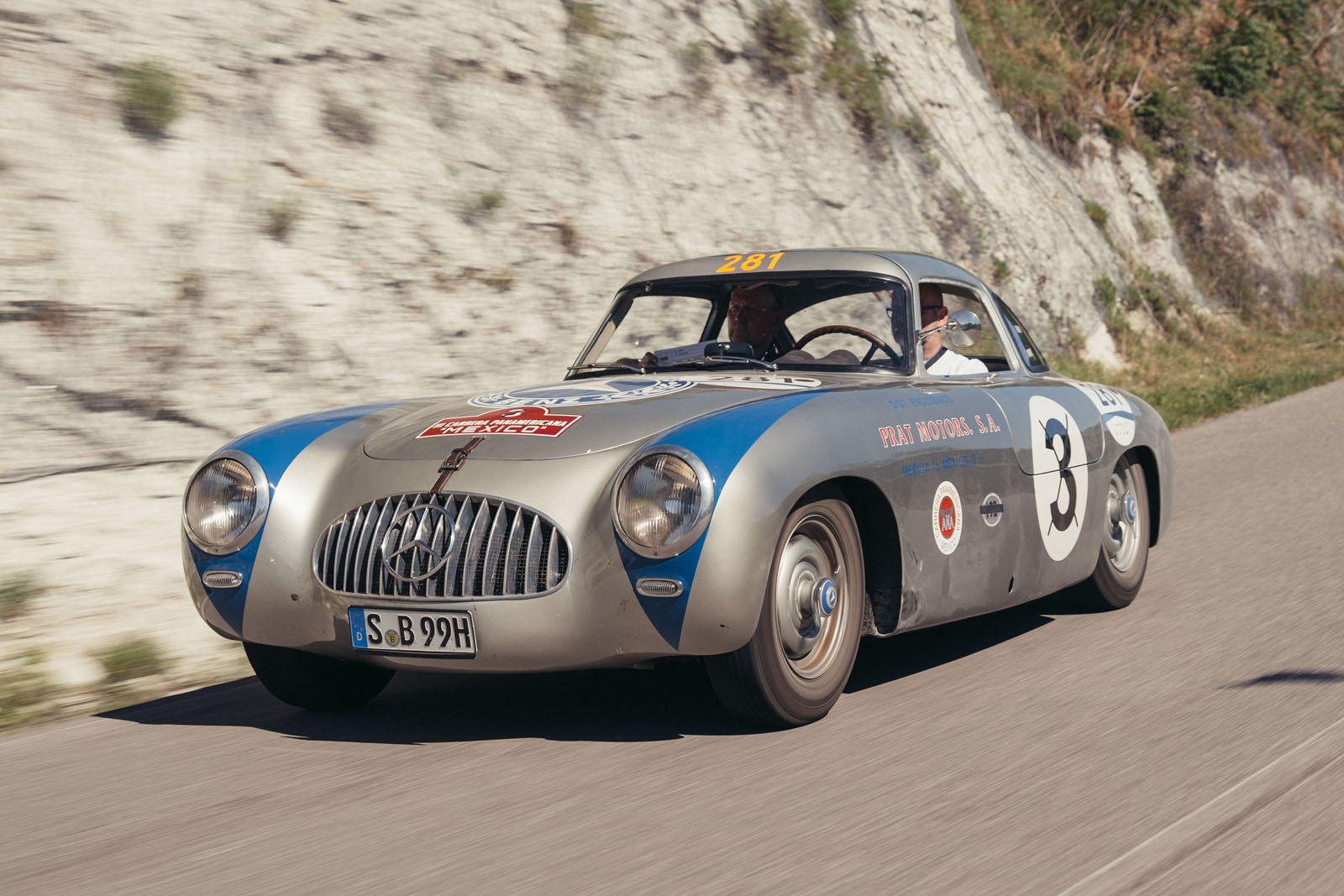
If you’d like to know how significant the Mercedes 300 SL is to an event like the Mille Miglia, you should know that on page 34 of a 63-page technical document for the modern event, the organisers use a silhouette of the SL to show competitors where they should mount their entry number stickers.
The car colloquially known as the Gullwing epitomises what, these days, is absolutely not a race. Not that sometimes you’d know it — which we’ll come to later.
The 1000 Miglia was a proper race when it began, of course, of 1000 Roman miles or thereabouts on mixed Italian roads from Brescia to Rome and back. And it became such an incredibly dangerous race that it was scrapped twice, first having run from 1927 to 1938, at which point it was abolished because in that year’s event, 11 spectators (but no competitors) were killed, creating such public outrage that Mussolini personally stopped it for 1939.
It was revived in 1940, albeit in peculiar circumstances, much shorter, and billed as the Grand Prix of Brescia in an effort to convince the public that things were carrying on as normal. There were, understandably, fewer overseas competitors. A BMW won it. It pays not to look too closely at some of the accompanying insignia.
The race was restarted proper in 1946 and ran until 1957, in which race two fatal crashes — one ending the life of a driver, the other two competitors and nine spectators, including five children — finished things completely.
Mercedes-Benz played a big part in the 1950s. The exact ‘W194′ 300 SL prototype you see here finished fourth in the 1952 race, driven by Rudolf Caracciola, as part of Mercedes’ first return to motorsport since the war. Another SL finished second, driven by Karl Kling. Mercedes made only 11 W194s and it still owns four of them today.
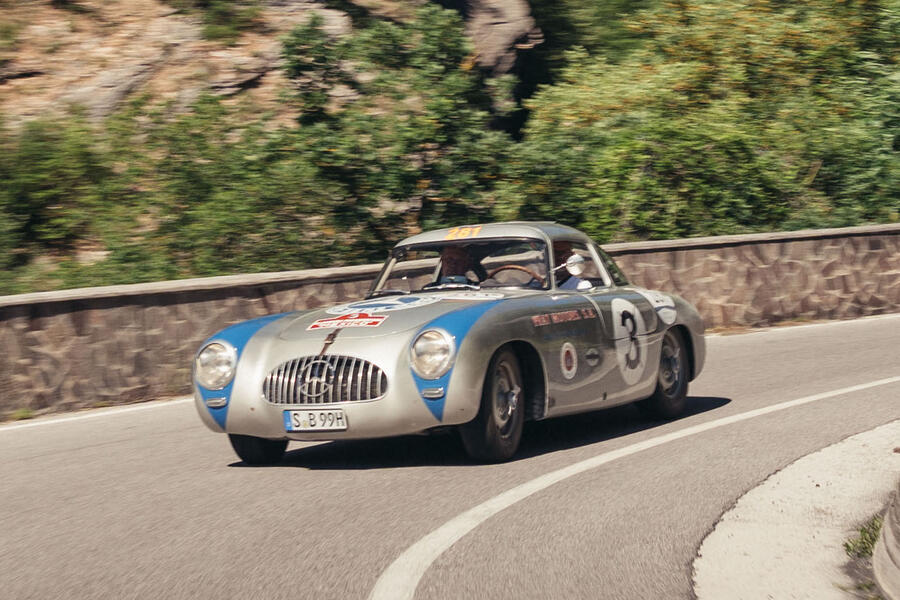
Of the others, two have been scrapped (one was the only roadster), two are whereabouts unknown, and three are privately owned. One of them isn’t strictly a straight W194, having been fitted with fuel injection and, more significantly, a transaxle gearbox: they know it as the ‘carpenter’s broom’ at the museum. Imagine turning up one of the unknowns, one of which competed at Le Mans, the Nürburgring and in the Carrera Panamericana. It’d be worth looking for it.
The one here is the fifth, chassis number 194010 00005/52. And Mercedes has turned down informal offers of €25 million (£21.5m) for it. This original SL was, apparently, a little underpowered compared with some of its (predominantly Italian) rivals, making just 175bhp from its 3.0-litre straight-six engine, fed by two carburettors. It has a four-speed, H-pattern gearbox, is rear-wheel drive and its structure comprises a tubular steel chassis clad in a lightweight aluminium body.