
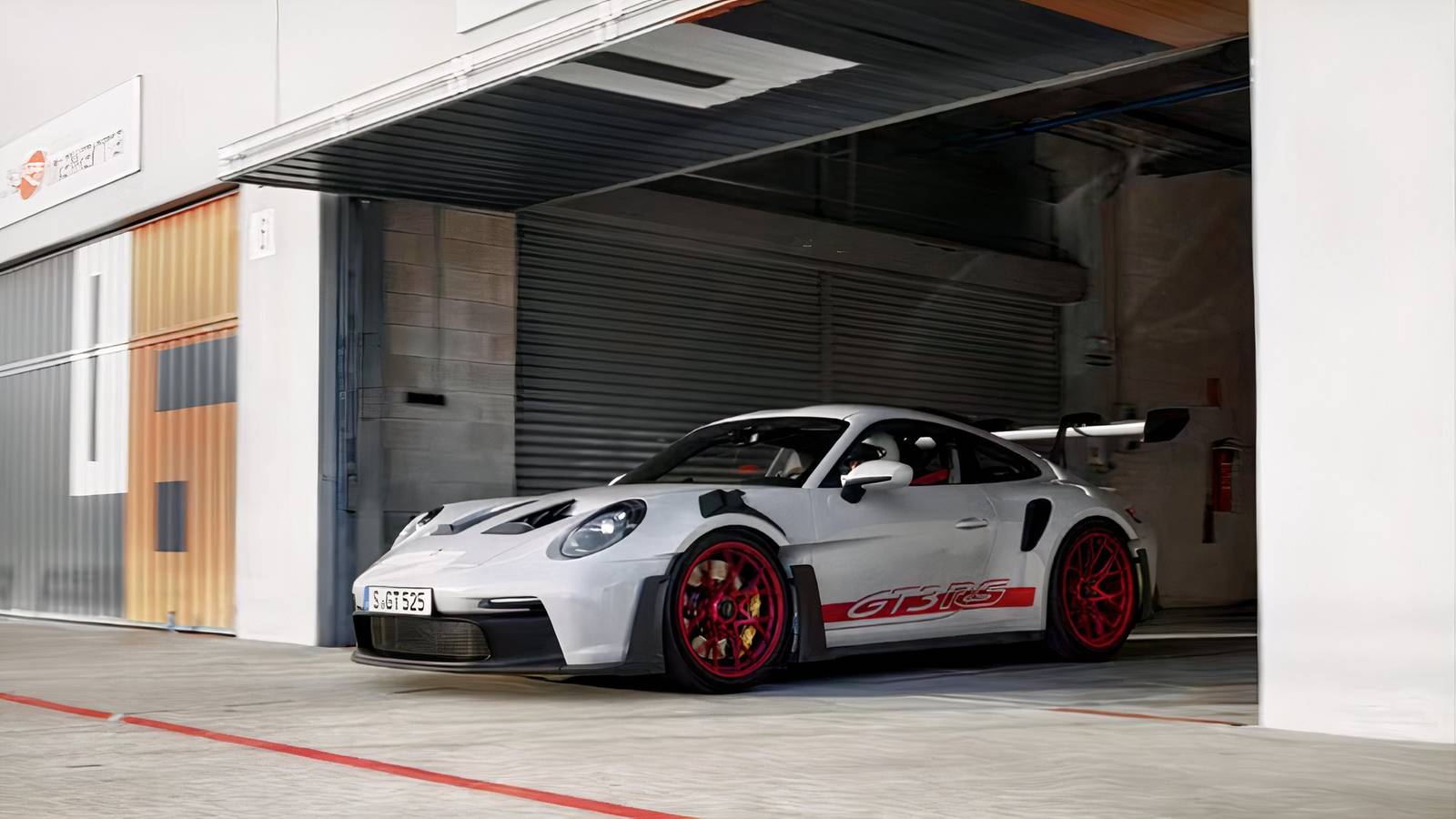
Badges used to be simple. They told you what engine sat under the hood, how many cylinders it had, or where a car fit within a lineup. Over time, though, badges began to mean something more. They evolved into symbols—representing philosophy, purpose, and identity. Today, that meaning is fading. Performance cars are faster than ever, packed with technology, and increasingly shaped by electrification.
But in the process, many have become quieter, more clinical, and less emotionally engaging. Speed is no longer rare. Connection is. And that’s where certain badges still stand apart. While many names have become marketing tools, a select few continue to represent something deeper—something rooted in motorsport, engineering, and intent. Among them, one badge carries a weight few others can match: the Porsche 911 GT3 RS—not because it’s the most powerful car Porsche builds, but because of what it represents.
What The Porsche 911 GT3 RS Badge Actually Means
Breaking Down GT3, RennSport, And Porsche’s Naming Philosophy

The Porsche 911 GT3 RS isn’t just a name—it’s a philosophy condensed into a badge. Each part of that name has a purpose. “GT3” originates from endurance racing. It represents a category where cars are engineered around balance, precision, and driver skill rather than outright horsepower. When Porsche introduced the GT3 road car in 1999, it wasn’t trying to create the fastest 911—it was building the most focused one.

Then there’s “RS,” which stands for “RennSport,” which is German for “racing sport.” In the past, this name was used only for Porsche’s most extreme road cars designed for racing. It means less weight, sharper dynamics, and a willingness to sacrifice comfort for better performance. The GT3 RS badge means something quite specific: it’s a car that can be driven on the road but was made with racing in mind.

It’s not about comfort or luxury. It’s about accuracy, performance, and purpose. The GT3 RS is an amazing piece of equipment. It’s a hardcore Porsche, but Porsche always does things very carefully. There are no unnecessary design elements; it’s all about function over flashiness. But, understanding the badge is only the beginning. The real story is how this philosophy survived when every other manufacturer abandoned it—and why that survival came at such a cost.

5 Porsche Models That Hold Their Value Exceptionally Well
These five Porsche models defy typical depreciation patterns through their combination of performance, desirability, and enduring enthusiast appeal.
How The GT3 RS Became Porsche’s Ultimate Track Weapon
From GT3 Road Car To 992-Generation Engineering Masterpiece

The difference between a GT3 and GT3 RS isn’t just more aggressive—it’s a fundamentally different machine that shares only a name with its sibling. The Porsche 911 GT3 has long been considered one of the purest driver’s cars available. Naturally aspirated, rear-wheel drive, and engineered for precision, it strikes a rare balance between track capability and everyday usability. The GT3 RS takes that formula and pushes it much further.

The latest 992-generation Porsche 911 GT3 RS, introduced for the 2023 model year and continuing into 2024 and 2025, represents the most extreme evolution yet. It is no longer just a sharper GT3—it is a fundamentally different machine. Weight is reduced wherever possible. Aerodynamics are dramatically enhanced. Suspension systems are re-engineered for track dominance. The result is a car that blurs the line between road car and race car more than ever before while remaining road-legal.
Porsche 911 GT3 RS Specifications
|
Engine |
4.0-liter naturally aspirated flat-6 (boxer) |
|
Torque |
342 lb-ft |
|
Horsepower |
518 hp |
|
Transmission |
Rear-wheel drive |
|
Drivetrain |
7-speed PDK automatic (only option) |
What Makes The Porsche GT3 RS So Special
Naturally Aspirated Power, Advanced Aerodynamics, And Race-Derived Tech

At the heart of the GT3 RS is something increasingly rare in modern performance cars: a naturally aspirated engine. The 992-generation model is powered by a 4.0-liter flat-six, producing 518 horsepower and 342 lb-ft of torque. It revs all the way to 9,000 rpm, delivering power that feels linear, immediate, and deeply mechanical. Its sound is also incredible. There’s no turbocharging and no artificial surge—just a precise, naturally aspirated engine that rewards driver input. It accelerates from 0 to 60 mph in around 3.2 seconds and reaches a top speed of approximately 184 mph, but the experience goes far beyond the numbers.

And in a world where hybrids and turbocharging are becoming increasingly common, the GT3 RS isn’t trying to reinvent the wheel. Porsche simply fine-tunes the fundamentals—refining, evolving, and perfecting its formula over time. Through subtle enhancements and meticulous engineering, cars like the GT3 RS become quicker, sharper, and more direct without ever sacrificing that lightweight, connected feel. That’s the brilliance of Porsche. But people often forget about the transmission, which is a key element of the GT3 RS experience. The GT3 RS comes only with Porsche’s seven-speed PDK dual-clutch transmission, unlike many other purist-focused cars of the past. There is no manual option here, and that’s on purpose.

The PDK is incredibly fast, making shifts happen almost instantly, which is something a regular manual couldn’t do. That level of precision is important on the track. It lets the driver focus completely on braking points, cornering lines, and throttle application without distractions. Some purists may miss the manual transmission, but the truth is that the PDK makes the car better. It makes the GT3 RS sharper, faster, and more reliable, which makes it even more of a track-focused car.

Aerodynamics play a crucial role here. The GT3 RS produces serious downforce thanks to its aggressive aero package, which includes a massive rear wing, functional front aero elements, and carefully managed airflow underneath the car.
It even features a Formula 1-inspired Drag Reduction System (DRS), allowing the rear wing to adjust, reducing drag on straights and increasing downforce under braking.

The chassis is just as focused. Rear-wheel steering enhances agility, while track-tuned suspension and adjustable dampers allow you to fine-tune the car to your liking. Every input is translated instantly, making the driving experience feel sharp, direct, and purposeful. Inside, the cabin reflects that same philosophy.

Lightweight materials are key—weight reduction is the name of the game in the GT3 RS. There’s extensive use of Alcántara, along with available carbon bucket seats, all emphasizing function over luxury. The layout is driver-focused, with minimal distractions and a clear emphasis on engagement.

This isn’t an interior designed to impress with flashy tech or comfort—and honestly, that’s part of its charm. It’s designed to connect the driver to the car, providing a pure driving experience that emphasizes control and responsiveness—and that feeling is becoming increasingly rare in today’s market filled with technology-driven vehicles. Modern cars are starting to feel more game-like, but the GT3 RS reminds you what real driving is all about.

Best Of The Best: Greatest Porsche 911 Models Of All Time
Within the 911 lineage, certain models stand out as definitive highlights with milestones that pushed the boundaries of design, technology, and speed.
Where The GT3 RS Stands Against Its Rivals
Track Focus vs. Power vs. Everyday Usability

To really get the GT3 RS, it’s helpful to look at what else is out there in this market. This is because its competitors have quite different ideas about how to improve performance. The 911 Turbo S is different from other cars in Porsche’s lineup. It has a twin-turbocharged engine and all-wheel drive, so it goes fast all the time and is easy to use every day. It’s faster in a straight line and is much more comfortable, but it lacks the raw, naturally aspirated feel and the razor-sharp concentration of the GT3 RS.

The basic 911 GT3 aligns more closely with the primary principle. It has the same naturally aspirated feel and driver-focused design, but it’s much easier to operate every day. In a perfect world, you would have both: one for the week and one for the weekend. The battle gets much more exciting beyond Porsche.

The McLaren 765LT and Ferrari 296 GTB, on the other hand, have a lot more power. They use turbocharging and hybrid assistance to get amazing performance numbers. On paper, they’re speedier and generally more spectacular in their delivery.

Then there are cars like the Lamborghini Huracán STJ that, like the GT3 RS, are very track-focused and have naturally aspirated performance. But they have a much more dramatic and aggressive personality. That’s where the GT3 RS stands out.

It doesn’t chase numbers, and it doesn’t depend on showiness. Instead, it concentrates on accuracy, consistency, and connecting with the driver. While other cars feel explosive and overwhelming, the GT3 RS feels deliberate. In many ways, Porsche sells much more than just a car—a sense of desirability based on discipline and refinement. Their performance models have a subtle confidence about them that makes people admire them. Porsche stays focused while others go loud and showy, and that’s what makes it so great.
Why The GT3 RS Is More Than Just A Price Tag
Understanding GT3 RS Price, Exclusivity, And Long-Term Value

The cost of entry into the 911 GT3 RS is undeniably high. The latest model starts at $241,300, and with options like the Weissach Package — which adds extensive carbon fiber components and further weight reduction — that figure can climb well past $270,000. That said, Porsche’s GT models, particularly the GT3 and GT3 RS, are known for holding their value exceptionally well. Demand consistently outstrips supply, often leading to dealer markups, meaning many buyers end up paying significantly above the original list price.

But the GT3 RS isn’t just expensive — it’s exclusive. Production numbers are limited, and securing an allocation isn’t always straightforward. In many cases, it’s not just about having the money but also your relationship with the brand and dealership. That exclusivity only strengthens its long-term appeal. As a result, GT3 RS models tend to retain their value better than many other high-performance cars, with certain examples even appreciating over time, depending on specification and condition. In the end, owning one is about more than just the price tag. It connects you to a legacy of precision engineering—a lineage of performance refined and perfected over decades.

The Most Powerful Naturally Aspirated Flat-Six Ever Put In A Production Car
This venerated manufacturer is known for its high-performance six-cylinder sports cars, and one of them has the most powerful N/A six in the game.
Why The GT3 RS Badge Still Matters Today
Emotion, Engineering, And A Dying Philosophy

The automotive landscape is changing rapidly. Electrification is redefining performance, and technology is reshaping how cars behave. Speed is becoming easier to achieve, but the sense of connection is becoming harder to find. The GT3 RS represents a different philosophy. It prioritizes driver engagement over convenience, mechanical feedback over digital assistance, and emotion over clinical perfection. It is not designed to be the most comfortable or the most practical car. Instead, it is designed to deliver a specific kind of experience.

The sound of a naturally aspirated engine climbing toward 9,000 rpm, the precision of its steering, and the way it responds to every input all contribute to a driving experience that feels immediate and engaging. That’s what makes it significant. In a world moving toward quieter, more efficient vehicles, the GT3 RS stands as a reminder of what performance once meant and what it can still be. It remains a machine built not just to perform, but to connect.
Sources: Porsche, Car And Driver, Edmunds