
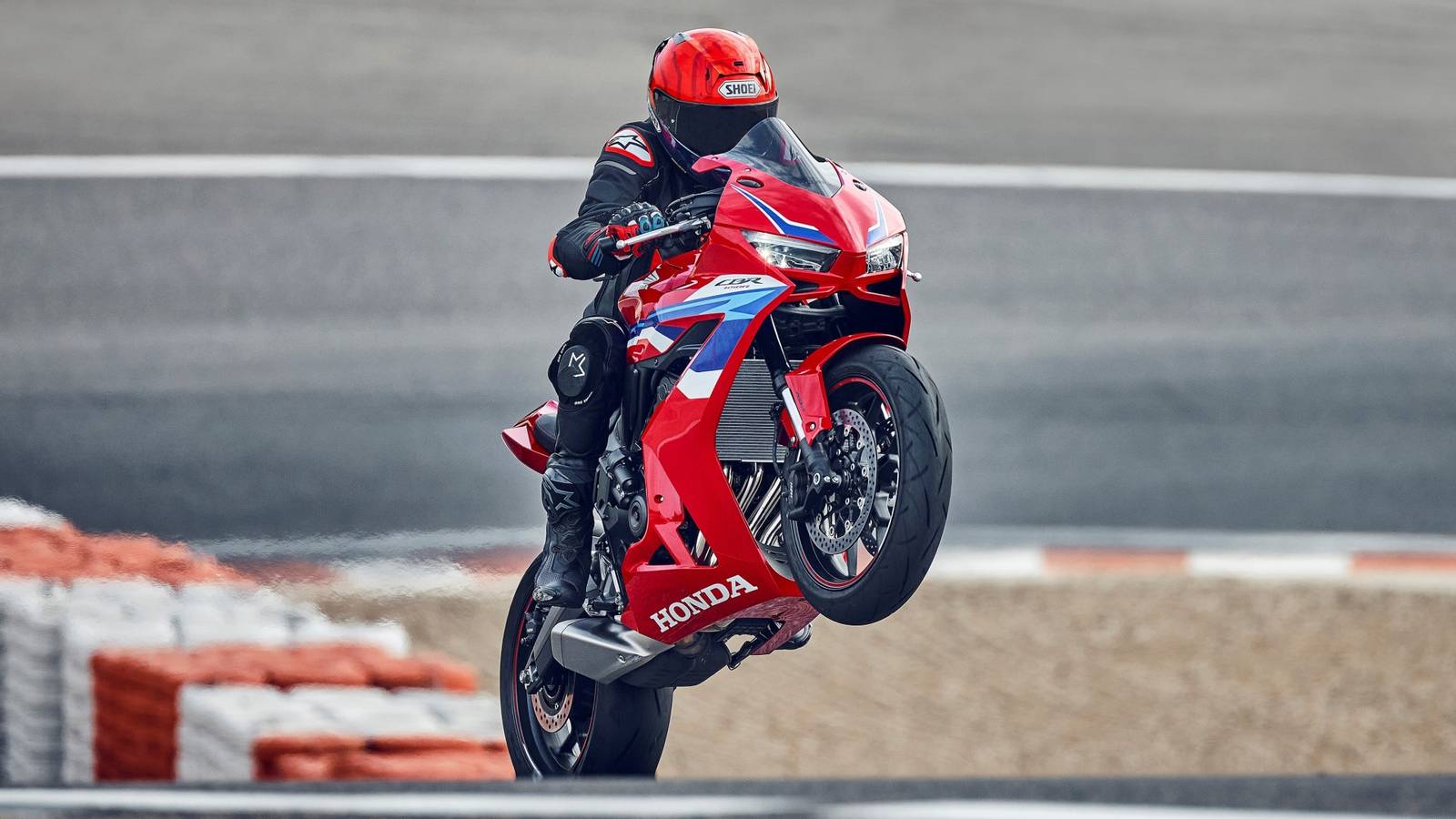
For the longest time, sports bikes have been focusing on introducing new technologies, cutting down tenths around a lap, and eking out maximum horsepower. In the past few years, however, there has been a serious shift in this category. Most consumers no longer want track-specific superbikes, but instead crave versatility and usability. We don’t blame you, either.
These are street bikes at the end of the day, and if they don’t do track days, you’re technically putting your back and arms through all that stress for no reason. If you believe in this idea and think sports bikes should make sense beyond the track, you’ll be glad to know there’s no shortage of such machines today. Out of these, there’s one that makes the most sense, and it comes from arguably the most sensible bikemaker today.

The Most Aggressive-Looking Japanese Sports Bike In 2025
Honda’s flagship CBR trumps all of its Japanese rivals to look the part in 2025
The Honda CBR650R Is The Sports Bike That Makes Sense Beyond The Racetrack

Our pick here is the Honda CBR650R. Yes, we know it’s one of the quieter bikes in the competitive middleweight segment. But don’t forget, the focus here is on doing things beyond the racetrack. This is where the CBR truly shines, while giving you a proper inline-four sports bike experience.
It has a pleasing exhaust note, good road presence, and you can reach high speeds on it as well. All this while, the do-it-all nature is really prominent, as you sit in an upright riding posture (by sports bike standards) without any pain points.

Making matters sweeter, there’s the new-for-2025 E-Clutch technology. That helps omit the physical clutch usage entirely. Yes, not even as you roll away from a standstill. No other bike in the segment can manage that as of now. Last but not least, the CBR650R sells for under $10,000. So it’s accessible for most of us middle-class folks as well.

What else offers a similar experience, you ask? Well, the Kawasaki Ninja 650 comes close. It is a really simple sports bike built to do everything well outside of the racetrack. However, this is rather inferior to the CBR in terms of power, design, and features. Kawasaki has also been quite lazy in giving the 650 regular updates.
The Suzuki GSX-8R is another brilliant alternative. It has one of the highest torque figures in the segment, meaning oodles of usability. At the same time, the overall package is comparable, if not more premium than the Honda. But we feel the E-Clutch and inline-four mill give the CBR a minor edge.
A Stress-Free Transmission Makes The Honda CBR650R Highly Practical

The stress of feathering the clutch is real, regardless of whether you’re in the city or on the racetrack. Honda’s new tech focuses on making life easier for you in this respect. This is like a souped-up version of a quickshifter-blipper combo. That means you can shift up or down the six-speed transmission without the clutch.
But as a bonus, you don’t even need to use the clutch while moving from a standstill. The result is a really practical sports bike for life beyond the track. Oh, and in case you want to do things traditionally, there is still a physical clutch lever present.
In Honda’s words, “In situations where the driving force changes, such as starting, shifting, and stopping, electronic control technology provides instantaneous, fine-tuned optimum clutch control, enabling smooth starting/shifting/stopping without the need for the rider to operate the clutch lever.”

10 Budget Sports Bikes That Combine Style, Simplicity, And Comfort
All of these sports bikes cost under $10,000 but don’t compromise on style or comfort
A 649cc Inline-Four Engine Powers The CBR650R

While the E-Clutch helps the CBR stand out, its engine is quite a feat, too. That’s because there is currently no other inline-four middleweight sports bike on sale. As for numbers, the 649cc inline-four mill operates at a mildly spicy 11.6:1 compression ratio to produce 94 horsepower and 46.5 pound-feet. Both figures kick in surprisingly low for an inline-four bike, which shows its focus on tractability rather than top-end grunt. You can still manage a top speed of over 155 miles per hour.
Simple Underpinnings Reiterate The CBR650R’s Focus on Life Beyond Track

Like the engine, the CBR650R keeps things simple here, too. So you get Showa separate function forks up top, along with a Showa monoshock at the back. Only the rear is adjustable, and we think front-end adjustability is a serious miss on Honda’s part. The suspension works in tandem with 17-inch cast alloy wheels, where the front houses dual 310 mm rotors and the rear has a 240 mm disc. Nissin calipers bite all three. The protagonist, meanwhile, is a steel diamond chassis.
A High Curb Weight Might Make Life Difficult, Though

Extra cylinders often mean extra weight, and that’s quite evident here. The CBR650R weighs 466 pounds fully fueled, which is quite high by middleweight sports bike standards. That means it certainly won’t be the easiest to live with in tight traffic situations. What will help, though, is the rather low sub-32-inch saddle height.
You Get All The Necessary Features On The Honda CBR650R

For the longest time, the CBR650R had been one of the most basic bikes in its class. In 2025, though, it’s gotten more modern. You get a TFT instrument cluster with different display modes and smartphone connectivity as standard. There’s also traction control, dual-channel ABS, and the E-clutch we mentioned above. We don’t think you need anything else on a motorcycle of this caliber, although a six-axis IMU would’ve been a nice touch.


Here’s Why Buying This Japanese Sports Bike In 2025 Is A Smart Decision
This Honda model makes the most sense if you’re looking for a middleweight sports bike to daily
The features are joined by an updated design. It’s a more pleasing aesthetic in our books, thanks to the more minimalistic lines. Yet, the characteristic Honda vibe remains present, enhanced by the HRC triple-tone livery. Speaking of liveries, there’s just one option, even though the international market has a matte black option.