
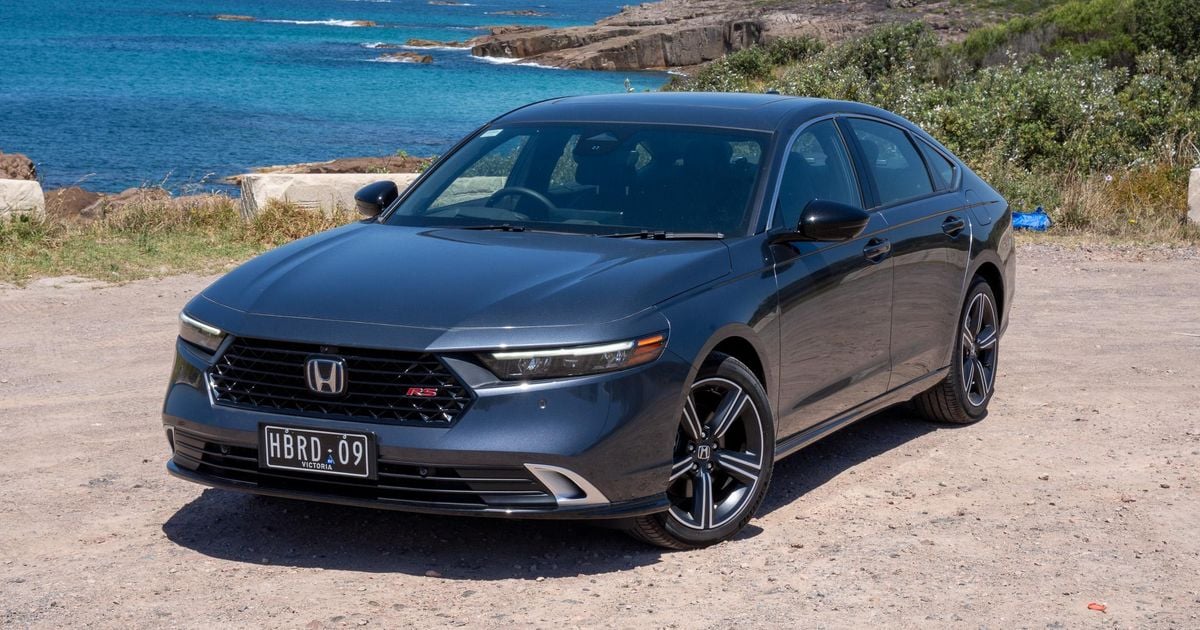
Traditional sedans are on the edge of extinction.
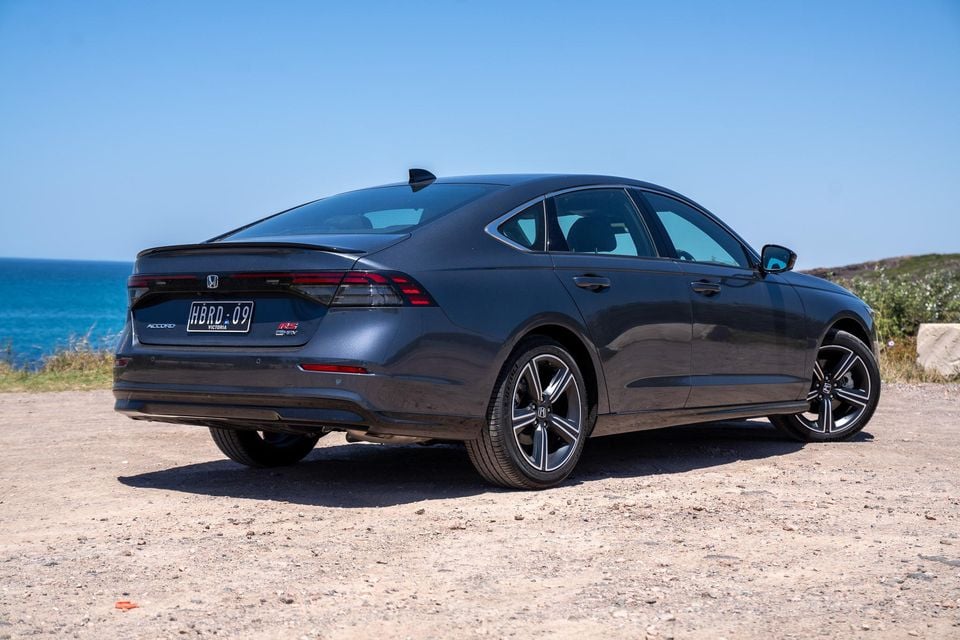
The mid-size four-door was once a staple of suburban driveways, but its popularity – and the proliferation of models available – has been eroded by the shifting sands created by the introduction of the modern SUV.
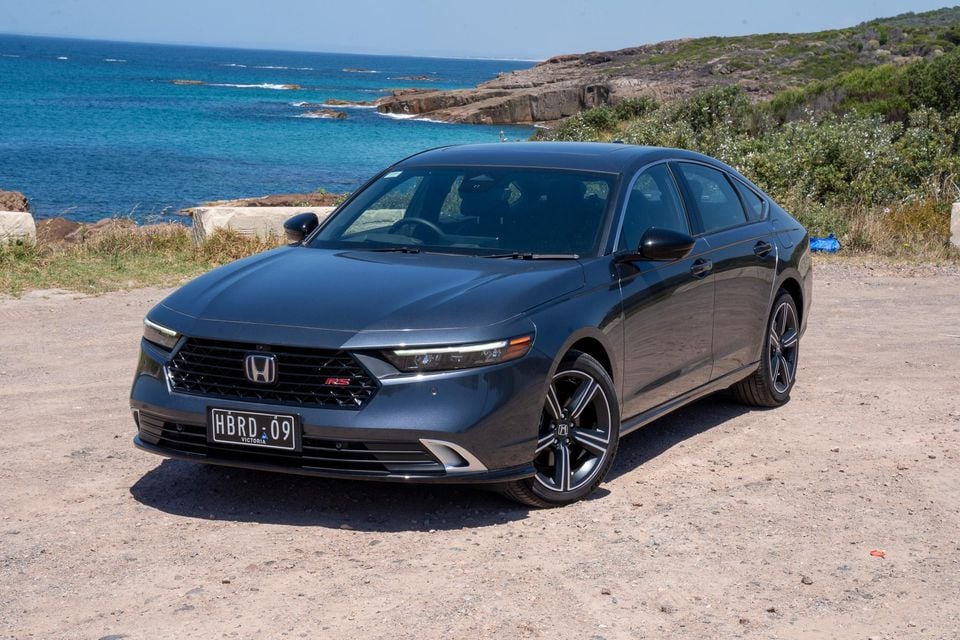
Sure, the sedan is a little better protected at the top-end of town, but there are only a precious few remaining below the luxury threshold, like the Honda Accord e:HEV RS which has recently joined our long-term fleet.
We’ll be spending a considerable amount of time behind the wheel of the latest 10th-generation version over the next couple of months to see if the sedan still stacks up as everyday family transport, or whether it has found shelter in a different environment.
Until then, let’s take a look at it on face value and see what sort of first impression it makes.
How much does the Honda Accord e:HEV RS cost?
Honda only offers a single variant of the current Accord sedan – the fully loaded e:HEV RS that costs $64,900 drive-away.
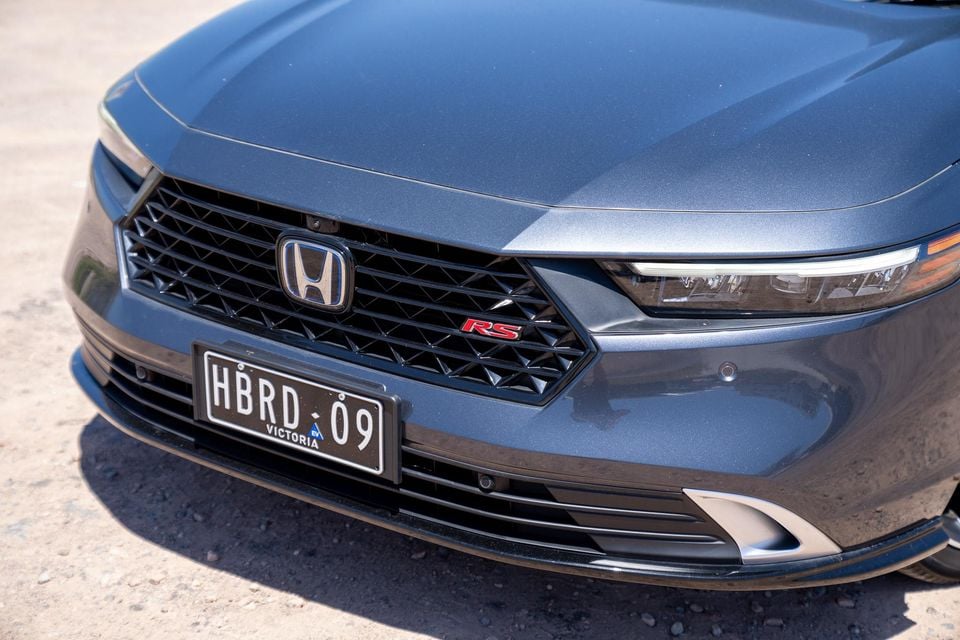
That positions it in interesting territory, between its long-time rival in the Toyota Camry and a fleet of entry-level European luxury sedans such as the BMW 3 Series, Mercedes-Benz C-Class and Audi A5.
And then there’s a whole bunch of other options like the electric Tesla Model 3, BYD Seal, Polestar 2 and MG IM5, and the Hyundai Sonata and new MG7, plus even the entry-level Lexus ES which is also cheaper than the Accord.
On sticker price alone, Honda’s hybrid sedan presents us with a dilemma: is it too expensive as a regular family sedan, or is it too cheap to be considered a genuine alternative to the established luxury models? Let’s find out…
To see how the Honda Accord stacks up against its rivals, use our comparison tool
Let us help you find your new car
Buy your new car without the stress. It’s fast, simple and completely free.

Great service from Travis and team, second time I have used this business would not hesitate to recommend them to anyone
Craig C.
Purchased a Ford Ranger in Sunshine Coast, QLD
CarExpert helped Craig save thousands on his Ford Ranger, now let us save you on your next new car.
What is the Honda Accord e:HEV RS like on the inside?
First impressions are that the Honda Accord’s cabin is a very nice place to spend a lot of time in.
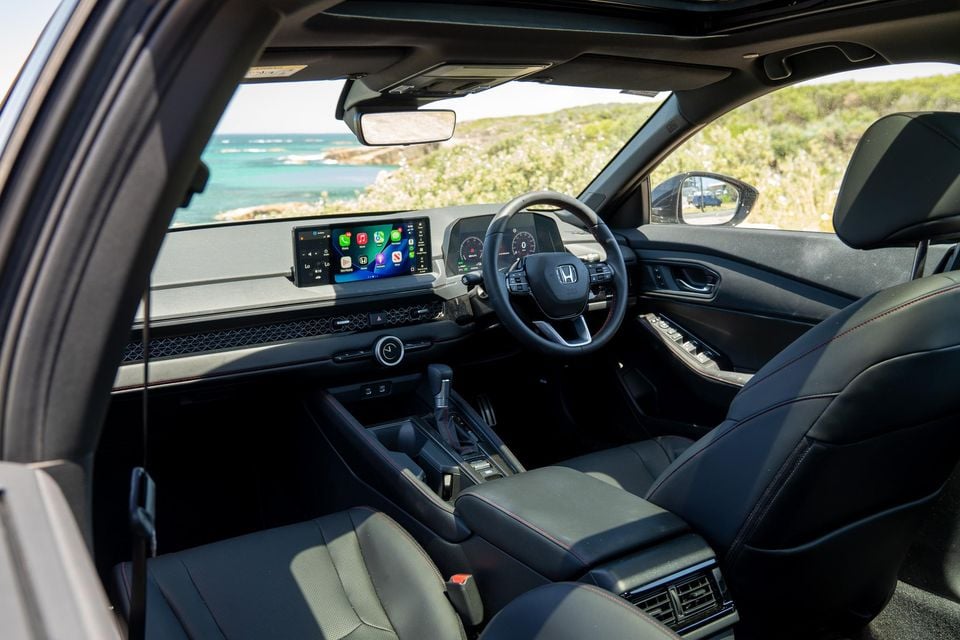
It’s not overly flashy or modern in its overall design, with a rather conventional T-shaped layout to the dashboard which features the infotainment touchscreen and digital instrument cluster protruding from the horizontal top section, while a conventional gear shifter sits alongside cupholders, as well as a storage tray and lidded bin, in the centre console.
But there are some nice and unique touches, such as the honeycomb section in the centre with flat toggles to change the direction of air flow from the ventilation system, and the oversized digital (yet analogue) clock dial that stands out in the centre.
And all of the high-quality materials and tactile surfaces feel extremely well screwed together.
The front seats are comfortable and supportive, and offer plenty of adjustment to suit a myriad of drivers, who get excellent vision all around.
There’s enough room across the back seat for three, with plenty of legroom for outboard passengers, plus twin air vents, two USB-C power outlets, and retractable sun blinds for each window. But the transmission tunnel in the centre does limit the middle seat to small kids.
The black interior colour palette does make the cabin heat up quickly in the summer sun, but it is offset by a subtle splash of colour with red stitching in the seats, chrome trim highlights and a multi-colour ambient lighting strip that runs through the dash and into the door cards.
And the large panoramic sunroof bathes the cabin with light to amplify the sense of space.
With 570 litres of cargo-carrying capacity in the boot, the Accord has as much room for luggage as many large SUVs, which we will put to the test during our time with the car.
To see how the Honda Accord stacks up against its rivals, use our comparison tool
What’s under the bonnet?
The Honda Accord has a 2.0-litre naturally aspirated four-cylinder engine paired with a continuously variable automatic transmission (CVT) that drives the front wheels and incorporates two electric motors.
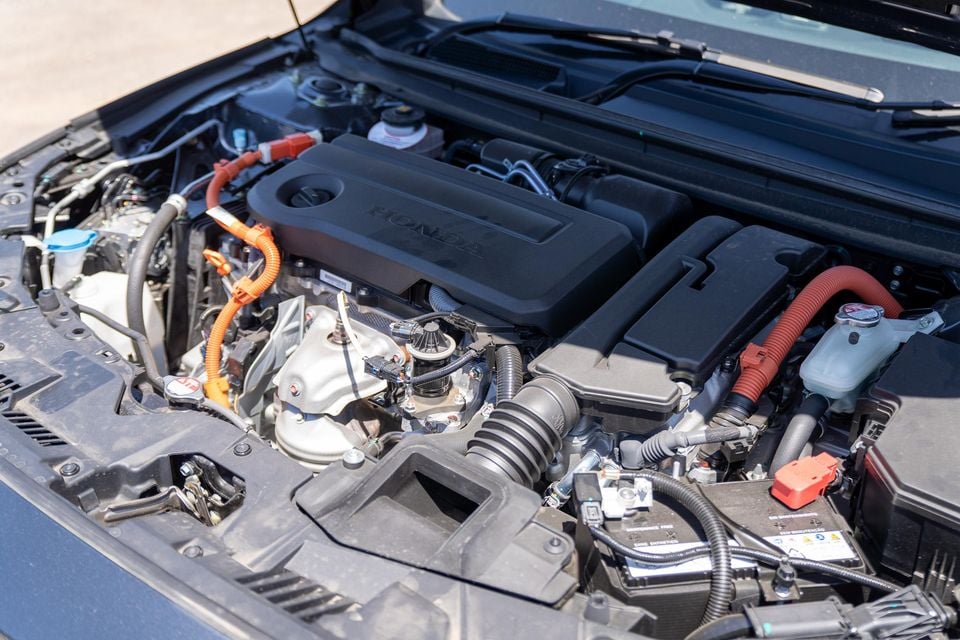
The primary motor delivers enough power to drive the vehicle at slow speeds and assists the engine under acceleration, while the secondary unit acts predominantly as a generator to ensure the 1.06kWh lithium-ion battery pack retains enough charge to be used at any time. But uniquely, it can combine both e-motors for maximum thrust when called upon.
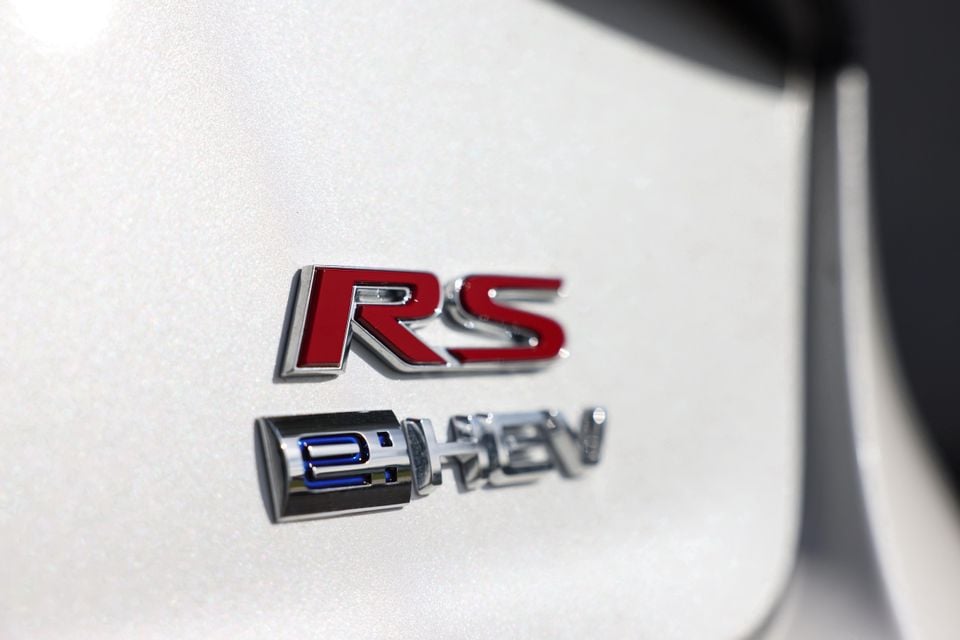
Honda doesn’t quote separate power outputs for the individual components, but claims the entire system produces a combined 135kW of power and 335Nm of torque, which doesn’t sound terribly exciting or powerful enough to justify its (presumably) sporting RS badge.
| Specifications | Honda Accord RS Hybrid |
|---|---|
| Engine | 2.0L 4-cyl petrol |
| Engine outputs | N/A |
| Electric motor outputs | N/A |
| System outputs | 135kW / 335Nm |
| Battery | 1.06kWh |
| Transmission | e-CVT |
| Drive type | Front-wheel drive |
| Weight | 1609kg |
| 0-100km/h (claimed) | N/A |
| Fuel economy (claimed) | 4.3L/100km |
| Fuel economy (as tested) | 4.7L/100km |
| Fuel tank capacity | 48L |
| Fuel requirement | 91-octane standard unleaded |
| CO2 emissions | 98g/km |
| Braked tow capacity | N/A |
However, it is designed primarily to reduce fuel consumption rather than induce eye-popping performance. And, in that regard, it does an admirable job with a claimed average figure of 4.3L/100km.
After its first week in our long-term garage, in which it covered a few hundred kilometres including a decent two-hour stretch on the freeway, the Accord is currently averaging 4.7L/100km.
Interestingly, Honda says the Accord only consumes an average of 2.4L/100km in urban driving conditions, which is where it will spend most of its time during our testing period. So we’ll see how much of a fuel-miser it can be around town.
To see how the Honda Accord stacks up against its rivals, use our comparison tool
How does the Honda Accord e:HEV RS drive?
Even in an age of AI-generated animations, it’s still easy to recognise a real photo, video or song, right?
Sure, some of the AI stuff is close enough to the real thing that it requires a laser-sharp focus to spot the distorted reality, but real-life excellence is more instantly obvious.
I’m saying that because there’s a similar theme happening with mainstream family SUVs; they’re becoming homogenous devices littered with flaws and compromised by their very nature, but they’re forgiven due to either their price, space or promise of high-tech conveniences. Many are like an AI-generated photo of someone with a sixth finger: a subtle but annoying fault.
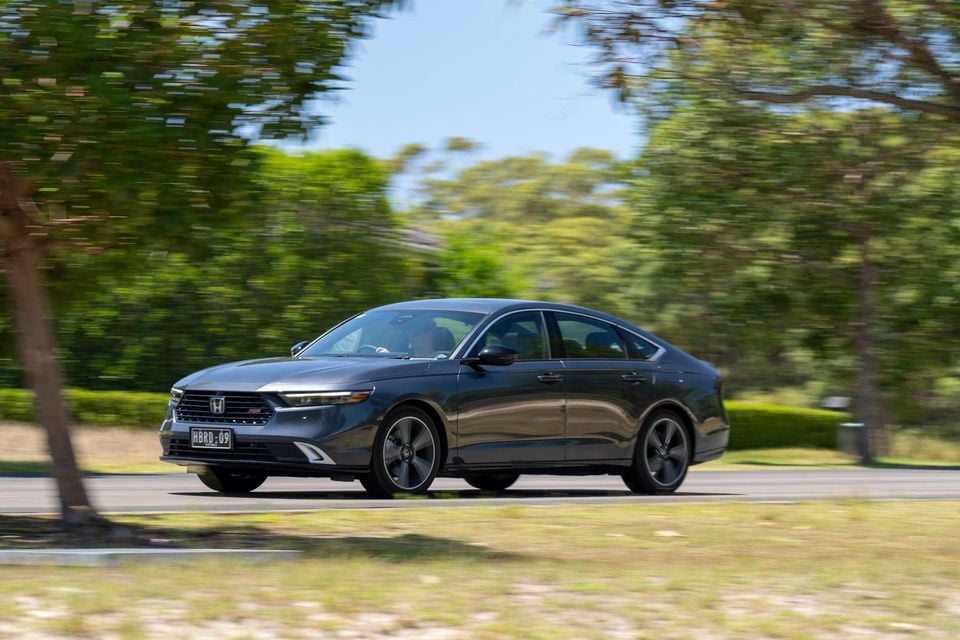
Okay, as a low-slung five-seat sedan, the Honda Accord might not suit every family’s needs – especially those with more than two or three small kids – but in terms of how it drives, it is a reminder of what great automotive engineering should be.
All the fundamental elements – steering, ride quality, handling, NVH and performance – are absolutely spot-on for this type of car. And it doesn’t pretend to be anything it’s not.
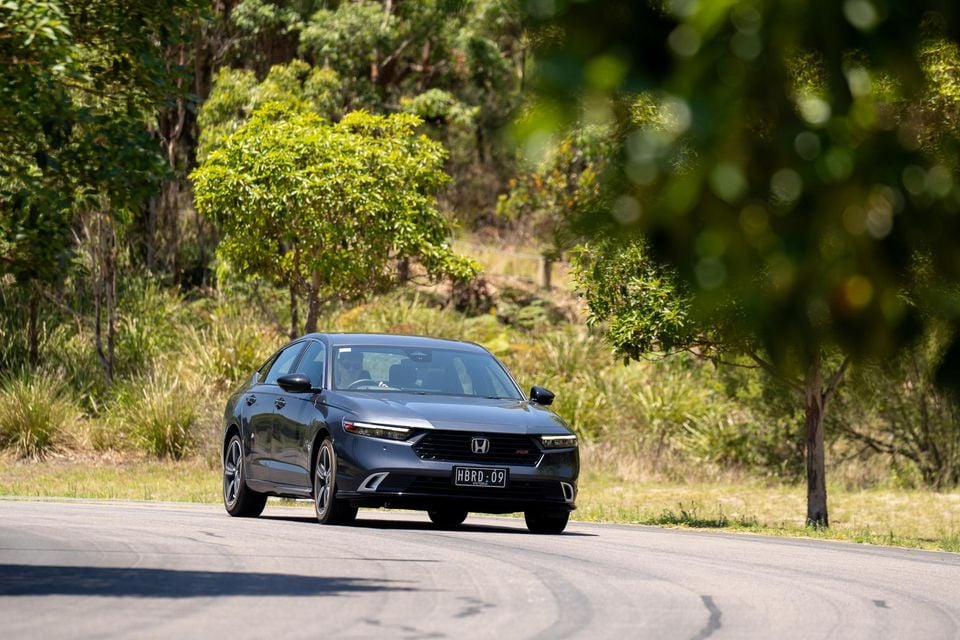
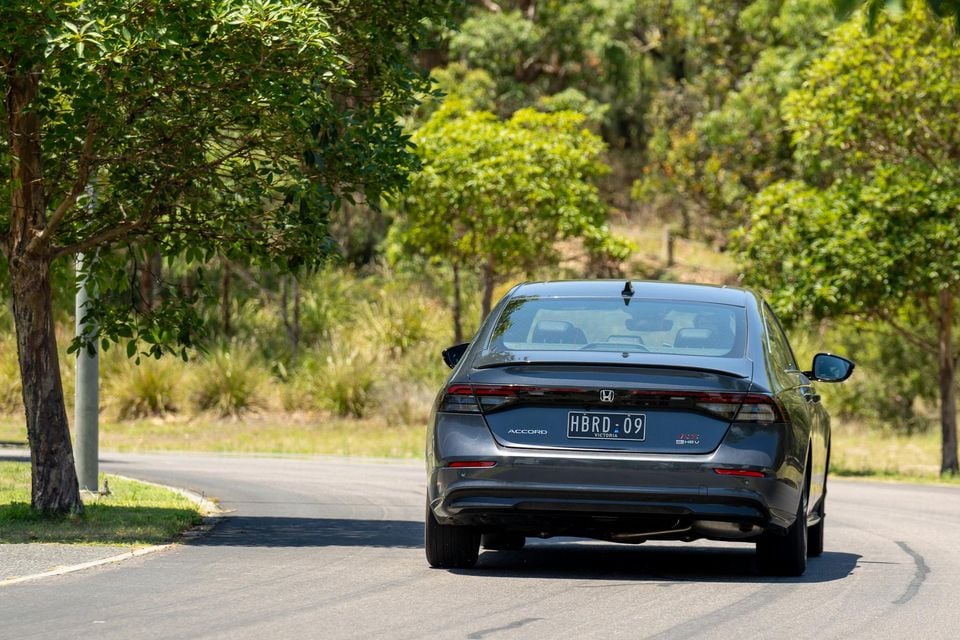
The hybrid powertrain, for starters, is seamless in the way it uses the electric motors at low speeds, providing smooth and effortless acceleration away from a standstill before the petrol motor chimes in totally unobtrusively.
There’s no obvious vibration or sudden noise when it starts up, like with some other hybrids, and it’s so quiet and refined at cruising speeds that you hardly know it’s operating.
That is partly helped by the Active Noise Cancelling technology in the audio system, which also wipes out wind and road noise from the cabin to further add to the sense of refinement.
The suspension setup – with MacPherson front struts and a multi-link rear-end – doesn’t have any tricky electronic dampers to change its character from comfort to sporty. Instead, it’s just beautifully tuned so that it can be both, depending on how you drive it.
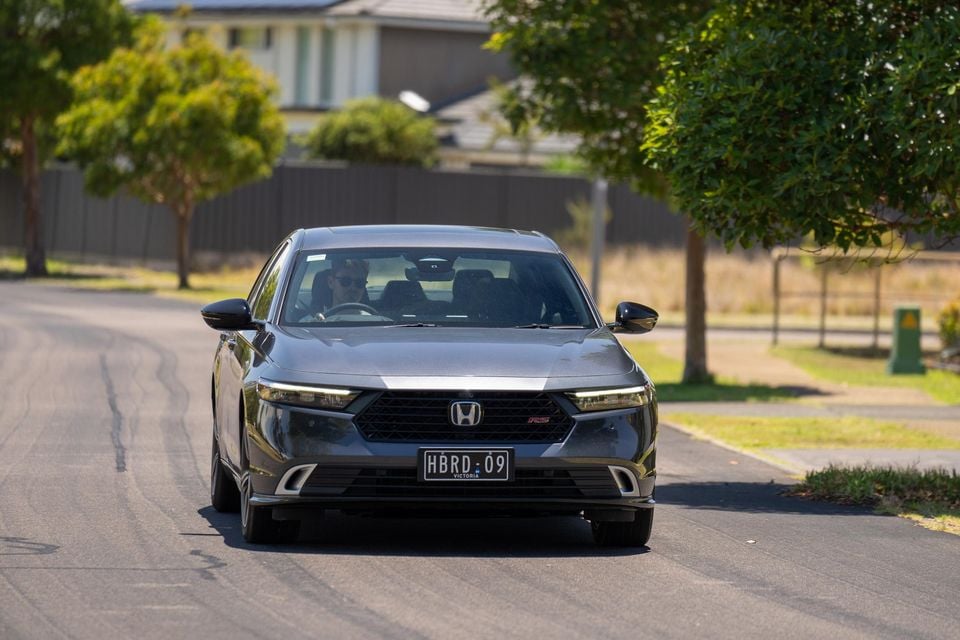
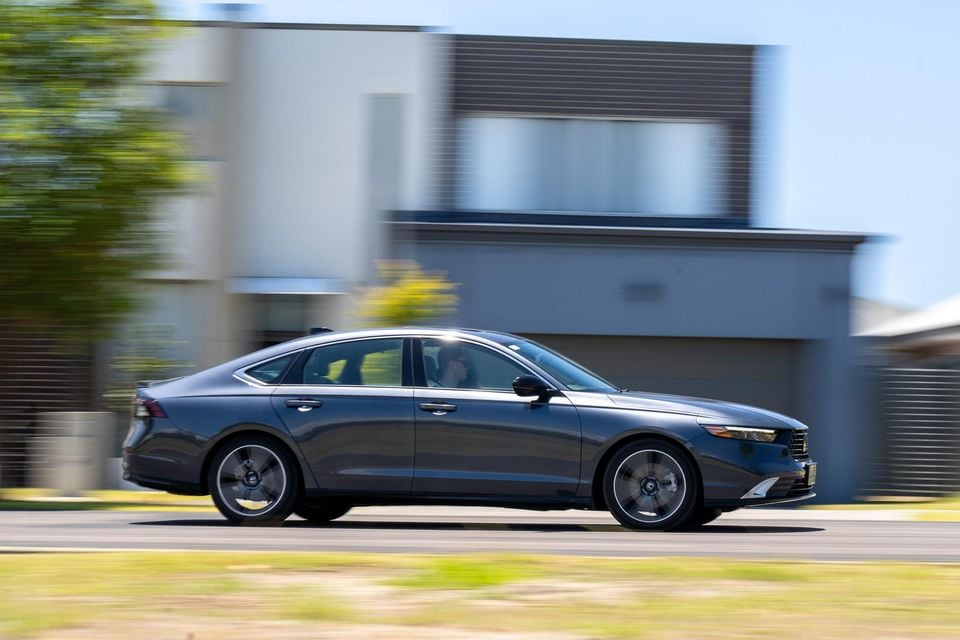
Sure, it’s biased more towards soaking up bumps than launching off ripple strips at the racetrack, but it is surprisingly well-balanced – and even a little bit fun – to punt along a twisty country back-road. And it feels much more like a proper car than an elephant on roller skates, like some SUVs do especially on a wet road.
But the biggest thing that makes the Accord stand out – and showcases Honda’s engineering nous – is how well calibrated its suite of safety systems are.
This myriad of modern functions like lane keeping assistance, driver attention monitoring and forward collision warning can be so overzealous that they become annoying enough for owners to automatically de-activate them before they start driving, which is totally contradictory to having them in the first place.
Honda, on the other hand, has clearly spent considerable time and effort to tune them properly so that they intervene only when required and in such a way that you appreciate the car has them – not the other way around. So far, we haven’t found the need to switch off any safety function, which is rare these days.
To see how the Honda Accord stacks up against its rivals, use our comparison tool
What do you get?
As you’d expect for the price, and being available only in a single specification, the Accord comes loaded with a decent list of standard equipment.
2025 Honda Accord e:HEV RS equipment highlights:
- 18-inch alloy wheels
- LED headlights
- Keyless entry with push-button start
- Dual-zone climate control with rear vents
- Power windows
- Panoramic sunroof
- Synthetic leather interior trim
- Power-adjustable front seats
- LED ambient interior lighting
- 10.2-inch digital instrument cluster
- Head-up display
- 12.3-inch infotainment touchscreen
- Bluetooth connectivity
- DAB+ digital radio
- Wireless Apple CarPlay and Android Auto
- Built-in Google functions including Maps, Assistant and Play Store
- Over-the-air system updates
- 12-speaker Bose audio system with active noise cancelling
But there is one notable omission as the Accord misses out on heated and/or ventilated front seats, which we’ve already noticed makes it uncomfortable on a hot summer’s day because the black-trimmed seats absorb so much heat.
To see how the Honda Accord stacks up against its rivals, use our comparison tool
Is the Honda Accord e:HEV RS safe?
The current Honda Accord has yet to be tested by ANCAP despite the fact it has been on sale in Australia for a couple of years now.
But it does come fitted with all of the latest safety systems under the banner of Honda Sensing Technology, which would likely see it score a maximum five-star rating, including:
- Autonomous emergency braking
- Forward collision warning
- Lane keeping assistance
- Traffic jam assist
- Adaptive cruise control
- Speed sign recognition
- Driver attention monitoring
- Tyre pressure monitoring
- Adaptive high-beam headlights
- Front and rear parking sensors
- Rear cross-traffic alert
- 360-degree parking display
- Eight airbags
It also features the latest Honda Connect telematics and smartphone app, which (when connected) automatically calls a customer service representative in the event of a collision and will alert emergency services, providing the exact location of the vehicle, if the owner doesn’t respond to a call, or asks for assistance.
To see how the Honda Accord stacks up against its rivals, use our comparison tool
How much does the Honda Accord e:HEV RS cost to run?
The Accord is covered by Honda’s five-year, unlimited-kilometre warranty with free roadside assistance.
The battery pack and electric motors are guaranteed for eight years. Beyond that, it is extremely affordable to maintain, with the first five visits capped at just $199 each, and maintenance required every 12 months or 10,000km.
To see how the Honda Accord stacks up against its rivals, use our comparison tool
CarExpert’s Take on the Honda Accord e:HEV RS
Our first impressions living with the Honda Accord are extremely positive.
From expert reviews to the right deal
CarExpert brings reviews, research tools and trusted buying support together, guiding you from research to delivery with confidence.
It is a reminder of what a great car company can do when it focuses on quality and refinement more than bling or box-ticking. It’s a brilliant, unpretentious car that is quiet, comfortable, efficient and spacious.
If anything, the calibration of its safety systems highlights Honda’s commitment to top-notch engineering and exemplifies how good the Accord is at everything else, but the hybrid-only RS sedan does come with a premium price tag.
While that shouldn’t be the only consideration when buying a new car, it leaves us asking whether there is more Honda should do to justify the Accord’s market position, which we will explore over the next month or so as part of our long-term test.
To see how the Honda Accord stacks up against its rivals, use our comparison tool
Click the images for the full gallery