
Yamaha is an old, storied, and well known motorcycle manufacturer. It might not be as large as Kawasaki or Honda, but it holds its own, with a long and checkered history in motorsport. Yamaha motorcycles are known for their handling prowess, and fun-to-ride factor, while still offering left-brain satisfaction with reliability and low ownership costs.
Finding the motorcycle that perfectly captures Yamaha’s DNA is not an easy task, because its entire range could fit the bill. There are retro examples like the Bolt R-Spec, which is a cruiser that offers old-school fun with modern reliability. There’s the YZF-R1M, which is a tech fest that only a select few will be able to exploit to the fullest. Models like the YZF-R9 and Tenere 700 fall somewhere in the middle, offering a combination of technology and fun that keeps its feet firmly on the ground. There is one particular bike that combines all of Yamaha’s traits exceedingly well in a single package, though.
The Yamaha XSR900 Is The Motorcycle That Perfectly Captures Yamaha’s DNA

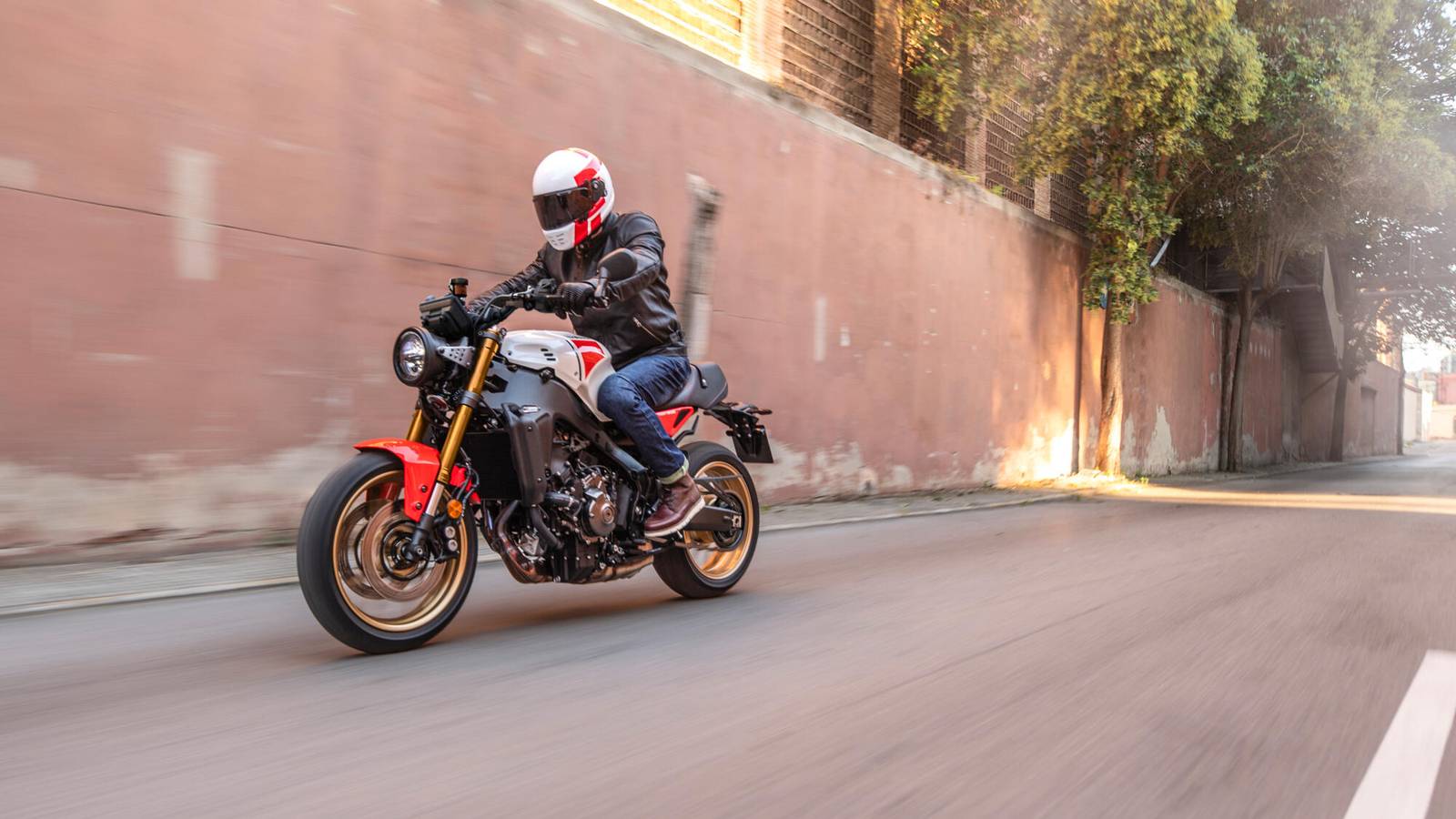
Yamaha’s XSR series of motorcycles covers a wide range of displacements, beginning with 125 cc in European markets, and the biggest one of them all is the XSR900. It has all the right proportions, has the right (Yamaha anniversary) colors, and the chassis and driveline have been a fan favorite for a long time. Because of its eagerness and ability to put a wide smile on your face, coupled with its stress-free ownership experience, the XSR900 is the motorcycle that perfectly captures Yamaha’s DNA.

The neo-retro middleweight naked bike segment is considerably larger than you’d think it is, with a wide range of products available at different price points. The XSR900 sits smack in the middle of it with a price of $10,599, but it delivers value on that price as well.
Three Cylinders Ensure A Lot Of Fun

The XSR900 is powered by a very familiar engine. This mill is not just fun, but incredibly versatile. It debuted well over a decade ago, and it hasn’t needed change since then. However, Yamaha has plonked into a touring motorcycle and a sport bike, and they are just as much fun as the MT-09.
This 890 cc engine puts out 117 horsepower at 10,000 RPM and 68.6 pound-feet at 7,000 RPM, but the real story is how strong it is at any revs and in any gear. The value of the odd firing order has since been proven, with others following in Yamaha’s footsteps. A six-speed manual gearbox with an assist and slipper clutch is present, and a third-generation quickshifter that will upshift or downshift with the throttle open or closed is present as well.

10 Modern Classics That Marry Vintage Looks With Modern Reliability
From café racers to cruisers, these modern classics deliver old-school aesthetics with the confidence of today’s tech and performance.
The Same Underpinnings As The MT-09

The XSR900 is the MT-09 with different styling, and that’s no bad thing. The chassis, therefore, is a die-cast aluminum frame, but it is unique in that it is two halves (the right and left halves) bolted together. A standard box-section swingarm made from aluminum joins hands with the chassis. On the suspension front, the 41 mm KYB inverted forks have adjustable preload, compression, and rebound, while the rear shock has adjustable preload and rebound damping. Travel available is 5.1 inches at the front and 5.4 inches at the rear.
Lastly, the brakes consist of twin 298 mm discs at the front paired with radial four piston fixed calipers and a Brembo radial master cylinder as well, while at the rear, a 245 mm disc has a surprisingly performance-focused two piston fixed caliper. 17 inch spinforged alloy wheels and tubeless tires are present.
Compact Dimensions And Low Weight

The XSR900 is midweight-sized, with an overall length of 84.8 inches and a width of almost 40 inches. Its wheelbase is under 59 inches, which is part of what makes it so nimble. Ground clearance is a good 5.5 inches, and the fuel tank is slightly small at 3.7 gallons. However, that is perfectly alright for a city bike, especially since Yamaha claims 49 MPG from this XSR. With the tank full, it weighs 425 pounds wet, which is on par with the competition regardless of cylinders.
Definitely A Modern Set Of Features Here

The XSR900 might look gloriously retro, but Yamaha took a logical call and gave it a 5-inch TFT display, a six-axis IMU, and a by-wire throttle. That means it gets ride modes, cornering traction control, cornering ABS, slide control (three levels), selectable wheelie control, and a back-slip regulator to prevent the rear wheel from locking under aggressive downshifting.
There is cruise control as well, and it can be enabled from 25 MPH onward in third gear and up. Bluetooth is present, as is navigation via Garmin StreetCross. Self-canceling indicators with a lane-change feature are standard. It is a crying shame that the ‘Racer’ aftermarket OEM kit that converts the XSR into an old-timey racer isn’t available in the US market officially, because it elevates the design so much.

10 Retro Motorcycles That Combine Old-School Charm With New-School Handling
These bikes make you feel like you’ve time travelled, but only to the good times!
Yamaha XSR900 Competition

Someone shopping for one of these is in for a treat. Or a lot of confusion. Each competitor brings its own style of engine to the party. There are 270-degree parallel twins, a 90-degree V-twin, a boxer twin, inline threes with both even and odd firing orders, and an inline four available in the segment. Let’s start with the most affordable one, the Triumph Trident 800 ($9,995). It is a good-looking motorcycle with a good feature set, but Triumph continues to use the strange LCD/TFT instrument cluster, the TFT component of which is very small compared to the others.

Another manufacturer that does this better is Suzuki and its GSX-8T ($10,649). This gets a proper rectangular TFT display as the XSR does. However, it is significantly heavier than the Yamaha, and the performance is more suited to a lower class of vehicle. Next, if you want a properly retro machine, you couldn’t do better than the Triumph Speed Twin 900 ($10,895). Triumph has brought it into the 21st century with the same instrument cluster as the Trident, and it has a six-axis IMU as well. A couple of premium motorcycles that are in the tray of consideration here are the Ducati Monster ($12,995 – MY 2025) and BMW R 12 ($13,145). They both bring a distinct flavor to the table: the Italian with its 90-degree V-twin, the German with its boxer twin and shaft drive.

However, the XSR900’s natural competition is the Kawasaki Z900RS. It has been around for a while now, but Kawasaki recently updated it and gave it a full electronics suite, so it now has cruise control, a quickshifter, and cornering-enabled safety, as the Yamaha does. It has the old school even-firing inline four engine that is focused on torque rather than power. Its price might work against it, since it is almost as dear as the Ducati(!) despite features like an analog/LCD instrument cluster.
Yamaha XSR900 Vs Kawasaki Z900RS
|
Model |
Yamaha XSR900 |
Kawasaki Z900RS |
|
Price |
$10,599 |
$12,899 |
|
Engine Type |
I3, crossplane |
I4 |
|
Displacement |
890 cc |
948 cc |
|
Power |
117 HP @ 10,000 RPM |
115 HP @ 9,300 RPM |
|
Torque |
68.6 LB-FT @ 7,000 RPM |
73 LB-FT @ 7,700 RPM |
|
Curb Weight |
425 pounds (wet) |
476 pounds (wet) |
Source: Yamaha Motorsports