
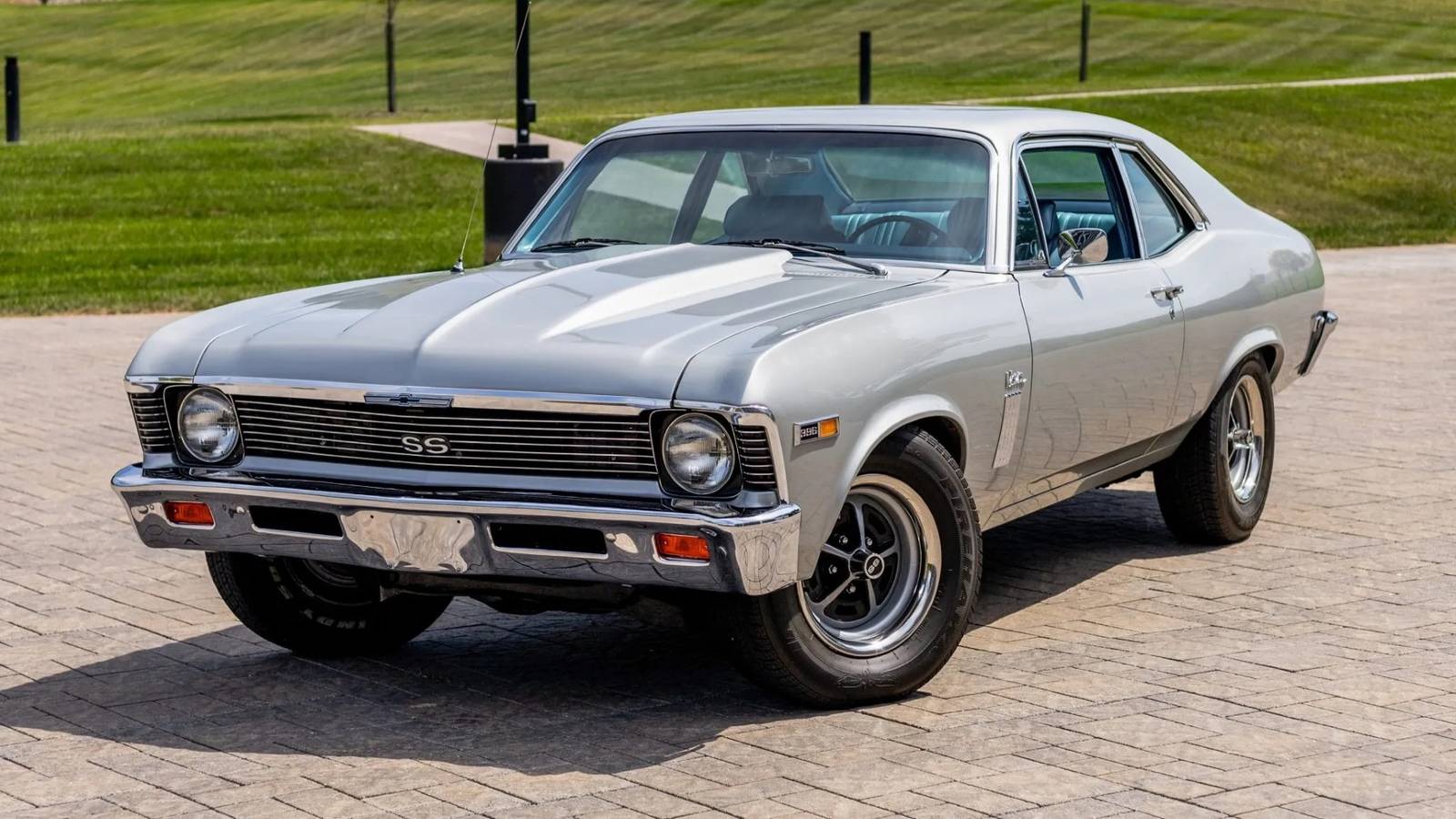
Over the years, Chevrolet has released some considerably iconic models in various body styles and segments, cementing itself as one of the big three American brands. Some of its more classic models have become highly collectible artifacts, favored by many enthusiasts and gear heads. This is especially true when looking at its extensive list of classic muscle cars, some of which now sell for tens of thousands of dollars.

Chevrolet
- Founded
-
November 3, 1911
- Founder
-
Louis Chevrolet, Arthur Chevrolet, William C. Durant
- Headquarters
-
Detroit, Michigan, United States of America
- Owned By
-
General Motors
- Current CEO
-
Mary Barra
The 1969 and 1970 Chevrolet Nova SS is a prime example of a highly esteemed muscle car that sells for massive numbers in today’s used market, be it a factory original or professionally resto-modded example. If this sleek performance coupe is a muscle car that you are currently interested in, this is everything you need to know about Chevy’s iconic muscle car.
The Nova SS Changed The Muscle Car Landscape

By the late 1960s, Chevrolet lifted the Nova SS from its humble and accessible compact sedan and coupe form into a giant-killer within GM’s historic muscle car lineup. The brand strategically positioned this beneath the larger Chevelle and the flashy Camaro, making it a fitting entry point to its performance catalog. Both the 1969 and 1970 Chevy Nova SS offer a no-frills and lightweight alternative for enthusiasts who prioritize power-to-weight ratios over chrome trimmings.
The Nova SS’s target market when new consisted of budget-conscious street racers and young buyers who wanted the lethal performance of a big-block engine, specifically the 396 cubic inch V-8, without the heavy price tag or insurance premiums of a full-sized muscle car.

The impact of the Chevy Nova SS on the muscle car segment remains profound as it essentially democratized high performance. With the Nova SS, Chevrolet proves that a muscle car doesn’t need a long wheelbase to dominate the drag strip, simply by installing a large engine into a senior compact frame.
When new, many considered the Nova SS to be a sleeper aesthetic, while its impressively rapid acceleration forced competitors to rethink the value of the compact segment. You could say that this model shifted the industry’s focus toward smaller and more agile platforms, eventually popularizing the pony car segment. Even today, the 1969 and 1970 models remain the gold standard for the all-go, no-show philosophy that defined the peak of the muscle car era.
Common Issues You Need To Look For

If you are currently in the market for a 1969 or 1970 Chevrolet Nova SS, the main issue that you need to be on the lookout for is general structural corrosion, as is the case with most cars from this era. These two model years are prone to rust in the hat channels located at the rear floor braces, trunk pans, rocker panels, and the lower portion of the A-pillars, as these points are where debris traps moisture.
Mechanically, it’ll be in your favor to inspect the rear leaf spring perches and front subframe mounts for structural thinning. A common pitfall in the classic market is the tribute or clone models, which is hard to spot because both the 1969 Chevy Nova and 1970 VIN numbers don’t characterize SS models. These feature the same 114 prefix affixed to non-SS V-8 models. The only real way to authenticate these models is by consulting their original build sheet or Protect-O-Plate.

It’s also a good idea to analyze SS-specific hardware that is difficult to replicate. These include the factory power front disc brakes, a 12-bolt rear differential, and unique dual-exhaust hangers welded to the floor pan. If the car is advertised as a numbers-matching example, be sure to verify the partial VIN stamped on the engine pad behind the alternator.
If you are happy with building your own up, you should ideally prioritize a solid and dry body over a running engine. Mechanical parts for the Nova SS are plentiful and reasonably affordable, but high-quality metal work is far more expensive and labor-intensive. You can also use a magnet to check for excessive body filler along the lower quarter panels and rear wheel arches before committing to a purchase.

The Forgotten Powerhouse: Chevrolet’s Rarest Engine
The 427 Z11 V-8 dominated the drag strip and could have owned the classic muscle car era had GM allowed it.
A Powerful Collection Of V-8s

The 1969 and 1970 Chevy Nova SS engine range was headlined by the formidable Turbo-Jet 396 cubic inch V-8, which transformed the compact car into a drag-strip legend. The entry-level L34 variant produces 350 horsepower and 415 pound-feet of torque, while the high-compression L78 version pushed output to 375 horsepower and 415 pound-feet. If it’s the maximum velocity you want, the L78 will satisfy with a 0 to 60 MPH acceleration time of a claimed 5.9 seconds and a quarter-mile time of 14.5 seconds at 101 MPH.
The factory-rated top speed at 120 MPH because the SS is largely limited by aerodynamic drag and aggressive rear-end gearing. If you’re prioritizing balance, the small-block L48 350 V-8 offers a respectable 300 horsepower and 380 pound-feet of torque, producing a 0 to 60 MPH sprint in the mid-seven-second range and a quarter-mile of about 15.5 seconds. Chevrolet introduced the 402 cubic inch V-8 in 1970 as somewhat of a replacement for the 396, but opted to keep the original badging because the increased capacity was achieved by a slight overbore.

The mechanical soul of the 1969 and 1970 Nova SS is defined by its Rat Motor architecture, consisting of the 396 and 402. These utilize a cast-iron deep-skirt block with high-flow porcupine cylinder heads, named for their unique canted-valve angles that optimize airflow. The high-output L78 variant features solid lifters, a forged steel crankshaft, and 11:0:1 compression pistons, requiring high-octane fuel.
The 350 relies on a more conventional two-bolt main block with hydraulic lifters for easier maintenance. To handle this torque, Chevrolet implemented the heavy-duty Muncie four-speed manual that you might find with the optional Hurst shifter or the robust Turbo Hydra-Matic 400 automatic for big blocks and TH350 for small blocks.
The chassis is a semi-unibody design, utilizing a bolted-on front subframe with independent coil springs and a solid rear axle on multi-leaf springs. To curb the Nova’s notorious wheel hop, SS models feature stiffer heavy-duty shocks and thicker front stabilizer bars. Stopping power comes from standard power-assisted front 11-inch disc brakes and rear drums, which do struggle against the weight of the big-block during repeated hard stops. The car gripped the asphalt via E70-14 red-stripe or white-letter bias-ply tires mounted on 14×7-inch steel Rally wheels, which admittedly is a setup that prioritizes period-correct aesthetics over modern lateral grip. Existing models will have more modern compounds applied.

How A Chevy V8 Found Its Way Into An Unexpected European Luxury Coupe
GM was on track for global domination in the 1960s by challenging Mercedes in Germany.
Simple But Effective Interiors

The interior of the 1969 and 1970 Nova SS reflects a budget identity for its time, balancing utility with focused muscle car aesthetics. The cabin features a standard full-width bench seat or optional Strato-bucket seats, typically upholstered in heavy-duty expanded vinyl with a distinct pebble-grain texture.
Black was the dominant upholstery choice, but some enthusiasts applied the Parchment or Blue colors for a more distinctive appearance. Typical to the period, the dashboard is horizontal and functional, centered around a 120-MPH linear speedometer. If it’s data you prioritize, you should be on the lookout for the Special Instrumentation package examples, featuring a tachometer and a four-gauge pod that monitors oil, volts, fuel, and temperature, mounted uniquely on the center console.
Convenience features remained relatively modest for it’s time to keep costs down, but the options list allowed for some refinement. When new, you could specify Four-Season air conditioning, power steering, and a wood-grained steering wheel. Lifting the entertainment aspect was a basic Delco AM or AM/FM push-button radio, with an optional rear-seat speaker. Safety-wise, these years introduced the locking steering column and headrests as standard equipment.

How Chevrolet’s Small Block V-8 Became America’s Engine
By blending simplicity, affordability, and adaptability, Chevrolet’s small-block V8 powered generations of cars.
Nova SS Models Sell For Big Money

In 1969, a base V-8 Nova coupe started at $2,400, with the Super Sport Z26 package adding $280 and the top-tier L78 396 engine requiring an additional $500. By 1970, the base price for the Nova SS 396 rose to $2,978, though heavy optioning with features like a four-speed manual and performance rear ends could easily push the final window sticker price toward $3,700.
The modern market for 1969 and 1970 Nova SS models has shifted from budget alternative to high-stakes investment, with values dictated heavily by engine displacement and documented provenance. According to both Hagerty and Mecum analytics, a standard small-block 350 Chevy SS in good condition typically costs anywhere between $35,000 and $48,000. If you find an example of the legendary L78 396 375 horsepower variant, you can expect to pay more than $75,000. A record-breaking low-mileage 1970 L78 recently sold under the hammer for a $275,000 at Mecum.

On platforms like Bring a Trailer, the driver-quality market remains active, but buyers are increasingly wary of tribute cars, which often sell for 30 to 40 percent less than verified factory SS models. Yenko and COPO iterations exist in a six-figure stratosphere of their own, often exceeding $190,000 for high-tier restorations.
Overall, the market shows a clear K-shaped trend that sees entry-level Chevy Nova for sale projects remaining somewhat accessible, while numbers-matching big-block survivors with original Build Sheets are rapidly appreciating as blue-chip assets, outperforming many of their larger Chevelle and Camaro siblings in percentage growth due to their comparative rarity.
Sources: Hagerty, Mecum, Bring-A-Trailer