
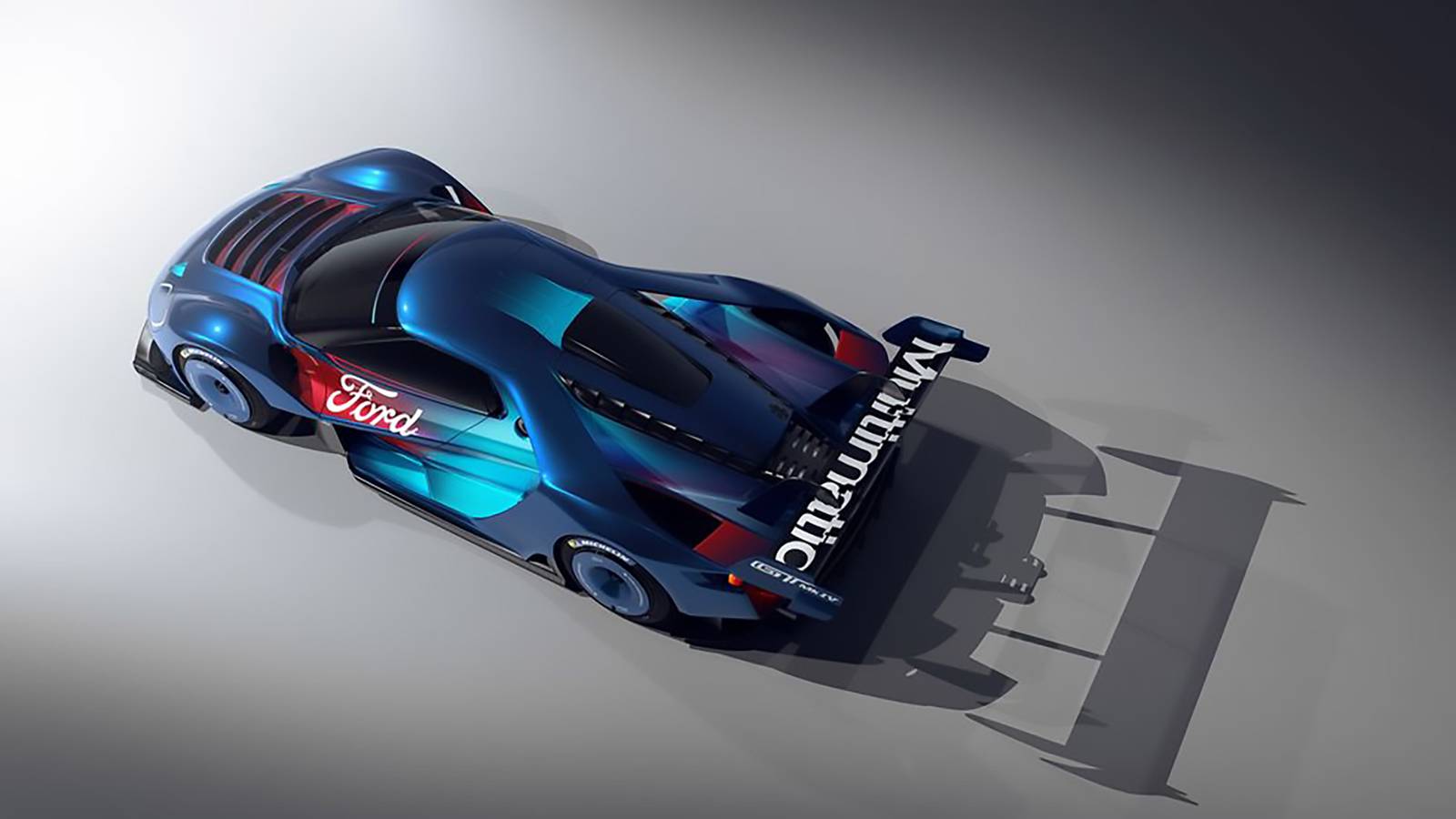
For decades, American performance was defined by V8 engines, with V6 engines viewed as more sensible alternatives and often less extreme. That mindset began to change as modern performance prioritized efficiency, packaging, and repeatable power, prompting Ford to shift gears and select a V6 for its high-performance supercar rather than a large V8.
The result was the D35 EcoBoost — a purpose-built, twin-turbo V6 developed for the Ford GT program and later unleashed in its most extreme form in the Ford GT Mk IV. With output exceeding 800 horsepower and a racing pedigree to match, it didn’t just rewrite expectations for American V6 engines — it redefined them entirely.
What Makes The D35 EcoBoost V6 Different
A Purpose-Built Engine

The D35 EcoBoost V6 was developed from the Duratec 35 3.5-liter V6, though heavily, and I mean heavily, modified. It was built to compete at the highest level of endurance racing and later to power one of the most uncompromising American track cars ever produced. At the D35’s beating heart lies a 3.5-liter, twin-turbocharged V6, but that description barely scratches the surface. While it shares a displacement figure with Ford’s road-going engines, almost everything else is bespoke. The block, internals, turbocharging system, lubrication, and cooling architecture were designed to withstand prolonged high-load operation—not just short bursts of peak output.

Unlike production EcoBoost engines, which must balance performance with emissions compliance, cost efficiency, and everyday reliability, the D35 prioritized durability under stress. It was designed to operate at extreme temperatures, sustain high boost pressures for longer periods, and deliver consistent output lap after lap. This was not an engine designed for the road; it was adapted for racing. And the D35’s intent is what sets it apart from the rest of the pack of American V6 engines. It was built to endure, not to impress on paper.

Here’s What Makes The Track Only 2023 Ford GT Mk IV So Special
Limited to just 67 examples, Ford Performance and Multimatic have come together to create the most extreme version of the GT ever
Why Ford Built A V6 Supercar Engine
A New Performance Direction

For an American manufacturer, choosing a V6 to power a flagship supercar was a bold move. The V8 had long been central to Ford’s performance identity, both culturally and mechanically. But the Ford GT program was not driven by nostalgia — it was driven by competition. From the start, the GT program had one leading goal in mind: returning to Le Mans with a car that’s confident and capable of running at the front. That goal ultimately influenced the decisions there, including the choice of engine, and a V6 powerplant offered clear advantages in packaging, weight, and efficiency.
The Undeniable Benefits Of Downsizing

Its compact size made it more agile, and the engineers behind this vehicle leveraged it to their advantage, creating greater airflow through the car’s bodywork, which further improves cooling and overall aerodynamic efficiency. And in the same breath, the lighter V6 lowered the center of gravity and sharpened weight distribution. Fuel efficiency also played a role, as a turbocharged V6 could deliver serious power while reducing the number of pit stops required over a long race. Choosing a V6 marked a shift away from tradition and toward engineering-led performance — a decision that would soon prove its worth on the world stage.

The Untold Story Behind America’s Most Durable Engines
These three legendary engines have defined the greatness of American engineering.
Power That Redefined Expectations
Record-Breaking Output

When discussing the most powerful American V6 engine, context matters. Peak numbers alone can be misleading without understanding how — and where — they are achieved. In its most extreme form, the D35 EcoBoost V6 was produced with staggering figures of just over 800 horsepower, placing it firmly at the top of the American V6 hierarchy — very impressive, if you ask me.

That output came from a twin-turbo setup and an engine built to withstand heavy stress, but what really mattered was its ability to sustain that performance over extended periods. In racing trim, the D35 showed it could run hard for hours at a time, with reliability becoming one of its defining traits. Consistency is what gave the engine real significance, challenging the long-held view that American V6s were merely efficient alternatives to V8s. By delivering both power and durability at the highest level, the D35 showed that fewer cylinders, when properly engineered, could outperform tradition.

The Highest Horsepower Naturally Aspirated American Engines Currently In Production
These are the last remaining American power units still keeping the old tradition alive.
Engineering Without Compromise
Why Fewer Cylinders Worked

The success of the D35 EcoBoost was not simply a function of forced induction. It was the result of a holistic engineering approach that prioritized balance, durability, and precision. With fewer cylinders, the engine was inherently lighter and more compact, allowing for tighter packaging and improved chassis integration. That mass reduction had a cascading effect, improving handling response, braking stability, and overall vehicle balance. In a car as aerodynamically complex as the Ford GT, these gains were invaluable.


Find 2023 Ford GT Mk IV and more cars for sale on our Marketplace
Race-Ready Engineering At Its Finest

Cooling was another area where the V6 configuration paid dividends. The engine bay layout enabled more efficient airflow management, helping control temperatures even under sustained high-load conditions. Reinforced internals, race-grade materials, and a robust lubrication system ensured the engine could withstand the demands placed upon it. Rather than relying on displacement to generate power, the D35 focused on controlled combustion, precise boost management, and structural resilience. It was an engine built with intention — one that valued repeatability over spectacle.

The Most Powerful Naturally Aspirated Flat-Six Ever Put In A Production Car
This venerated manufacturer is known for its high-performance six-cylinder sports cars, and one of them has the most powerful N/A six in the game.
The D35 EcoBoost’s Legacy
What It Represented

The clearest expression of the D35 EcoBoost’s potential came in the Ford GT Mk IV. Freed from road homologation requirements and racing regulations, the Mk IV allowed Ford engineers to push the engine to its absolute limits. In this track-only form, the D35 delivered its most extreme output, surpassing the 800-horsepower mark and cementing its status as the most powerful American V6 engine ever built. More importantly, it did so in a fully functional vehicle designed for sustained track use, not as a theoretical exercise or marketing showcase. The Mk IV demonstrated why the V6 architecture was so effective.

Its compact size enabled optimal aerodynamics, while its turbocharged layout delivered immense power without the mass penalty of larger engines. This combination reinforced the idea that intelligent engineering could outperform tradition when freed from convention. In the broader performance landscape, the D35 EcoBoost occupies a unique position. Other high-performance V6 engines exist, but few combine such extreme output with endurance-racing pedigree and manufacturer backing. The D35 was not just powerful — it was purposeful.
Changing The Landscape For Years To Come

Its success marked a turning point for American performance engineering, proving that innovation and efficiency could coexist with emotional appeal. In doing so, it redefined expectations of what an American engine could be. The title of The Most Powerful American V6 Engine is not awarded lightly, nor should it be based on headline figures alone. It demands context, credibility, and intent. By those measures, the Ford D35 EcoBoost V6 stands apart. At its peak, the Ford GT Mk IV delivered over 800 horsepower, sustained that output under real-world track conditions, and was backed by a racing program that demonstrated its durability.

More than that, it represented a philosophical shift —from displacement-led thinking to precision-driven engineering. The D35 EcoBoost did not just challenge expectations; it dismantled them. It showed that an American V6 could sit at the very top of the performance hierarchy, not as an alternative to the V8, but as its equal — and in this case, its superior. In an era increasingly defined by efficiency and intelligent design, the D35 EcoBoost V6 remains a landmark achievement, and one that fully merits its place in American performance history.
Sources: Ford, Multimatic