
The 2026 Chevrolet Corvette ZR1 is an excellent homegrown example of a supercar. It produces a whopping 1,064 horsepower and can sprint from zero to 60 miles per hour in just 2.3 seconds, with a top whack of 233 miles per hour. Such performance is what makes the ZR1 one of the best Corvettes ever made, along with one of the better supercars sold in the US. And the best part is that it can be yours for well under $200,000. But unless you want all-out performance for your money, the Corvette ZR1 is perhaps not your best bet.
It’s a brute force of a car that may thrill you at the start, but can you really use it every day? And despite being a top-dog Corvette with all the good bits, you can’t deny that it still doesn’t differentiate itself from its lower trims well enough. Yes, we know the last bit is a bit subjective. That’s where the 2025 McLaren Artura comes into the picture. It’s an excellent antithesis to the Corvette ZR1, and where it lacks in sheer horsepower, it makes up for it with a relentless power delivery and stunning British aura.
McLaren Artura Is The Future Of Performance Cars

|
Horsepower |
Torque |
0 to 60 MPH |
Top Speed |
Quarter Mile |
|---|---|---|---|---|
|
690 HP |
531 LB-FT |
2.6 seconds |
205 MPH |
10.7 seconds |
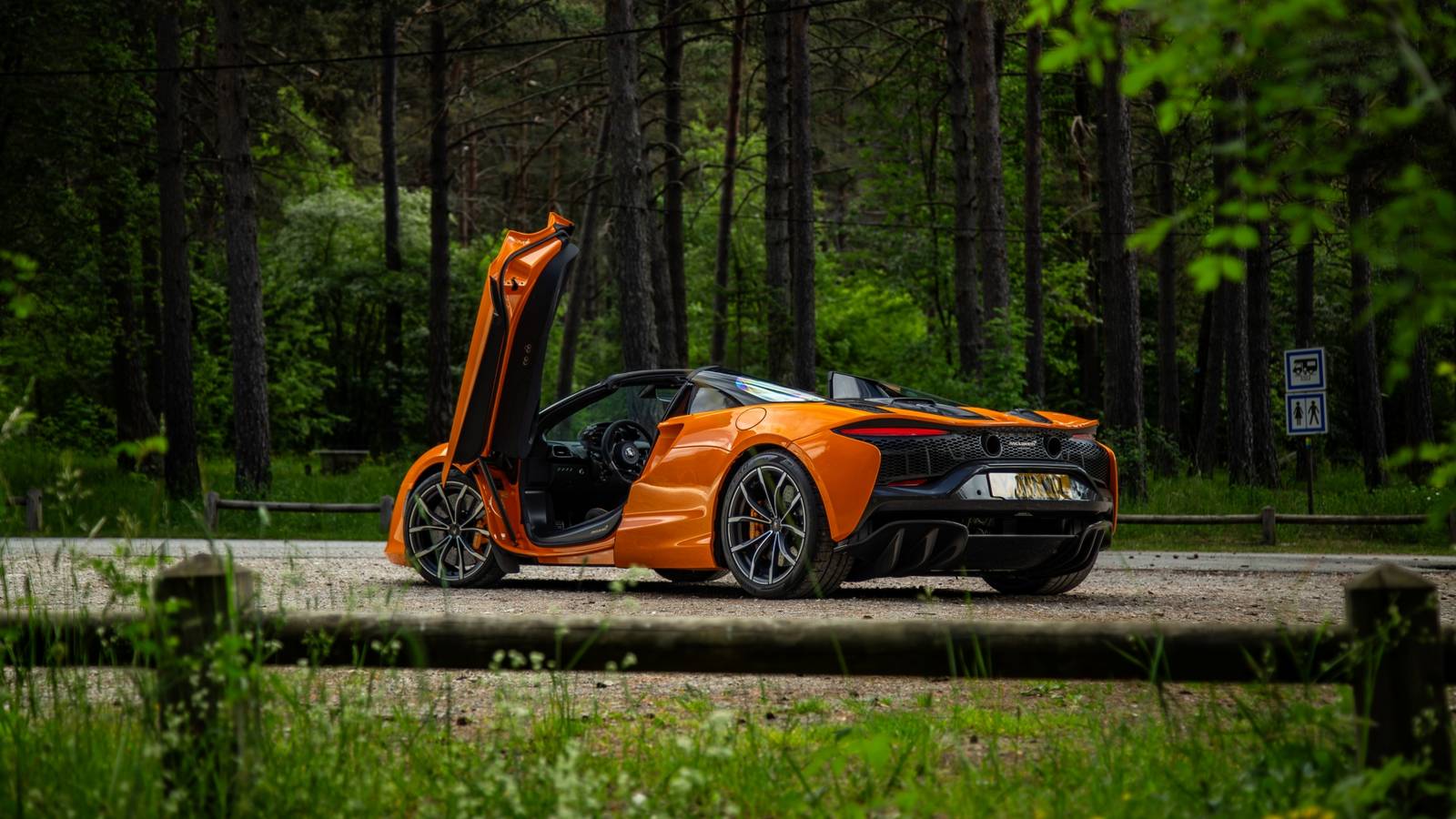
The word Artura is kind of a portmanteau of Art and Future, and it completely suits this supercar. It’s a performance car with a twist, and instead of mid-mounted V8 engines found on most McLaren supercars, this new-age model features a plug-in hybrid twin-turbo V6 engine. While the powertrain is a departure from the traditional V8s McLaren is known for, the Artura promises to deliver the same performance that you’d associate with cars that wear the orange speedmark.

Despite the relatively small engine, the Artura isn’t a slouch. It delivers McLaren P1 performance at a fraction of the cost. The 3.0-liter twin-turbo V6 engine is supplemented by an axial flux electric motor, delivering a combined total output of 690 horsepower and 531 pound-feet of torque. Our review drive of the MY25 Artura found it to be “something of a small monster.” With a zero to 60 miles per hour time of 2.6 seconds and a 205 miles per hour top speed, the Artura is more than capable enough to entertain most drivers.

Apart from the engine performance, the car also features ultra-light supercar engineering and all the good bits, including an advanced E-differential. Every element of the car promises a unique, intense driving experience. Sure, it may not be the loudest or the rowdiest supercar you can buy in 2026, but it should get the job done. The only caveat: despite McLaren reworking the exhaust last year, it still won’t satisfy those looking for the howl associated with V8 McLaren cars.

How McLaren Builds Supercars: Our Tour of the MTC
We find out what it takes to make some of the world’s greatest super sports cars.
Its First-Of-Many Features Contrast The ZR1’s Traditional Brute Force

We call this the future of supercars because it’s a one-of-a-kind PHEV sports car that comes with the first of many. For example, it is one of the world’s first supercars to come with Pirelli’s Cyber Tire, which provides real-time feedback on pressure and temperature. It’s also the first McLaren to feature an electronic locking differential. Other firsts include its super-formed outer shell, which uses hot gas instead of conventional pressing, reducing weight and improving aerodynamic efficiency. It’s a glimpse into where performance cars are heading, which brings us to our next point.
It’s A Foil To The Corvette ZR1’s Excess

Despite its capabilities and power-to-weight ratio, the Artura cannot compare to the Corvette ZR1’s twin-turbocharged V8 powerplant, dumping 1,064 horsepower to the rear wheels. And that’s not a bad thing. The ZR1 is all about brute force, and it represents the peak of American supercars. For those looking for the ultimate homegrown sports car, there’s hardly anything better than the monstrous Corvette. But for the rest, the car can be intimidating, and, honestly, not very different from the thousands of Corvettes plying the streets of the US.

Meanwhile, the Artura is the future of performance cars. It features hybrid tech, lighter platforms, and many new-age features. Despite the lower power output, the car isn’t too far behind in terms of acceleration and handling. What’s more, for most drivers, the Artura is a touch more accessible, at least in terms of performance, not price tag. That’s something most thousand-horsepower supercars can’t match. And in terms of design, subjectively speaking, its exotic British finesse is something that the Corvette ZR1 can’t match.

Here’s What It’s Like Going Around The 10/10th Track In A McLaren Artura
Toss about, go fast, up, down, through the corners, and quickly across the line in a McLaren Artura during a lap aournd the 10/10th track.
It’s A PHEV Of The Sporty Kind, With Little Focus On Efficiency

It’s natural to associate hybrids, especially the plug-in varieties, with efficiency, practicality, and long-range. Fortunately, the Artura does not belong in that circle; it’s a supercar that reinterprets what it means to be a PHEV. And that approach gives the Artura a character that you wouldn’t expect at this price point and with these power figures. The PHEV powertrain does not care much about fuel economy; it focuses its power on acceleration and power delivery.
Hysterical Acceleration That’s Fractions Behind The Corvette ZR1

The Artura uses the ICE engine and EV motor strategically to dump whatever it has onto the rear wheel, resulting in a searing acceleration from standstill to 60 miles per hour of just 2.6 seconds for the coupe model. That’s just 0.3 seconds behind the Corvette ZR1, which makes substantially more power. The Artura can keep dumping this power to reach the quarter-mile mark in 10.7 seconds and reach a top speed of 205 miles per hour. Oh, and there’s no reverse gear; that’s taken care of by the hybrid tech.
Explosive Power Delivery, Too

In our review, Garret Donahue found that the Artura offers an explosive power delivery, thanks to its amazing use of EV torque-fill. Essentially, in track mode, the engine keeps charging the battery to be used at any moment, offering the most torque possible at all times. We found the torque being available right from the get-go and “readily available at any level, any speed, and as much as I needed.” This makes the Artura feel powerful at all times, which is bound to make the car feel exhilarating and addictive to drive.
Manufacturers often claim to mitigate turbo lag with EV components, but this has to be the closest to eliminating lag altogether. I’ve never driven anything with such a relentless feeling of thrust. The EV component gives a sense of endless power that perfectly complements the ICE engine all the way to redline.
— Garret Donahue for TopSpeed
All-Electric Range Is Only Good For Your Neighbor’s Sleep

The PHEV powertrain is backed by a small 7.4-kilowatt-hour lithium-ion battery, which is claimed to give it a 21-mile all-electric range, though our test only resulted in 18 miles. For what it’s worth, this all-electric range is best suited for sneaking out of your garage without waking your family and neighbors at the crack of dawn or if you want to save some fuel on your grocery runs. Even in terms of fuel economy, the powertrain is not gentle, delivering a fuel economy of 19 miles per gallon (combined) in our tests.

2025 McLaren Artura Review: Meet The Supercar Standard
It’s anything but entry-level. McLaren’s new hybrid V-6 offering is a supercar through and through.
No-Nonsense Approach Where It Matters The Most

TopSpeed | Garret Donahue
As with most McLaren cars ever made, the Artura is stunning to look at, featuring a mature mix of sharp and edgy features juxtaposed with organic elements. It’s beautiful, with every part of it just working, and while it may not look as substantial as a Corvette ZR1, it should definitely be harder to ignore on the road. It’s also easy to see subtle nods to McLaren’s past models in it. But this sophisticated, no-nonsense approach also extends to other areas of the car. It promises to be a sophisticated supercar, just like a McLaren should be.
Sticks To The Basics Where It Counts

The Artura may be pushing the boundary of supercar engineering, but in some areas, it sticks to the basics. For example, the steering is hydraulic-assisted, not electric, and the same is the case with the braking system, promising excellent feedback to the driver. To further maintain that natural feel, there’s no brake regeneration. Still, the standard carbon ceramic brakes offer excellent stopping power, taking the car from 62 miles per hour to zero in just 31 meters. Similarly, the car lacks active aero, while still maintaining excellent downforce, thanks to the rear spoiler, diffuser, hidden door inlet ducts, and rear buttresses.
Minimalist Interiors With Surprisingly Comfortable Seats

A similar no-nonsense approach extends to the interior, too, with a driver-focused, minimalistic interior. The interior takes a function-before-form approach, doing away with as many buttons as it can, while still maintaining that high-end car feel. The interior features leather and microsuede with a bit of carbon fiber touches all around. We even found the seats to be surprisingly comfortable (for a supercar), though there is no rear seat, and the six cubic feet frunk is best suited for carrying car essentials.

In terms of infotainment, don’t expect much. The eight-inch vertical screen features Bluetooth, Apple CarPlay, and built-in navigation. You get a speaker setup standard, and available features include a wireless charging pad and Bowers & Wilkins 12-speaker surround sound system, as part of the Technology pack. That may seem a bit Spartan, but we wouldn’t expect anything else from a McLaren. The Artura’s futurism matters where it counts the most, especially when it comes to going up against the more traditional, raw supercars. There, infotainment is merely an afterthought.
Source: McLaren, Chevrolet