
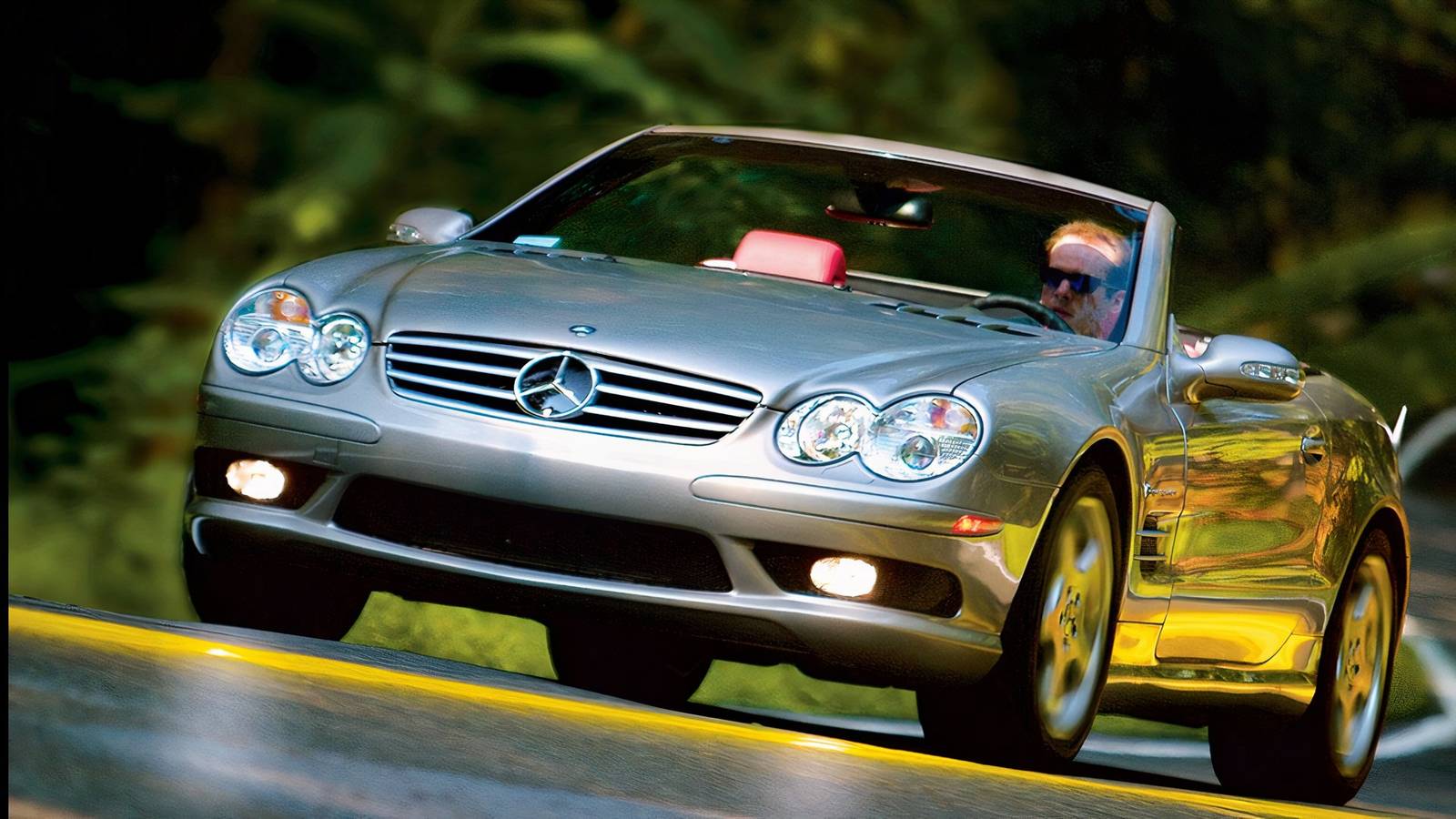
When the Mercedes-Benz SL55 AMG was launched for the 2003 model year, it was not really possible to know how fast it was. Officially, it was limited to 155 mph, which was fast for a 4,400-pound car, even if it was a two-seat, two-door, removable top roadster. But buyers back then did not pay $115,000 to sit in the slow lane on the Autobahn and watch Porsche 911s zip past, so most removed the restrictor. Technically, this would have taken it to 208 mph, but back then, there were no road tires that could safely take such a heavy car to that speed.
With no restrictions except for the tires, the AMG could do about 186 mph, go 0-60 mph in around 4.5 seconds, and do all this in supreme comfort. Back then, stock standard, the Mercedes-Benz SL55 AMG could take on most supercars in top speed, acceleration, and even handling. And that is not even the whole story. Turns out that Merc was being extremely conservative in tuning this AMG, possibly to not compete with the Mercedes-Benz SLR McLaren launched around the same time. The performance of the SL55 AMG twenty years ago was at supercar level, but supercars have moved on. Yet at the heart of this early AMG is the ability to boost its performance to where it can take on the supercars of today.
The Supercar Killer That Hid In Plain Sight

The Mercedes-Benz SL55 AMG was launched in 2002 as the 2003 model year. The normal SL has always been the poster child of expensive comfort, an Ivy League kid in a letter sweater. The AMG was that same kid, now wearing a leather jacket and carrying a flick knife. It was refined for your daily drive, but underneath lurked power that could take on most supercars and beat them.
The Heart Of The AMG

The difference between the cool SL and the edgy SL AMG was the supercharged MK113K 5.4-liter V8, a hand-built engine that produced 493 horsepower and 516 pound-feet of torque. This was more than the 911 of the time, as well as most Lamborghinis and Ferraris. This massive torque came at only 2,650 rpm, and the acceleration was so brutal that most drivers did not believe the official 0-60 mph time of 4.5 seconds, and reviews usually arrived at figures of 4.3 seconds or less.
Supercar Killer Without Breaking A Sweat

In motoring terms, 2003 was, if not Stone Age, perhaps Bronze Age technology. Yet even then, the SL55 AMG could blitz through 180, do the quarter mile in 12 seconds, and do all that in a folding hardtop that gave the passengers all the comfort in the world. It was this mixture of performance and refinement at a sort of lowish price that created its wild reputation.

ProCharger vs Supercharger: An In-Depth Comparison
If you’re confused about which supercharger you should fit to your project car, this article should make things easier to understand.
The MK113K: AMG’s Indestructible Supercharged Masterpiece

Any performance car’s worth is measured by the sum of its parts. In the SL55 AMG, the biggest number in that sum is the engine. It remains one of the iconic engines of the past 20-odd years, certainly of any built by AMG. In today’s terms, the MK113K is a bit analogue, a 5.4-liter V8 with a twin-screw supercharger. The internals are forged, the factory tuning is seriously conservative, and the stock cooling system was completely over-specced, almost as if someone realized that this engine would be boosted far beyond the limits that left the factory.
Begging For More Power

Mercedes actively kept the SL55 lower-key than it had to. The boost levels were mild, the exhaust flow was restricted, and it could deal with extreme heat without breaking a sweat. This engine was reliable, routinely clocking over 300,000 miles, still with the original parts. This was an open invitation for SL55 owners to push the envelope, to find out how far you could take this engine before it reached its mechanical limits.
Upgrading the MK113K

Owners found the AMG relatively easy and inexpensive to increase the power. The best bang for the buck was a simple bolt-on pulley, replacing the factory unit with a smaller-diameter reduction pulley. This required an ECU tune as well, and the increased heat in some cases needed a better intercooler. An upgraded intercooler setup plus the pulley/tune could boost the horsepower to around 600, while keeping the power consistent during repeat runs or extended hard RPMs. Prices for this vary a lot, from way under $1,000 to over $11,000.

If you were looking for more power and had the money to spend, a large aftermarket or twin supercharger swap would be the answer. This would entail replacing or modifying the Kompressor head, and could require fuel upgrades and specialist tuning, and probably the clutch and some of the internals as well. While taking the horsepower well north of 600, it can cost double the price of a used SL55. You can always opt for a boutique build by the likes of Brabus or Kleemann, and this could elevate the cost by anywhere from $10,000 to over $50,000.

10 Most Reliable Mercedes-AMG Models On The Used Market, Ranked
These are the most reliable used Mercedes-AMG models you can buy today; get yourself a potent machine that will spend more time on the road.
Body, Chassis, Surprising Capability In A Luxury Package

When compared to its lighter, smaller rivals, the SL55 AMG should not be able to handle as well as it does. It weighs 4,400 pounds, has a retractable hard-top, and comes with loads of electronics, heavy hydraulics, and a very strong body. The secret to its great handling lies in the innovative active body control suspension. This was a groundbreaking hydraulic system that would eliminate almost all body rolls, pitch, and dive in real time. Despite needing long-term maintenance to continue to operate efficiently, it turned the AMG into a ballet dancer in a linebacker’s body.
Big Car Comfort, Sports Car Handling

A performance car is nothing without great handling, and the active body control of the SL55 AMG provided this, even though it was not as light and agile as the 911 and similar sports cars. The car, even though technically a grand tourer in size and weight, felt stable and in control, even at high speeds. Corners were taken without excessive body roll, and even at over 150 mph, the AMG was always in control. The brakes of the SL55 also contributed to its performance chops, with multi-piston calipers and oversized rotors to compensate for the extra weight that had to be stopped.
Design That Stood The Test Of Time

The R230 chassis used for the SL55 AMG has a timeless quality, giving this 20-year-old car clean lines accentuated by prominent fender flares, aggressive and elegant at the same time. The four exhausts at the rear added a real presence, as did the deep front air intakes. The retractable hardtop was practical and rigid, and could be deployed in less than 16 seconds.

10 Budget-Friendly German Sports Cars From The 2000s
This list highlights ten budget-friendly German sports cars from the 2000s that deliver outstanding value.
Ownership Experience, Legacy, And Why It Is Still Relevant Today

Despite its huge performance as a standard factory model and its tuning potential, the SL55 AMG is a practical and luxurious car to drive on a daily basis. Unlike the hard-riding, noisy cabins of the Ferraris and other mainstream sports cars then and now, this car looked after the driver. Features that make daily driving or long-distance travel comfortable include:
- Dual-zone climate control
- Massaging seats
- Superb leather upholstery
- A Harman Kardon sound system
- A spacious driving position
Any performance car needs maintenance, and this AMG is no exception. The main areas that require preventative attention are active body control hydraulics and the retractable hardtop mechanism. These can be cared for with preventative maintenance, and serious failures are covered by third-party aftermarket suppliers.
Value For Any Money

One of the reasons the SL55 AMG is so sought after today lies in its age/price bracket equation. It is notably less expensive than supercars of its time, and a good example can be had for less than the price of a new hot hatch with not nearly the performance or presence on the road. Because the engine and transmission are so reliable, running costs are reasonable as long as the hydraulics are maintained. This value proposition has caused the price of these used cars to steadily rise over the past few years, an example of the market in operation.
The End Of An Era

The SL55 AMG lives beyond its performance, although anyone who has heard its V8 in full flight would remember that. It was the last of the generation of AMG cars that were over-engineered, leaving the factory with untapped potential. After this car, engines became smaller, with fewer emissions, hybrid power replaced raw horsepower, and electronics became more important in the performance of the engine. It will take a true Luddite to want to give up all the advances of the past 20 years. Yet the SL55 AMG has earned its place in motoring history, a modern classic.
Sources: Bring a Trailer, RepairPal, Classic.com