
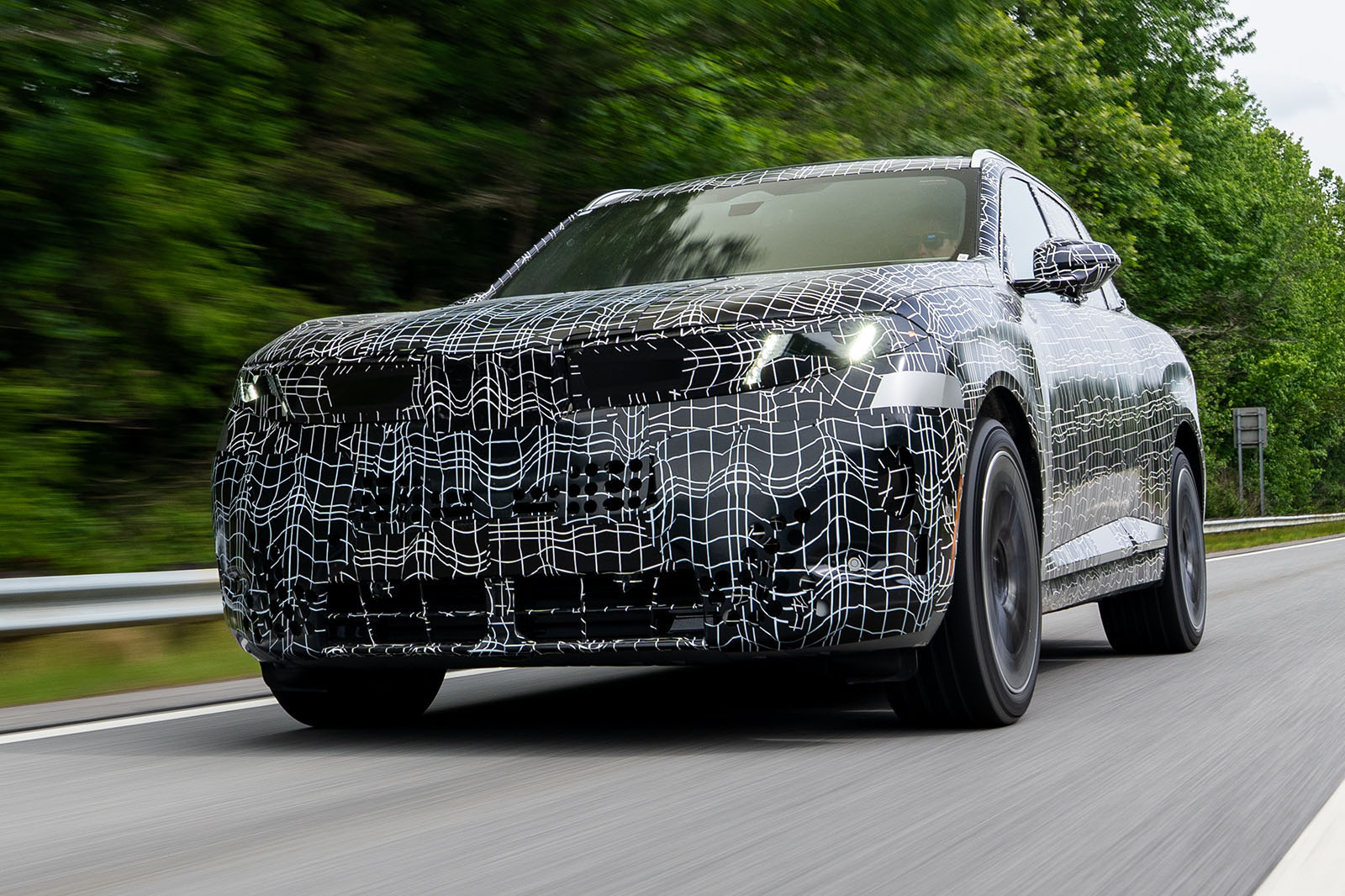
They get assembled straight into a pack rather than sub-divided into modules, which then lives in the floor of the car, with the power electronics put in a compartment on top for easier access.
The engineers say it was a big challenge to keep the overall height of the pack (and therefore the cabin floor) low in order to avoid that awkward double-decker feeling of some EVs. This wasn’t a goal accomplished by one quotable technology, instead a process of finding a millimetre here and a millimetre there.
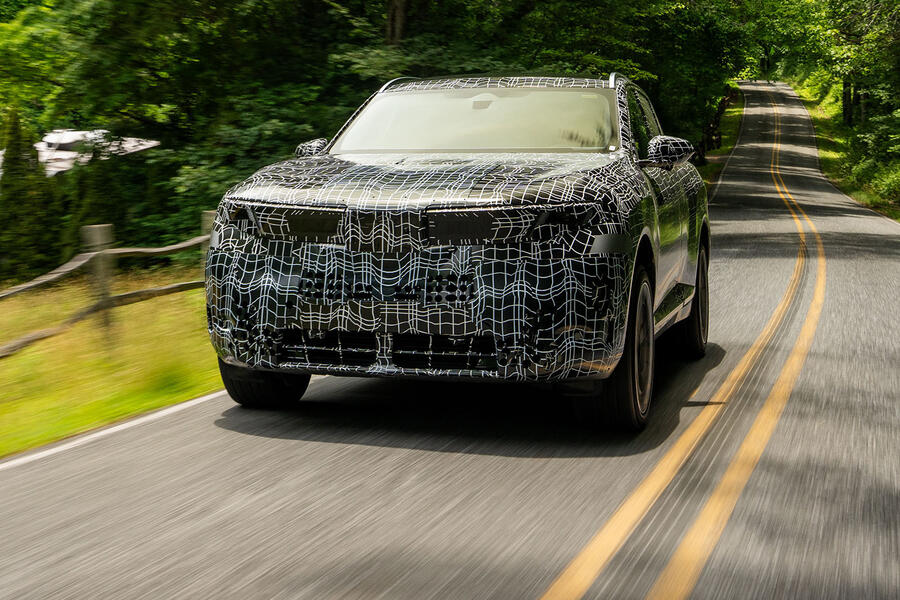
The other big thing was keeping the weight down, but don’t get too excited. We’re talking about a special kind of gravitational pull here: a 141kWh battery could have made the iX5 flirt with the 3.5-tonne threshold that would require an HGV licence. Instead it will be something around the 3.0-tonne mark. Small victories…
To keep all that weight under control, the EV always gets air suspension on both axles. The engineers seem pretty happy with the advances they have made here. The big improvement is on the rear axle, where the air spring and damper have been divorced. Don’t worry, it’s amicable. This has two big benefits: the first is spring rate. Previously, the damper would effectively take up space inside the airbag. Now that they’re separate, the airbag’s internal volume is bigger, so it can be softer if necessary. After all, a larger volume of air can compress more. The control can come from the adaptive damper, which is mounted further outboard, where it gets to use more lever effect on the suspension arms and therefore work better, thus giving a better balance of ride and handling.
The front suspension (double-wishbone, albeit with a split lower wishbone) is more or less the same as before, but then most of the hard work is done by the rear suspension. Another improvement is that the rear anti-roll bar has been relocated to where it can have the ideal lever effect, making it more effective.
If you want to go even further with chassis technology, you can optionally specify active anti-roll bars and four-wheel steering. The latter does ‘only’ about 3.5deg, rather than the 10deg you see on some Mercedes-Benz models, because the engineers want the X5 to feel like a BMW, not a forklift.
On the design front, there isn’t a huge amount to say yet, for obvious reasons, except that the EV and ICE versions will look all but identical and adopt the smooth Neue Klasse design language that was introduced by the iX3. The full unveiling is set for later this month.