
The dual-sport or off-roading capabilities of motorcycles that we see today are in some way or another derived from wartime machines. Apart from this, other features, such as reinforced frames, high-clearance fenders, and even luggage or utility racks, were inspired by or trickled down from some of the most durable motorcycles used by the military during the world wars. Now, most war-spec machines are all about durability, reliability, ease of repair, and rugged appeal.
And when motorcycle makers decided to make war-machine-inspired civilian bikes or even repackage the surplus for the masses, they added comfort features. This quick and crude formula is the origin story of many dual-sports and ADV motorcycles today. We have compiled five early adopters of war-grade utility and all-day comfort from automakers like Harley-Davidson, Indian Motorcycle, Kawasaki, and even the all-electric Zero Motorcycles.
This list is organized by year of manufacture.
5
Harley-Davidson WLA “Liberator”
Production Years: 1940–1952

The Harley-Davidson WLA was a motorcycle produced for the US Army specifically during and around World War II. It was based on an existing civilian model—the WL. This bike was used in wars to dispatch riders and was the primary motorcycle ridden by Allied forces to liberate occupied countries and cities throughout Europe during WW2. This is how it acquired the nickname “Liberator”. Most WLAs in America were sold as surplus and civilianized models after the war.

Powering the Harley WLA is a 45-degree, air-cooled V-twin. This 739 cc mill produced approximately 23 horsepower and was designed for ruggedness and reliability rather than high speed. The engine runs on a low 5:1 compression ratio, which helps with smooth functioning on lower-octane wartime fuel.
The war-spec Harley had some cool features, such as blackout lights, an oil-bath air cleaner, a Thompson submachine gun scabbard, an ammo box, and heavy-duty luggage racks. Some of these features were omitted from the civilian bikes for obvious reasons. The harmless bits were unchanged. Also, the sturdy Springer forks and skirtless fender design were retained on the civilian model.
Notable Features
- Skid plates
- Blackout lights
- Metal ammo box
- Reinforced frame
- Olive Drab paint job
- Heavy-duty crash bars
- Heavy-duty luggage rack
- Thompson submachine gun scabbard
Engine Specs (Civilian Model)
|
Engine Configuration |
45-degree V-Twin; Air-Cooled |
|
Engine Displacement |
739 cc |
|
Compression Ratio |
5.0:1 |
|
Bore X Stroke |
2.7435 in. X 3.8125 in. |
|
Power |
23.5 HP |
|
Torque |
N/A |
|
Transmission |
3-Speed Manual |
10 Harleys Owners Say They’d Buy Again (And Why)
Some Harleys wear on you; these 10 do the opposite, and that’s why owners never leave or they keep coming back
4
Indian 841
Production Years: 1941–1943

This was an experimental military motorcycle designed for desert warfare. A 45-cubic-inch air-cooled, longitudinally mounted V-twin engine powered this motorcycle, later popularized by Moto Guzzi. The 841 was heavily inspired by the BMW R17, with features such as a tubular frame, plunger rear suspension, a four-speed transmission, a foot-operated shifter, and final shaft drive.

The air-cooled mill had a low compression ratio of 5.1:1 to run on low-octane fuel. The cylinders were further guarded with crash bars. Features designed specifically for military use also included 8-inch drum brakes, two large split fuel tanks totaling five gallons for a longer range, a luggage rack, and a rifle scabbard. During the project, a shift in military demand toward four-wheeled Jeep offerings led to the cancellation of the 841. This is why these are very rare collector motorcycles today.
Notable Features Of The Military-Spec Bike
- Shaft drive
- Girder front forks
- 5-gallon split gas tank
- Plunger rear suspension
- Low compression engine
- Crash bars for engine cylinders
- Specialized cooling system for desert use
- Foot-operated shifter with manual hand clutch
Engine Specs (Civilian Model)
|
Engine Configuration |
V-Twin; Air-Cooled |
|
Engine Displacement |
739 cc |
|
Compression Ratio |
5.1:1 |
|
Bore X Stroke |
2.875 in. X 3.5 in. |
|
Power |
24.6 HP |
|
Torque |
N/A |
|
Transmission |
4-Speed Manual |
3
Harley-Davidson XLA Sportster
Production Years: 1957–1972

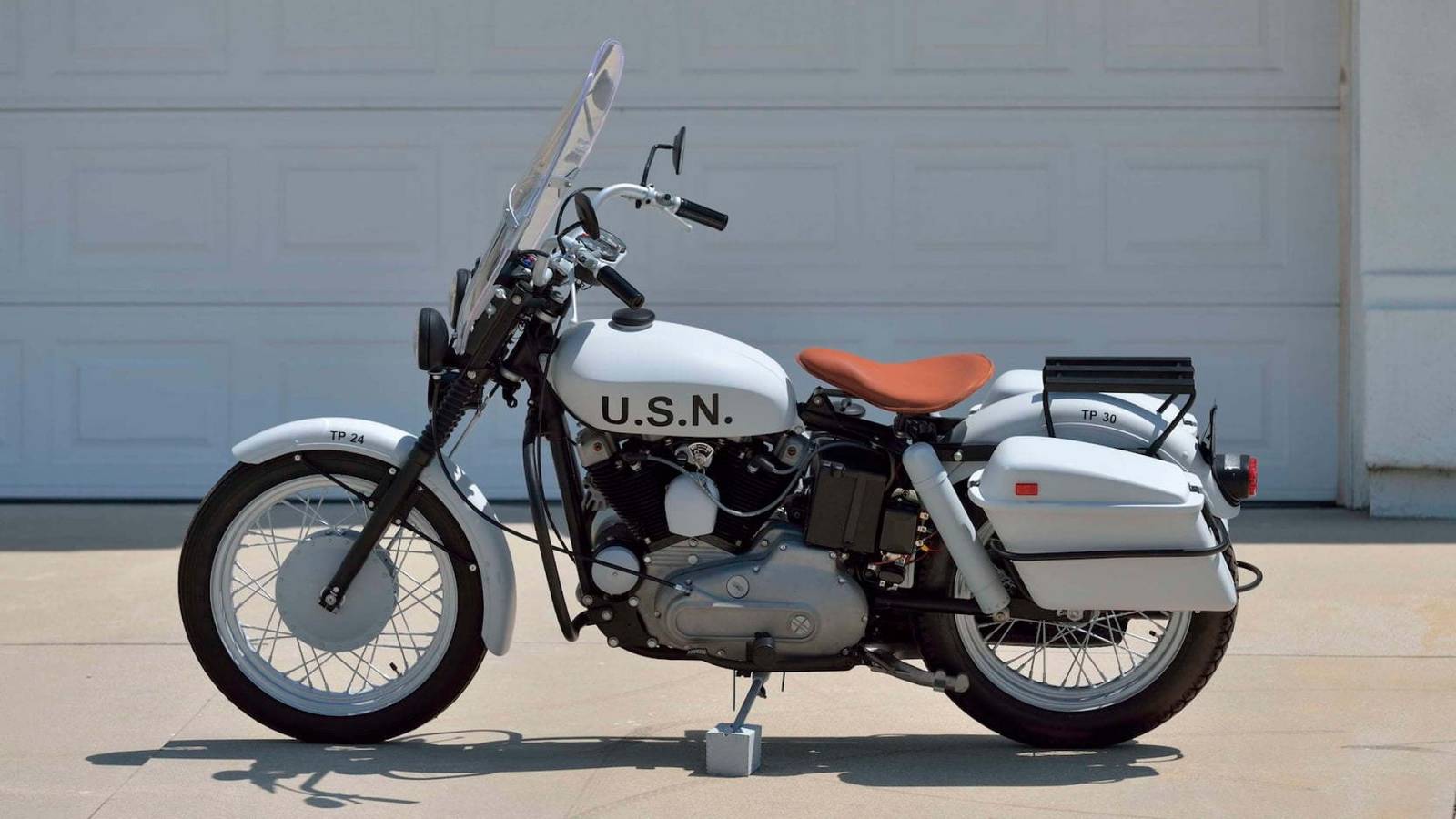
This is one of the rarest American military motorcycles, and many are unaware of it. The XLA Sportster, as the name suggests, was based on the 1940s Sportster model. This is one of those military bikes with a higher comfort quotient, as it was ordered by the military not to be a combat-ready machine but a patrol vehicle for use on base.
Notable Features Of The Military-Spec Bike
- Crash bars
- Steering dampers
- Heavy-duty luggage racks
- Specialized lighting and tires
- Olive drab paint job and trimmed parts like brake backing plates, shocks, and oil tanks.

Apart from the regulatory olive-drab paint scheme, the XLA was very similar to the civilian XL Sportster model it was based on. Powering this relaxed cruiser bike was the same OHV 883 cc, 45-degree, V-twin engine of the XL, coupled to a four-speed manual gearbox. Other features unique to the XLA included larger, unbranded fuel tanks, enclosed chain drives, wider handlebars, and minimal chrome. Getting hold of this military-spec Harley was a tough affair back then.
But today, thanks to the military surplus auctions, private sales, or public collector auctions, many XLA Sportsters are cruising around on public roads. As for those who own an Ironhead-powered XL Sportster, you should feel proud to own a motorcycle that was the basis of a rare military motorcycle.
Engine Specs (Civilian Model)
|
Engine Configuration |
45-degree V-twin; Air-Cooled |
|
Engine Displacement |
883 cc |
|
Compression Ratio |
8.9:1 |
|
Bore X Stroke |
3.0 in. X 3.8 in. |
|
Power |
N/A |
|
Torque |
~51 LB-FT |
|
Transmission |
4-Speed Manual |
10 Forgotten Harley-Davidson Bikes That Still Hold Their Own Today
You might have forgotten these Harleys in 2025, but they can still make their case against modern-day alternatives
2
Kawasaki KLR650
Production Years: 1987–Present
The Kawasaki KLR650 is often praised for being an indestructible motorcycle. Despite being outdated, it still packs enough punch to tackle any terrain and give the modern wave of do-it-all ADVs a serious run for its money and reliability. This is one of two still-on-sale motorcycles that have a strong military connection.
This Kawasaki’s durability caught the military’s attention, prompting them to develop an even more durable, specialized version for extreme use. Called the M1030M1/M2 and modified by Hayes Diversified Technologies (HDT), the military-spec KLR was powered by a highly frugal diesel engine. It was specifically designed to run on JP8 jet fuel, diesel, and even kerosene. It produced approximately 30 horsepower.

The stock underpinnings were rugged and durable enough to be retained. Impressive was its fuel efficiency of over 160 MPG, translating to a range of over 400 miles on a tankful of diesel. The military-spec model featured distinctive touches, including blackout lighting, infrared headlights, and a modified subframe. This military exercise with the KLR650 is also proof of the practical, do-it-all success of a diesel motorcycle.
Notable Features Of The Military-Spec Bike
- Crash bars
- Larger fuel tanks
- Heavy-duty suspension
- Matte finish and dark green paint job
- Total riding range exceeding 400 miles
- Blackout lighting and infrared headlights
- 611 cc diesel engine that runs on JP8 fuel
- Removed civilian safety features like the kickstand safety switch
Engine Specs (Civilian Model)
|
Engine Configuration |
Single-cylinder; Liquid-Cooled |
|
Engine Displacement |
652 cc |
|
Compression Ratio |
9.8:1 |
|
Bore X Stroke |
3.937 in. X 3.267 in. |
|
Power |
40 HP |
|
Torque |
39.1 LB-FT |
|
Transmission |
5-Speed Manual |
1
Zero FX
Production Years: 2013–Present

The Zero MMX shares its underpinnings with the Zero FX and previews new-age military vehicles. It showcases why compact, slim, and dual-sport electric motorcycles are best suited for military applications. They are quiet, generate low heat, and emit no exhaust gases. The operation is simple, the bike is lightweight, and it delivers instant torque, resulting in impressive acceleration.

For more flexibility, the Zero MMX packs quick-swappable battery packs. The electric motor is air-cooled and coupled to a direct-drive gearbox. Furthermore, due to its lack of a conventional multi-speed transmission, powertrain, or fuel, the Zero MMX is breezy to transport and maintain. The MMX shares its performance specs with the 2015 FX and produces 44 horsepower and 70 pound-feet of torque. It hits a top speed of 85 mph and weighs just 275 pounds.
Adding to its durability is long-travel Showa suspension, with added torsional rigidity at the front end for improved handling. It gets a hollow front axle to reduce unsprung mass. Zero offers capable Pirelli DOT-approved tires for solid grip. Other standard features include an off-board charger and a kickstand. The MMX can also be upgraded with optional features such as superior rear shocks, aggressive foot pegs, an on-board charger, a more durable belt-drive system, and dual-sport tires, an off-road-spec seat, handguards, and passenger footpegs.
Notable Features Of The Military-Spec Bike
- 3.1 meter water fording capability
- IR lighting
- Quick-detach components
- Military-spec switches on the minimal dashboard
- Tie-down eyelets for helicopter transport
- Aggressive off-road tires
- Rear tie-down straps
Powertrain Specs (Civilian Model)
|
Battery Pack |
Single 2.8 kWh Unit / Dual 5.7 kWh Units |
|
Electric Motor |
Z-Force 75-5 Interior Permanent Magnet, Brushless Motor |
|
Power |
46 HP |
|
Torque |
78 LB-FT |
|
Transmission |
Direct Drive |
Sources: Kawasaki, Zero Motorcycles, Harley-Davidson, Indian Motorcycles, Riding Vintage, and National Motorcycle Museum