
New-car prices in the US have been going northwards for quite some time. Market studies have shown that the average selling price of a new set of wheels now sits around ~$50,000. Data from J.D. Power reveals that new-car prices have soared by nearly 40 percent between December 2018 and December 2025. The reason? Depending on which side of the political spectrum one sits on, the blame is either put on environmental and safety regulations or on tariffs. But the luxury-car market in the country is playing by a different set of rules, where manufacturers are betting big on their high-end models for higher margins. So even as the masses see the problem of affordability pushing them towards the pre-owned market, the affluent buyer is ready to spend. And spend big.
It, however, isn’t just about mass-market models powering the American pre-owned vehicle business. A study conducted by Boston Consulting Group (BCG) and duPont REGISTRY Group highlights that sales of pre-owned luxury and exotic vehicles will increase 1.5 times faster than sales of new vehicles by 2035, even as the overall market for such vehicles — currently valued at an estimated $110 billion, will potentially jump to $215 billion over a decade from today. But why buy a pre-owned luxury machine?
Luxury Cars Lose Value Quicker

Luxury car models are estimated to lose anywhere between 20 percent and 30 percent of their original value in the first year since rolling off showrooms. This is significantly steeper than a mass-market vehicle, which, on average, loses up to 20 percent of its original value in the first 12 months, as per Kelley Blue Book (KBB). So what drives value down quicker in a luxury car vis-à-vis a mass-market model? The most important of several reasons include:
- Lease-driven luxury-car market, where models are typically returned within three years, impacting the demand versus supply cycle
- High ownership costs spell quicker selloffs
- High prestige pricing charged for brand image disappears after initial use
- Technology obsolescence
- Perception of reliability is lower in the luxury segment
But not all luxury car models on the American market are uniformly plagued by spiraling depreciating value. One particular model, in fact, beats all odds to hold value as well as most other mass-market brands, if not better. Buckle up because this will leave you surprised.

10 Luxury SUVs That Depreciate The Most After 5 Years
These 10 luxury SUVs may be stylish, but they lose their value at fast rates over 5 years – not great for new buyers, great for the used market buyers
G-Class: Timeless Luxury With A Wild Heart

The G-Class from Mercedes-Benz is one of the most iconic vehicles ever built, ever engineered, and ever crafted. Sitting at the very pinnacle of Mercedes’ SUV portfolio, the model is a spectacular blend of extreme off-road capability and extreme opulent indulgence. Also referred to as the G-Wagen, fanboys say this is what every SUV in the world aspires to be.
Mercedes-Benz G-Class Timeline
- 1979-1991 (W460)
- 1985-2022 (W461)
- 1990-2018 (W463)
Developed as a military vehicle in the early 1970s, it entered the civilian market in 1979 and quickly proved its mettle. With passing years, the level of refinement in terms of drive capability as well as cabin luxury has increased, and it is today one of the meanest machines around while offering near-unparalleled luxury. But how does an SUV, capable of taking a beating and yet driving out in style from it, hold value well?
The Hardcore Numbers Of A Hardcore Machine

The G-Class has several strengths in its impressive resume. But holding value doesn’t always get the recognition it deserves in the SUV’s portfolio. And yet, this often-missed highlight acts like a feather in its proverbial hat. The model loses around 44 percent of its value over five years, on average.

On its own, this is impressive, but when pitted against top models from Audi and BMW, it is extraordinary. This is because the likes of Q8 or X7 shed value by as much as 60 percent over five years. Even Range Rover, famed for robust drive capabilities, loses more than 50 percent of its original value over half a decade. Even the mighty SUV models from Lexus, synonymous with luxury and reliability, see values slide by half in this time frame.
All Of This Is Backed By Data, Surveys, And Studies

As per KBB‘s latest ranking of vehicles with the best resale value, the G-Class is placed fifth in a list dominated by Toyota models. It is also one of only two SUVs in the top five. And it is only one of two models in the top 10 with a six-figure price tag, with the Porsche 911 ranked ninth here.
KBB Best Resale Value For 2026
|
Rank |
Model |
Five-Year Resale Value |
|
1 |
2026 Toyota Tacoma |
63% |
|
2 |
2026 Toyota Tundra |
59.9% |
|
3 |
2026 Toyota 4Runner |
58% |
|
4 |
2026 Toyota GR Supra |
56% |
|
5 |
2026 Mercedes-Benz G-Class |
55% |
|
6 |
2026 Toyota Sienna |
54.3% |
|
7 |
2026 Ford Maverick |
54.1% |
|
8 |
2026 Chevrolet Corvette |
54% |
|
9 |
2026 Porsche 911 |
53.9% |
|
10 |
2026 Ford Ranger |
53.4% |
The G-Class is a repeat performer in the KBB Best Resale Value list, with the Mercedes SUV taking sixth place a year ago. But appreciation comes from elsewhere as well. According to CarEdge, a Mercedes G 550 will depreciate by just 48 percent over five years, while a similarly-priced Defender Octa loses its value by 52 percent and an Audi Q8 by 53 percent. Worse still, the upper trims of the X7 are estimated to lose around 59 percent of their original value.

In the real-world market, the asking price of a pre-owned G-Class can be even closer to the originally listed MSRP, considering a greater demand for the model than its supply. Over at Edmunds, a 2019 Mercedes G 550 with nearly 86,000 miles is listed for $87,819. The starting MSRP of the same model was $124,500 seven years ago. A 2021 AMG G 63 with 45,737 miles is listed for $138,462, down from the original MSRP of $156,500 five years ago. And Mercedes-certified pre-owned G-Class models can fetch a higher price still.

Top Boxy SUVs For Big & Small Budgets
Believe it or not, boxy cars still exist in today’s market, and they look good. Here are 13 of them.
What Makes The G-Class Hold Value?

Let’s face it, the Mercedes-Benz G-Class has always been an iconic model, one that is elite among elites, exclusive among exclusives, and aspirational, even for a class of buyers accustomed to opulence. Every single unit of the model since the 1970s has been hand-assembled in limited numbers from the Magna Steyr plant in Graz, Austria.

To date, around 600,000 units have rolled out to affluent customers across the world. In the American market, it was driven out for the first time in 2002, and estimates suggest around 80,000 units have been sold in a little over two decades.
Demand Vs Supply Conundrum

Did you know Mercedes manufactured a record 50,000 G-Class units in 2025 to address global demand for the model? And yet, the supply in both new and pre-owned markets across the globe has been unable to keep pace with the demand. The launch of the G-Class EV in April 2024 has further accelerated this demand.
Hitting The Spot, G Style

There’s hardly anything out there, anywhere, that comes close to offering the sweet spot between Mercedes-level luxury and monster truck-level drive capability. Periodic updates to the G-Class have focused both on performance and in-cabin luxury, while cutting-edge tech is almost a given. Massive twin-screen setup in the cabin? Sure! Unique boxy shape to make a statement? Check. Locking differentials and a ladder frame that can withstand torture? Easy. Zero to 60 mph in 4.2 seconds (AMG version) despite its 5,800-pound curb weight? Of course! So whether it is the G-Class, AMG G-Class, or the G-Class EV, the emphasis on a plush yet capable drive is never compromised.
2026 Mercedes-Benz G-Class Performance Specs
|
G 550 |
AMG G 63 |
|
|
Engine |
Intercooled Turbo Gas/Electric I-6 |
Twin Turbo Gas/Electric V8 |
|
Displacement |
3.0 L/183 |
4.0 L/243 |
|
Power |
443 @ 6100 |
577 @ 6000 |
|
Torque |
413 @ 1950 |
627 @ 2500 |
|
Drivetrain |
All-Wheel Drive |
All-Wheel Drive |
|
Wheels |
19-Inch Alloys |
20-Inch Alloys |
|
Fuel Economy |
18 MPG |
15 MPG |
Built To Take A Brutal Beating

The G-Class is one of the most reliable luxury SUVs money can buy. While the jury is still out on its all-electric avatar, the engine-powered models have enjoyed a solid reputation for several years. A stiff ladder frame, three locking differentials, 9.5 inches of ground clearance, water-wading capacity of 27.5 inches, and a slew of passive and active safety features for occupants have meant that even when the G-Class reaches the pre-owned showroom, it is far more reliable than many of its direct and indirect rivals.

This is not to insinuate that the model has been absolutely free from faults. Sensor problems, suspension issues causing rough ride and uneven tire wear, and defective ABS have been reported in select units in the past. But recalls have been rare. In fact, an iSeeCars study puts the G-Class at the very top of a list of vehicles with the fewest predicted safety recalls.
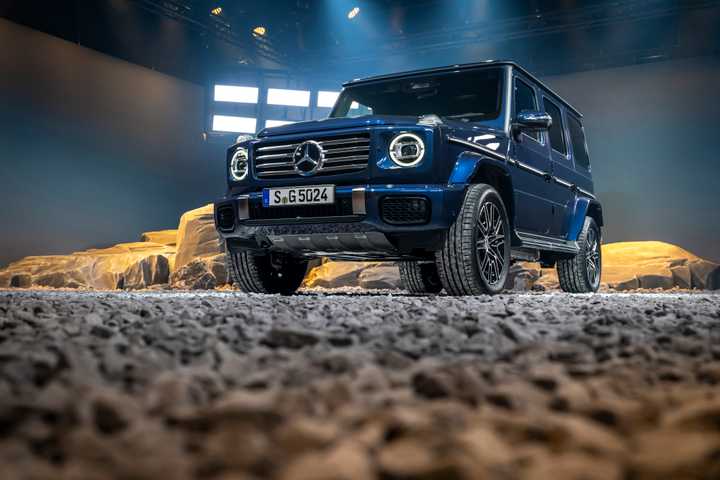

- Base Trim Engine
-
4L AMG V8 Hybrid
- Base Trim Transmission
-
9-speed automatic
- Base Trim Drivetrain
-
All-Wheel Drive
- Base Trim Horsepower
-
577 HP @6000 RPM
- Base Trim Torque
-
627 lb.-ft. @ 2500 RPM
- Base Trim Fuel Economy (city/highway/combined)
-
14/16/15 MPG
- Base Trim Battery Type
-
Lithium ion (Li-ion)
- Make
-
Mercedes-Benz
- Model
-
G-Class
Iconic To Aspirational, The G-Class Knows Just How To Shine

The iconic status of the G-Class has stood the test of time, often immortalized by Hollywood. Kim Kardashian owns one, Arnold Schwarzenegger drives it, and so do Kevin Hart, Mike Tyson, Bradley Cooper, Diane Keaton, Travis Scott, and many others. This often becomes a significant reason why anyone with the means to afford one wants one. The ‘I have arrived in life’ factor is silently signaled through the exhaust notes of the G. And it is music to the ears of the first and every subsequent owner.

10 Most Incredible Rides In Arnold Schwarzenegger’s Car Collection
A star like Arnold Schwarzenegger isn’t going to be messing around with subcompacts when there’s so much muscle to flex
Big Bucks For Big Dreams

The typical G-Class buyer isn’t someone looking for the best offers, whether in the new or pre-owned market. The potential customer is chasing something far more significant — a piece of automotive excellence, a lifestyle statement, and a machine that inspires admiration and envy in equal measures, whether on the move or just standing still.

Of course, the fact that the G-Class holds value the way it does and commands a hefty premium even when it does make way to the pre-owned market makes it a delicious deal that those who can afford it can’t resist. As the saying goes: A G-Wagen is either in your garage, in your bucket list, or at least in your dreams. But it’s there, alright, always.
Sources: Mercedes-Benz, JD Power, iSeeCars, KBB, duPont Registry, Boston Consulting Group