
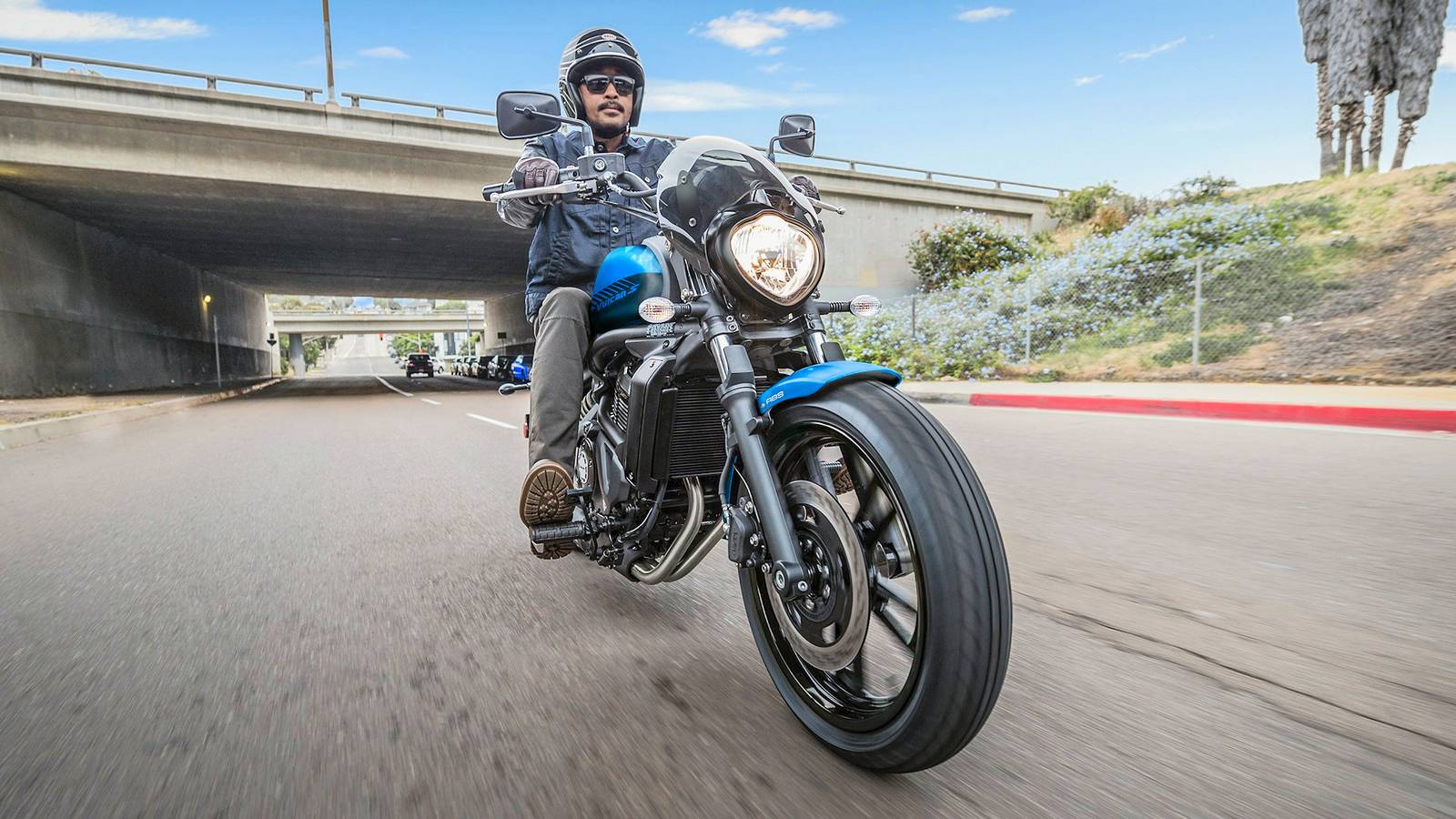
A larger-than-life appeal and even weight are two of the defining factors of a cruiser bike. Many OG cruiser bike owners actually love their bikes for the heft they carry. They don’t have much of an option, either, considering the behemoth engines they pack. But middleweight cruiser bikes are different. These cruisers put in all the effort to replicate the old-school formula of an OG cruiser bike, while trying to offer a nimble, compact, and relatively lightweight experience. Kawasaki has a special middleweight cruiser that perfectly elaborates on this idea.
Weight Is Often A Defining Factor Of A Big-Twin Cruiser Bike

Weight is a crucial factor that makes riding a cruiser bike special. A major advantage of a big twin cruiser bike‘s heft is highway stability. The higher mass (typically ranging from 600 to 800 pounds), combined with a long wheelbase, ensures that the motorcycle stays stable at high speeds for extended periods. No amount of wind gusts and highway sway will unbalance things.

The added weight, combined with a cruiser bike’s low center of gravity and a low seat height below 30 inches, further helps. Reasons why heft is an inherent property of a cruiser bike include heavy-duty raw materials for torque-rich engines, a sturdy steel chassis, and metal body parts. Comfort-focused engineering decisions, such as thick, padded seats, robust suspension, and sturdy underpinnings, contribute, too.
Many Middleweight Cruisers Try And Replicate This “Heavy” Feel

Many middleweight offerings are designed to mimic a quintessential cruiser bike‘s hefty appeal. Now, this is not possible with the engine choices because they are much smaller, in some cases, less than half that of what the big twin cruisers pack. But to replicate the experience with elevated stability, presence, comfort, and a planted feel, motorcycle makers make calculated decisions about using steel components for underpinnings and styling elements, and low-slung mass, even those that pack parallel-twin engines.

Prime examples include the long-standing Suzuki Boulevard C50 and the Kawasaki Vulcan 900 Classic. A charming 805 cc liquid-cooled V-twin powers the Suzuki cruiser bike, which has a seat height of 27.6 inches and weighs 611 pounds. The more popular Kawasaki offering is powered by a bigger 903 cc liquid-cooled V-twin, has a seat height of 26.8 inches, and weighs nearly 620 pounds. This replication of a big-bike feel, however, comes with the downsides of being less user-friendly, especially on urban roads. But the Kawasaki Vulcan S, built on a formula that deviates significantly from the OG cruiser bike packaging, is popular as a solid do-it-all motorcycle.

10 Cruisers That Will Run Forever With Basic Care
These bikes will give the Energizer Bunny a run for its money – and all they need is basic preventive maintenance done on time.
But The 2026 Kawasaki Vulcan S Can Do It All Without The Heft
Starts At $7,649

The Kawasaki Vulcan S doesn’t follow the seasoned cruiser formula. It is powered by a sport-bike-derived parallel-twin engine instead of a rumbling V-twin, and the underpinnings are lightweight. A short wheelbase, adaptive ergonomics, and loads of practical, accessory-focused options, including a pillion rider kit, are included, too. All of this is bundled into a package that starts at $7,649 for the non-ABS model and $8,149 for the ABS model; both cases uphold impressive value-for-money propositions. The cumulation of all these features makes the 2026 Kawasaki Vulcan S a do-it-all cruiser, while weighing notably lower than old-school rivals in its class.
Looks The Cruiser Bike Part, While Weighing Under 500 Pounds

The Vulcan S has the silhouette of a laid-back and stretched-out cruiser bike. It features a well-contoured, muscular fuel tank, complemented by a color-matched chopped rear fender. The short front fender is blacked out, along with the engine, exhaust system, and wheels, to emphasize its sporty side. Its chunky tires are a major part of the OG cruiser bike appeal, too.
Additionally, this is a relatively compact cruiser bike with a wheelbase of 62.0 inches. It is 90.9 inches long, 34.6 inches wide, and 43.3 inches high. The ground clearance is low at 5.1 inches, and the exhaust system is neatly integrated as an underbelly unit to maintain a clean, symmetrical design. The standout feature is its curb weight: 460.8 pounds for the non-ABS model and 467.5 pounds for the ABS model.

While the standard Vulcan S looks custom enough, Kawasaki also offers a Vulcan S Cafe model, priced at $8,749. It differs from the standard model with more custom-inspired bits, such as a two-tone paint job, signature tank badging, sporty stripes on the tank, and a dark-tinted visor. The Cafe model is only available with ABS.
Powered By A Versatile And Reliable Parallel-Twin Engine

Powering the Kawasaki Vulcan S is a very reliable 649 cc parallel-twin engine. This mill has been flexing its muscles since 2006 and has been a strong performer for over 20 years. Its first application was on the now-defunct Kawasaki 650R and the ER-6n models. Today, this mill powers the Ninja 650 sport bike, the Z650 streetfighter, the Versys 650 tourer, and the Vulcan S cruiser. It produces 60 horsepower at 7,500 RPM and 46.5 pound-feet of torque at 6,600 RPM. Power is sent to the rear wheel via a six-speed manual gearbox.
Flexible Chassis And Simple Hardware Make The Vulcan S Nimble

Complementing its versatile engine is a flexible frame shared with its stablemates. The engine sits as a stressed member in a perimeter frame made from steel tubes welded together. The chassis is suspended on 41 mm telescopic front forks with 5.1 inches of travel and an offset rear monoshock with linkage and adjustable preload offering 3.2 inches of travel.

Braking duties are courtesy of a 300 mm disc up front and a 220 mm disc at the rear. A two-piston front and single-piston rear floating calipers take care of the bite. Grip is taken care of by chunky 120-section front and 160-section rear tires wrapped around 18-inch front and 17-inch rear alloy wheels. The wheel-and-tire combo also contributes to this cruiser’s muscular appeal.
Clever Ergonomic Features Elevate Its Long-Distance Comfort

The Kawasaki Vulcan S is very accessible with a seat height of 27.8 inches. The rider triangle is relaxed, akin to a traditional cruiser bike, with forward-set footpegs and a tall, wide handlebar. However, there’s a party trick up the Vulcan S’s sleeve that adds adjustability to the already sorted riding triangle.

10 Most Overlooked Cruiser Motorcycles That Will Last A Lifetime
Some of the most reliable cruisers on the market remain underrated and overlooked

Called the Ergo-Fit, this Kawasaki-specific feature offers adjustable seat, handlebars, and footpegs to suit riders of varying heights better. Between Reduced Reach, Mid-Reach, and Extended Reach, 18 possible configurations help riders from 5 feet 7 inches to 6 feet 1 inch feel comfortable on the Vulcan S. With a shifting rider triangle, the center of gravity also shifts marginally, contributing to slightly different riding dynamics.
Source: Kawasaki