
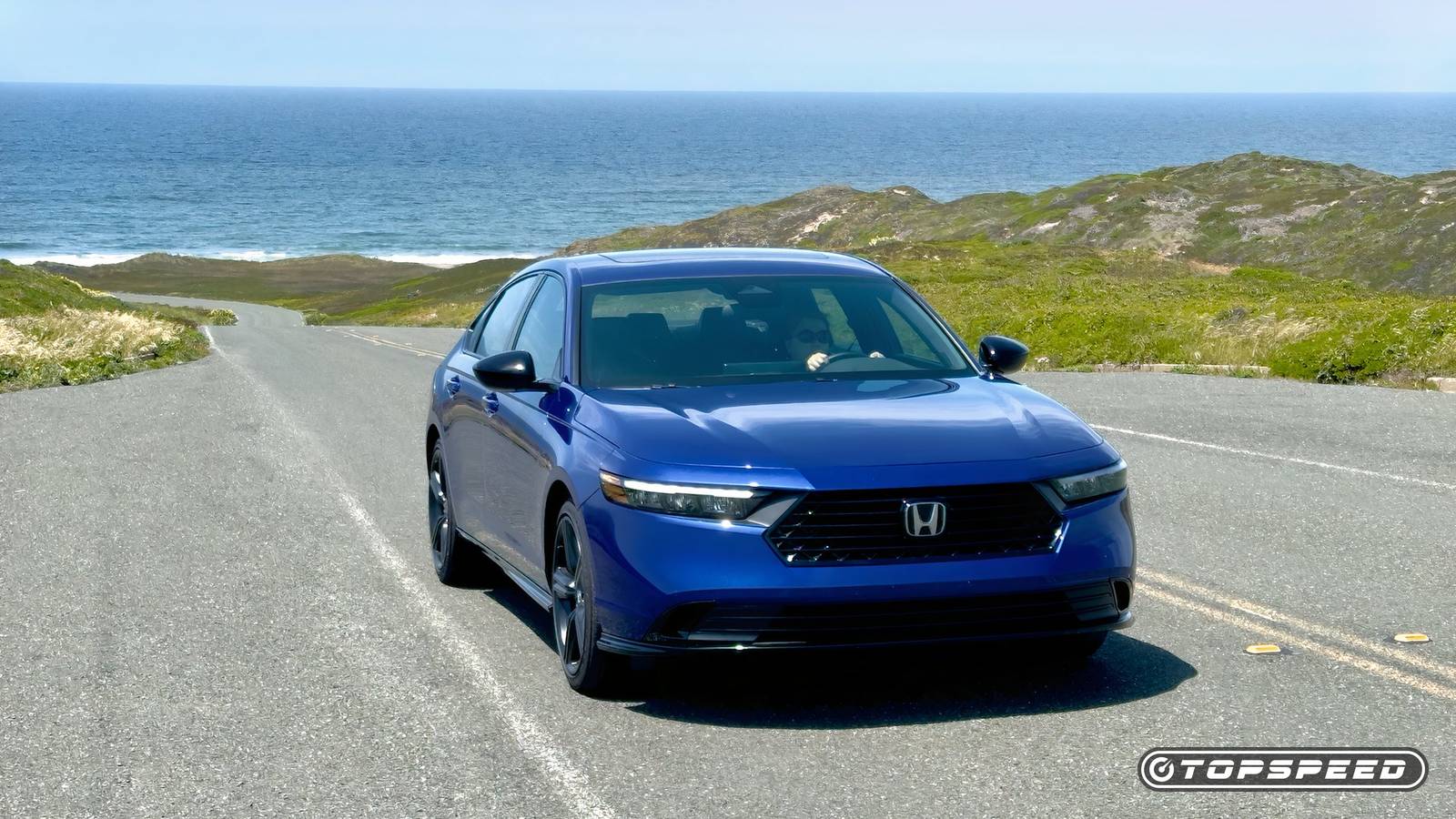
Honda’s Accord, celebrating its 50th anniversary this year, can claim a number of significant milestones. The first car from a Japanese manufacturer to be constructed in the United States, the Accord was also Honda’s first step toward becoming a full-line manufacturer. Consistently numbered among the best-selling cars in the States since its introduction, the Accord evolved from a compact hatchback into a midsize sedan and currently serves as Honda’s flagship offering in North America. Offering a distinctive blend of size, performance, comfort, fuel economy, and value, Honda’s Accord has become a benchmark against which offerings in this segment are measured.

- Base Trim Engine
-
2L Hybrid
- Base Trim Transmission
-
CVT
- Base Trim Drivetrain
-
Front-Wheel Drive
- Base Trim Horsepower
-
146 HP @6100 RPM
- Base Trim Torque
-
134 lb.-ft. @ 4500 RPM
- Base Trim Fuel Economy (city/highway/combined)
-
51/44/48 MPG
- Base Trim Battery Type
-
Lithium ion (Li-ion)
- Make
-
Honda
- Model
-
Accord Hybrid
In order to provide you with an honest and unbiased review, the vehicle reviewed in this article was driven on a daily basis throughout the course of daily life for a period of one week. For detailed insight into testing procedures and data collection, please review our methodology policy.
2026 Honda Accord Hybrid Sport-L Hybrid First Impressions
Currently in its eleventh generation, the CY2 (Honda’s internal designation) Accord Hybrid retains the front-drive layout Accords have employed since the model was introduced back in 1976. The current iteration, the CY-series, has been in production since 2023. If past is prologue, the model is due for a mid-cycle refresh within the next year or so. However, the current version goes so well, it’s hard to imagine what could be improved. Here, though, I must admit I haven’t always been a huge fan of the styling of the CY Accord. However, the look has grown on me over time—largely because of the way the car drives, which brings me to the next heading here.
Exterior Dimensions
|
Length |
195.7 Inches |
|
Width |
73.3 Inches |
|
Height |
57.1 Inches |
|
Wheelbase |
111.4 Inches |
|
Front Track |
62.6 Inches |
|
Rear Track |
63.5 Inches |
|
Curb Weight |
3,488 Pounds |
Driving Impressions And Performance

The CY2-series Accord is offered with two powertrains in the U.S. The example reviewed here used the model’s hybrid system, which married a normally aspirated 2.0-liter DOHC inline four-cylinder engine to a pair of electric motors. Total system output was 204 horsepower and 247 pound-feet of torque. Output was delivered to the front wheels through a continuously variable transmission with overdrive. The Accord’s other powertrain offering centers upon a 1.5-liter turbocharged four, which is good for 192 horsepower.

Smooth, quiet, composed, and yet fun to drive, the Accord offered confidence inspiring handling. Its steering was the epitome of precise, while its body motions were well-controlled. The Honda’s ride quality offered a high degree of compliance, which I found to be remarkable, given the eagerness with which the Accord cornered.

Under full throttle from rest, the CY2 Accord proved itself capable of sub-seven second runs to 60, according (no pun intended) to my Omega Speedmaster. Granted, that wasn’t exactly bulbus oculi flattening, however, it was more than adequate to fulfill the Accord’s primary mission as enjoyable family transportation. Further, at no point did the car feel underpowered.
Performance Specifications
|
Engine |
Gas/Electric I-4 |
|
Transmission |
CVT w/OD |
|
Horsepower |
204 HP @ 6,100 RPM |
|
Torque |
247 LB-FT @ 4,500 RPM |
|
Fuel Economy (CMB) |
44 MPG (EPA est) |
|
0-60 MPH |
6.6 Seconds |
|
Top Speed |
112 MPH (Governed) |
Honda Accord Hybrid Fuel Economy

According to EPA estimates, the Accord Hybrid is good for 46 mpg in the city, 41 on the highway, and 44 overall. This works out to be roughly 2.3 gallons every 100 miles. The Accord’s annual fuel cost estimate is $1,200, based upon 15,000 miles annually at $3.50 per gallon. Given the Honda’s 12.8 gallons of fuel capacity, one can expect approximately 563 miles of range.
|
City |
Highway |
Combined |
|
|
EPA Rated Economy |
46 MPG |
41 MPG |
44 MPG |
Interior Design And Comfort
Businesslike is the word that came to mind when I settled into the Accord Hybrid’s driver’s seat. The cockpit layout was as free of frills as it could possibly be. Yet it didn’t look stark. All primary controls were easily located and intuitively operated. I didn’t have to hunt for any of them. They were all exactly where I expected them to be.

The overall design of the interior hinted at the Accord’s sporty alter ego, while ensuring comfort and exhibiting quality. Integrating the HVAC outlets into the honeycombed dash trim cleverly relieved the architecture of clutter. Meanwhile, three large round dials afforded control over the ventilation system. Materials employed throughout the passenger compartment radiated a substantive look without evoking ostentation.

Legroom, shoulder room, hip room, and headroom were more than adequate at each of the primary seating positions. The 10.2-inch digital instrumentation screen was readily legible through the steering wheel, and the driving position was perfect. Outward visibility was largely unobstructed, which helped make driving the Honda an even more confidence-inspiring experience.
Interior Dimensions
|
Front |
Rear |
|
|
Headroom |
37.5 Inches |
37.2 Inches |
|
Shoulder Room |
57.9 Inches |
56.5 Inches |
|
Hip Room |
55.4 Inches |
55.4 Inches |
|
Legroom |
42.3 Inches |
40.8 Inches |
Technology And Ease Of Use
My Hybrid Sport L trimmed test car featured a 12.3-inch touchscreen infotainment interface, crowning the dash immediately adjacent to the instrumentation nacelle. Highly legible, logically arranged, and immediately responsive, the screen hosted Bluetooth, as well as wireless Apple CarPlay and Android Auto compatibility. Wireless phone charging was standard, as was the entire Honda Sensing driver-assistance suite of features. Its highlights included automated emergency braking and lane-departure warning, as well as adaptive cruise control and traffic sign recognition. Lane-keeping assist was standard as well.
Cargo And Storage Space
Quoted to measure 16.7 cubic feet, the Accord’s trunk proved to have more than enough carrying capacity to accommodate a family of four on an extended road trip. What’s more, the trunk can be expanded into the passenger compartment by folding the rear seatbacks. Doing so allowed the Accord to even accommodate a mountain bike, once I removed the bike’s front wheel.
-
Cargo Capacity
-
16.7 Cubic-Feet
2026 Honda Accord Hybrid Vs. Its Competitors


Honda’s Accord and Toyota’s Camry are often mentioned in the same breath. After all, the two models do go back and forth as the best-selling cars in the U.S. from year to year. Meanwhile, Hyundai’s Sonata, while not charting the sales numbers of its Honda and Toyota competitors, is also a formidable offering in this category. Accord Hybrid pricing starts at $33,795; Camry Hybrid starts at $29,300, and Sonata Hybrid starts at $29,200.
How The Honda Accord Hybrid Compares To The Hyundai Sonata Hybrid

- Base Trim Engine
-
2.5L Smartstream I4 ICE
- Base Trim Transmission
-
8-speed automatic
- Base Trim Drivetrain
-
Front-Wheel Drive
- Base Trim Horsepower
-
191 HP @6100 RPM
- Base Trim Torque
-
181 lb.-ft. @ 4000 RPM
- Base Trim Fuel Economy (city/highway/combined)
-
28/38/32 MPG
- Make
-
Hyundai
- Model
-
Sonata
- Segment
-
Midsize Sedan
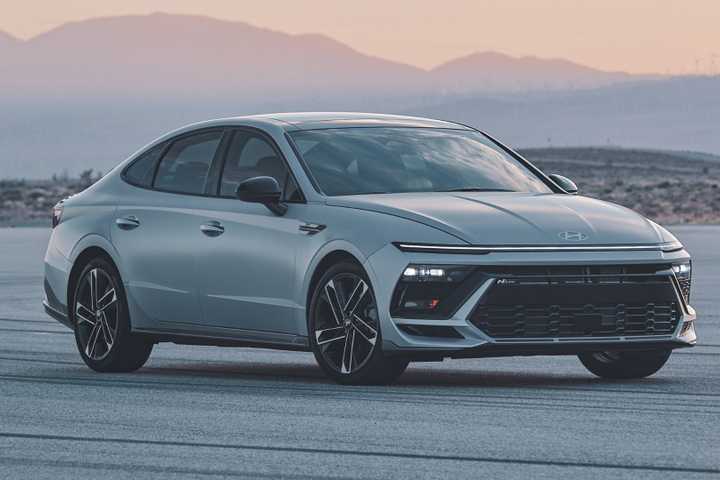
The Honda provides a more spacious cabin and greater horsepower than the Hyundai, while the Sonata brings more tech and a better warranty. The Sonata’s powertrain delivers 192 horsepower and 181 lb-ft of torque, while scoring EPA ratings of 47 mpg in the city, 56 on the highway, and 51 overall. The Sonata Hybrid also offers a remote smart parking assist, which can extract the car from parking spaces autonomously. It has a 360° camera too, which the Accord does not have. However, the Accord holds its value better, is more engaging to drive, and has a better reputation for reliability.
How The Honda Accord Hybrid Compares To The Toyota Camry

- Base Trim Engine
-
2.5-liter Four-Cylinder Hybrid
- Base Trim Transmission
-
CVTi-S CVT
- Base Trim Drivetrain
-
Front-Wheel Drive
- Base Trim Horsepower
-
184 HP @6000 RPM
- Base Trim Torque
-
163 lb.-ft. @ 5200 RPM
- Make
-
Toyota
- Model
-
Camry
- Segment
-
Midsize Sedan
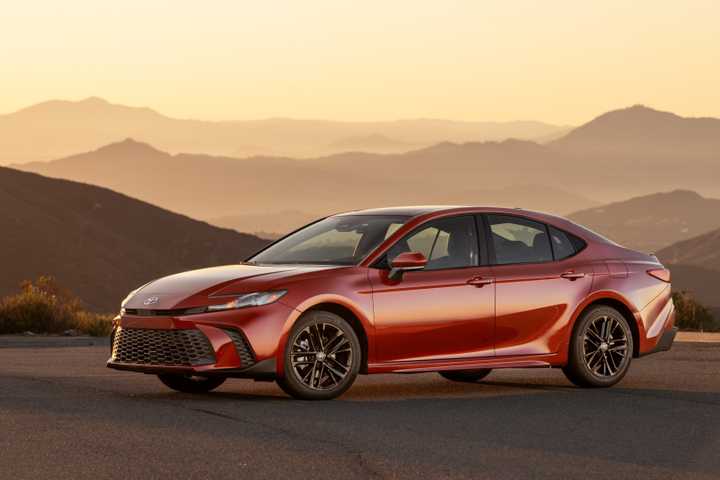
Now a hybrid-only offering, the Toyota bests the Honda in terms of fuel economy, with an EPA estimate of 51 mpg combined. The Toyota Camry also offers an all-wheel drive option, which the Accord does not. However, dynamically, the Accord is more enjoyable to drive. The Honda also offers a more refined ride, better handling, and a more spacious cabin. While the Camry’s base price is lower, you’ll need to move into a higher trim than the base model to get a comparably equipped Camry, which makes the price somewhat less than relevant when comparing the two.
Our Recommendation For Which Model You Should Buy So, which one is the one to run? It really comes down to the things you value most. The Toyota Camry is the best choice for pure efficiency, while the Honda Accord Hybrid offers the most fun driving experience and greater interior space. The two are neck and neck in terms of reliability. The Hyundai Sonata Hybrid stands out as the value-oriented option with a bold, futuristic design and a lower price tag.
That said, the Camry is the only one to offer all-wheel drive, while the Accord offers the sharpest handling.
Meanwhile, the Honda and Toyota are more refined than the Hyundai. On the other hand, Hyundai’s 10-year/100,000-mile powertrain warranty and three-year/36,000-mile complimentary maintenance offering tops both Honda’s and Toyota’s plans.

Although it should be noted, Honda offers a year of scheduled maintenance at no additional charge. Bottom line, all things considered, I’d go with the Accord, as it is the most interesting car of the three for me. And yes, fifty years after it was introduced, the 2026 Honda Accord remains the benchmark by which all entrants in the category should be measured.