
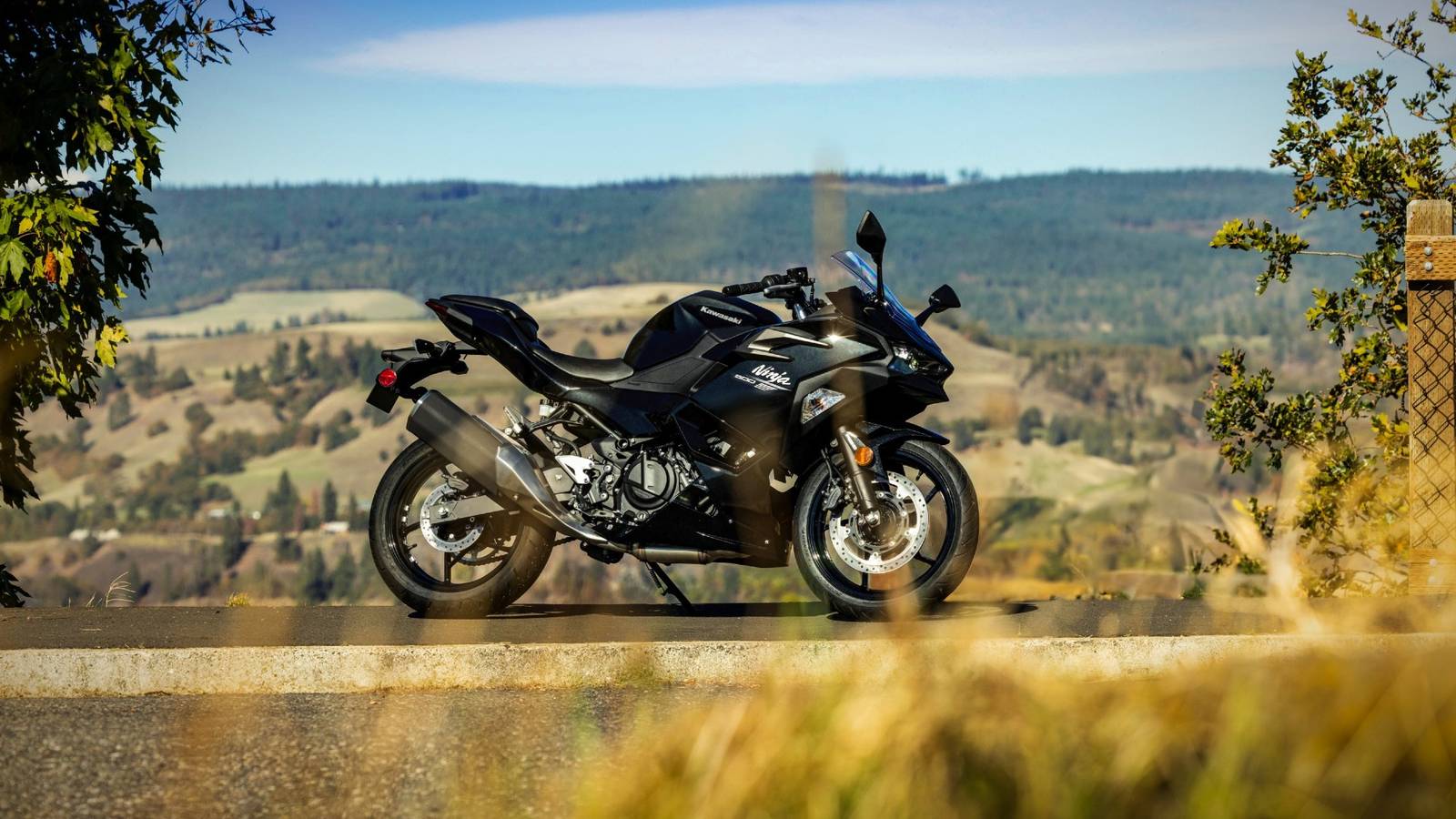
Each year, a large percentage of new riders go down the rabbit hole of finding their perfect first motorcycle. Only to realize there is no such thing as a perfect motorcycle. It all depends on what you want from your bike, and if you’ve grown up with Rossi posters on the wall, there’s a high chance you want a sports bike. Inevitably, you’d also want to build skills to feel like Rossi and lean into a corner with your knee glazing on the ground. Sadly, that’s easier said than done, and life becomes a whole lot more difficult if you don’t pick the right first bike. An ideal way to go is picking a lightweight, proven, and confidence-inspiring offering.
More Complexity Means More Weight

This stands true for nearly all kinds of motorcycles. The more features and cubic capacity you add, the more a motorcycle weighs. It’s a similar story with adding design elements like fairings and large body panels. As a result, all liter-class sports bikes all weigh well over 420 lbs. Yes, that is lighter than their liter-class ADV and tourer contemporaries, but this is still quite heavy for a not-so-experienced rider looking to build confidence.
Middleweight Sports Bikes Are Even Heavier

The state of middleweight sports bikes is worse. In a hunt for tighter prices and more practicality, the engines are bigger and built to a cost to maintain reliability rather than using expensive materials with tighter tolerances. Also, many bikes prefer materials like steel over aluminum. Add to that new features, and you have bikes that weigh similar to full-size liter-class bikes. For example, the Yamaha YZF-R9 is one of the high-spec machines in the midweight space that uses an aluminum chassis. Yet, it weighs 430 lbs fully fueled–just two pounds less than the Honda CBR1000RR and seven pounds less than the BMW S 1000 RR.
This Is Where Entry-Level Sports Bike Come In

Thus, if you want a lightweight, fully faired bike to build confidence on, the entry-level segment is where you should look. These bikes have an average weight of well under 400 lbs, which means easy handling and a less intimidating ride. The price also makes matters sweeter, with the average price of sub-500cc sports bikes hovering well under $7,000. That, in turn, means if you dump the bike (which is part of the learning process), it won’t burn a big hole in your pocket. Oh, and you still get a handful of modern features, as is the trend nowadays.
The Kawasaki Ninja 500 Is Lightweight And Helps Build Real Riding Confidence

Now that you know entry-level bikes are the answer here, we’d recommend the Kawasaki Ninja 500. Why, you ask? Well, because of its unbeatable blend of simplicity, class-leading performance, and versatile capabilities. At the same time, the Ninja weighs just 372 lbs wet without ABS and 377 lbs wet with ABS. That is almost 10 lbs less than the Aprilia RS 457, while being right in the ballpark of the CFMoto 450SS. The Honda CBR500R, meanwhile, weighs a whopping 44 lbs more.
At the same time, the saddle height and riding dynamics are super easy-going, which will help build confidence in the real-world. And if you want to hit the track, the Ninja has proven its mettle repeatedly there as well. A class-leading aftermarket support helps, too. So, be it the engine, chassis, or underpinnings, there’s an aftermarket upgrade for everything.
Upright Ergonomics And Predictable Handling Boost Confidence

Diving deeper, the ergonomics and handling are ideal for riders looking to learn sports bike riding. Your hands go on tall clip-on handlebars, while the feet rest on mid-set footpegs. Add the low 30.9-inch seat height (lowest in the class), and you have a sporty yet upright riding position. Kawasaki also offers its ERGO-FIT platform here, meaning you can fine-tune the ergos to suit exactly your stature.
The underpinnings follow a similar brief, prioritizing simplicity rather than going in any extreme direction. That’s evident from the steel trellis chassis, suspended on 41 mm telescopic forks and a monoshock. Only the rear has adjustability here, while each end works in tandem with 17-inch cast alloy wheels. Rounding things off are single disc brakes (310 mm front/220 mm rear).
Compact Wheelbase, Ample Ground Clearance, And An Uber-Low Weight

All those bits help keep the dimensions compact. The wheelbase is well under 55 inches, the ground clearance is almost 6 inches, and the tank capacity is over 4 gallons. With the latter full, the Ninja 500 weighs just 372.6 lbs (without ABS). Add ABS, and the figure rises to 377 lbs. Considering no one really rides on a full tank all the time, you will technically live with a sub-370-pound motorcycle for the most part. And that is really light!
Basic Features Ensure There Is Little That Can Go Wrong

The Ninja 500 is one of the most basic bikes in its class. No TFT, no electronic aids as standard, and no fancy tidbits like a six-axis IMU to make your life easier. While that does make it seem ancient, it also means there is little to go wrong in the first place. You can also argue that a motorcycle of this caliber doesn’t really need all that electronic wizardry. You’ll learn by not having those features and become a better rider with the fundamentals all clear, rather than your mistakes being masked by electronics. That said, the basics are all there, such as:
- Slipper clutch
- LED lights
- Digital instrument cluster
- Smartphone connectivity
The 451cc Twin-Cylinder Engine Is Peachy

While the Ninja 500 seems basic everywhere else, the story is different on the performance side of things. The 451cc engine has a parallel-twin layout and liquid cooling, along with a mildly spicy 11.3:1 compression ratio. All that helps it produce 51 HP and 31.7 LB-FT, where the former is the highest among its peers. For reference, the Aprilia RS 457 has 47 HP, the KTM RC 390 has 44 HP, and the CFMoto 450SS peaks at 50 ponies.
And It Promises Over 60 Miles Per Gallon

The output is class-leading, yes, but somehow, Kawasaki also claims an impressive 61 MPG for the Ninja 500. You will have to be easy on the six-speed transmission to achieve this figure, though. Expect the efficiency to drop below 50 MPG if you’re not easy on the gas and keep chasing the redline.