
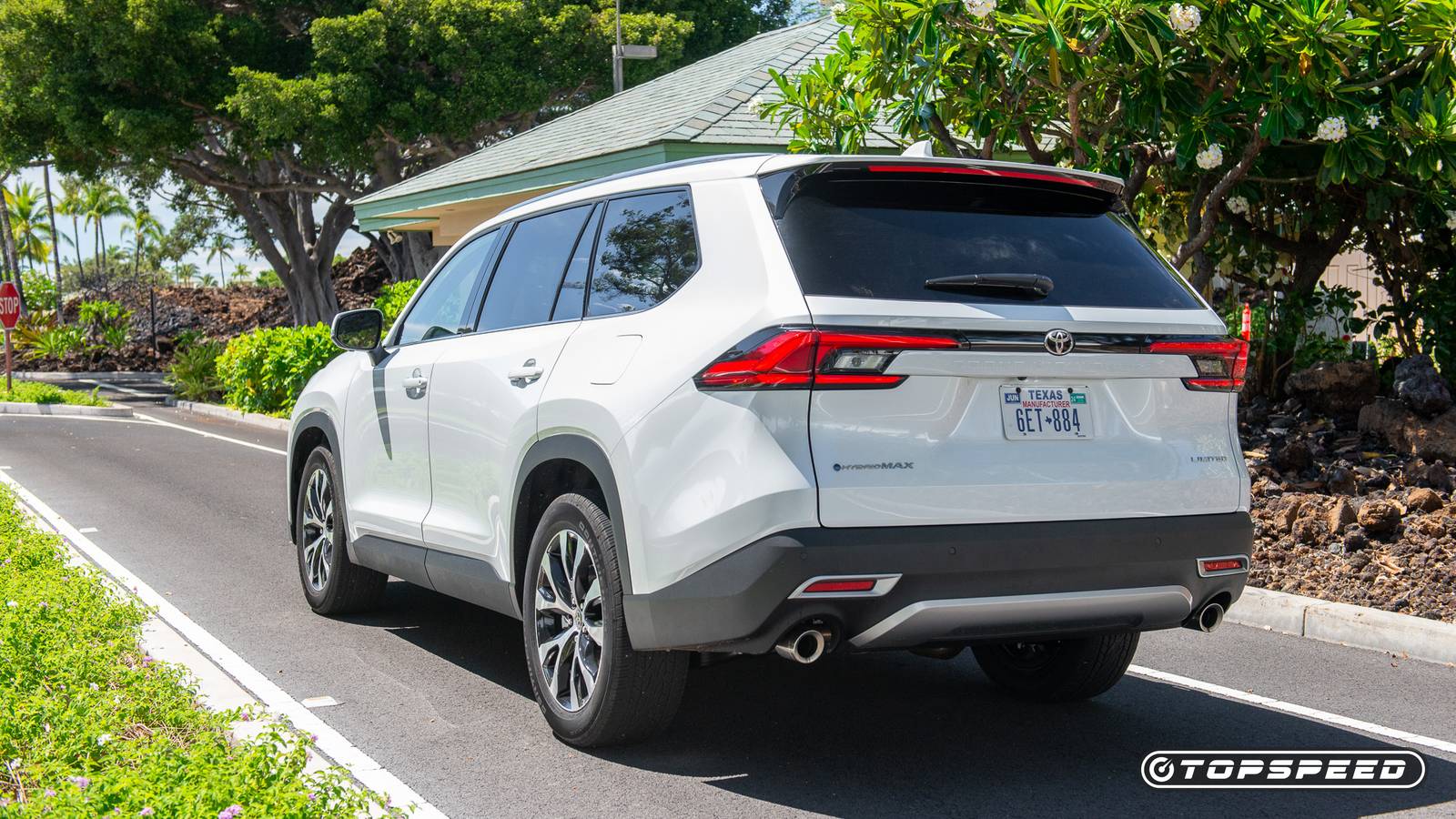
Toyota is currently capitalizing on the crossover and SUV sales craze in the U.S. by offering a wide variety of high-riding options suited to multiple driving scenarios. This includes seven- and eight-seater SUVs, one of which seems to be performing incredibly well, according to the brand’s January and February 2026 sales report.
The 2026 Toyota Grand Highlander is the larger and premium option compared to the standard Highlander. Despite its more premium position, the Japanese brand confirms that it has been a more popular option compared to its smaller counterpart. This is a bit of a curious case, but once you look at the two products on paper and Toyota’s confusing pricing strategy, it becomes easier to understand.
Toyota’s Upsized Family Mover

The 2026 Toyota Grand Highlander is a purpose-built, mid-size family hauler designed to bridge the gap between the standard Highlander and the full-size, truck-based Sequoia. Within Toyota’s extensive SUV hierarchy, it serves as the best unibody SUV offering, prioritizing maximum interior volume and on-road refinement over the rugged off-road focus of the 4Runner or Land Cruiser.
Its primary target audience is active families who prioritize interior space but don’t need more capability than a minivan like the Sienna could offer. They also don’t want to deal with the heavy-duty driving dynamics and poor fuel economy of a full-size body-on-frame SUV.
Understanding The Grand Highlander’s Popular Reputation

Thanks to Toyota’s longstanding reputation in the U.S. market, the Grand Highlander benefits from some impressive review scores and reliability ratings. J.D. Power awards the 2026 model year with an 82/100 consumer-verified overall score, including 82/100 for quality and reliability, 82/100 for the driving experience, 90/100 for resale, and 76/100 for the dealership experience.
On the depreciation front, iSeeCars indicates that you can expect to lose $14,601 or 35.7 percent of the Grand Highlander’s value after five years and 60,000 miles of usage, which is substantially better than the typical depreciation in this segment.

How Much You’ll Save In Fuel Costs Driving The Toyota Grand Highlander Hybrid
Regardless of how your family uses the Toyota Grand Highlander, there are powertrain choices to help you save on fuel costs, including two hybrids.
Impressive 2026 Sales Performance

According to the February 2026 sales report, Toyota managed to sell 11,106 Grand Highlanders, reflecting a 21 percent year-on-year sales increase. This brings the tally for the year up to 20,712 units, resulting in a 37.5 percent year-on-year improvement. Toyota only sold 5,164 Highlanders during February 2026, revealing a 35.1 percent year-on-year sales increase.
The primary difference between the 2026 Toyota Highlander and the Grand Highlander is physical scale and passenger utility, with the Grand Highlander being 6.5 inches longer and having a four-inch longer wheelbase.

This extra length translates to a significant 5.5 inches of additional third-row legroom, making the Grand Highlander more adult-friendly in the rear row. Additionally, the Grand Highlander has the benefit of more usable cargo space, regardless of the rear seating position.
Interestingly, because the 2026 Highlander has repositioned itself as a more premium offering by making all-wheel drive standard and dropping its lowest base trim, it has a higher starting MSRP than the more entry-level, front-wheel drive-equipped Grand Highlander LE.
The Grand Highlander’s Balanced Specification

The entire 2026 Toyota Grand Highlander range includes a standard 12.3-inch touchscreen featuring wireless Apple CarPlay and Android Auto and seven USB-C ports. Standard convenience features include a three-zone automatic climate control system, a power liftgate, and the Toyota Safety Sense 3.0 suite. The entry-level $41,660 LE trim includes an eight-passenger fabric seating configuration and 18-inch wheels, while the $44,430 XLE includes SofTex-trimmed heated front seats, a wireless smartphone charger, and an auto-dimming rearview mirror.
True Luxury From The Upper Trims

The $49,160 Limited adds leather-trimmed heated and ventilated front seats, and heated second-row seats, which you can have as captain’s chairs or a bench. You also get a premium 11-speaker JBL audio system, a hands-free power liftgate, and 20-inch alloy wheels. The flagship $54,845 Platinum includes a standard panoramic glass roof, a 10-inch color head-up display, a digital rearview mirror, and a panoramic view monitor for 360-degree visibility.
New for 2026 is the Hybrid Nightshade, priced at $53,490. This offers a specialized aesthetic with black-out exterior accents and 20-inch black wheels, matching the Limited trim’s high-end feature set. All-wheel drive adds $1,600 to the final price, but it is standard on Platinum and Hybrid Max trims.

The Most Reliable 3-Row SUV: Grand Highlander, Pilot, Or Palisade?
Choosing between these three-row SUVs comes down to proven reliability, which takes the crown for long-term peace of mind?
Impressive Reliability And Performance Returns

The Toyota Grand Highlander Hybrid clearly prioritizes efficiency over performance, despite featuring a powertrain that produces a fair amount of power. Under the hood, you’ll find a naturally aspirated 2.5-liter four-cylinder Atkinson-cycle engine that produces 186 horsepower at 6,000 RPM and 177 pound-feet of torque at 4,400 RPM.
Joining this is a pair of permanent-magnet electric motors that increase the combined output to 245 horsepower. Unfortunately, Toyota doesn’t declare the model’s combined torque output or specify how much power each of its motors generates. Both the front-wheel drive and all-wheel drive models feature Toyota’s direct-drive eCVT system. The Turbocharged model produces a combined 362 horsepower and 339 pound-feet of torque, with the engine alone generating 271 horsepower. This particular configuration employs a conventional six-speed automatic transmission.

As per Toyota’s claims, you can expect both variations to cover a zero to 60 MPH acceleration sprint in around 7.2 seconds with a 113 MPH top speed. The Hybrid Max boasts a claimed 6.3-second 0-60 MPH time, but independent reviewers were able to cut this down to an impressive 6.1 seconds. Both systems feature two permanent-magnet motors, but Toyota shifts the second motor to the rear axle for the all-wheel drive option, which is why it boasts the same performance outputs and figures.
All hybrid variations also feature an identical 3,500-pound towing capacity, making it a fairly practical and capable three-row family SUV option. The turbocharged model increases this capacity to a more accommodating 5,000 pounds. If hybridization isn’t your thing, you can have the Grand Highlander with the 2.4-liter turbocharged four-cylinder and eight-speed automatic, driving 265 horsepower and 310 pound-feet to your choice of the front or all four wheels, both of which will cover zero to 60 MPH in 7.5 seconds.

10 Alternatives To The Toyota Grand Highlander Hybrid
These are the best rivals you can consider over Toyota’s three-row HEV SUV.
Appealing Fuel Consumption Returns
The base entry-level Toyota Grand Highlander Hybrid front-wheel drive option covers an EPA-estimated 619 miles on a single tank of gas from its 17.2-gallon tank, making it the Japanese hybrid SUV with the highest estimated range claim in the new vehicle market. It also returns an impressive 37/34/36 MPG estimate on the EPA’s city/highway/combined cycle. Upgrading to the all-wheel-drive system means that your range decreases to 585 miles, while efficiency worsens to a 36/32/34 MPG set of estimates.
The flagship Limited and Platinum trims are pretty much unchanged, apart from their 34 MPG highway estimates. If you drive the base model, the EPA estimates that you’ll save around $2,000 on fuel every five years compared to the average new vehicle sold in the U.S., pay $2.40 to drive it 25 miles, and $59 to fill the tank. It also estimates you’ll spend $1,450 on fuel every year.

For the turbocharged 2.4-liter four-cylinder Hybrid Max option, the best range this configuration will get you is 464 miles, as it features the same tank and battery. In return, you benefit from much better performance figures and towing abilities, so it really does cater to a completely different demographic.
As for the ICE model, the EPA estimates that it will consume 21/28/24 MPG and cover 427 miles on a single tank. Expect to spend $1,500 more on fuel over five years, $1,900 on fuel every year, and $3.15 to drive 25 miles. The all-wheel drive worsens consumption to 21/27/23 MPG and range to 409 miles. You will find yourself spending $1,750 more on fuel every five years, $1,950 every year, and $3.28 to drive 25 miles.
Sources: The EPA, iSeeCars, and J.D. Power