
For years, the Honda CR-V has defined what a compact SUV should be in America. Practical, efficient, roomy, and relentlessly dependable, it became the default answer for families who didn’t want to overthink their purchase. But the compact SUV segment is no longer predictable.
Buyers are demanding more design personality, more technology, and more perceived value — without stepping into luxury-brand pricing. And in that shifting landscape, one underdog is gaining serious traction. The Kia Sportage isn’t just competing anymore. It’s positioning itself as a vehicle that could realistically challenge — and potentially outsell — one of America’s best-selling SUVs.
The Compact SUV Segment Is No Longer A One-Horse Race
Why Even Dominant Players Like The Honda CR-V Face Growing Competition

The CR-V remains a sales powerhouse in the United States, routinely ranking among the top-selling SUVs nationwide. Its formula is straightforward: strong resale value, smooth ride quality, excellent fuel efficiency (especially in hybrid form), and Honda’s reputation for durability. For 2025, the Honda CR-V starts at $30,920 for the base LX trim and climbs into the mid-$30,000 range for hybrid variants before topping out at $42,550 for the Sport Touring Hybrid trim.

Power comes from a 1.5-liter turbocharged four-cylinder producing 190 horsepower, while hybrid trims combine a 2.0-liter engine with electric motors for 204 horsepower and excellent fuel economy. It’s balanced. It’s rational. It’s safe. But the segment has evolved dramatically. Today’s compact SUV buyer isn’t just looking for reliability. They want standout design, large digital displays, premium-feeling materials, advanced driver assistance systems, and strong warranty coverage. That’s where the Kia Sportage begins to change the conversation.

If You Love The Toyota RAV4, Here Are 10 Other SUVs You Should Check Out
The RAV4 has a lot of competition in the U.S., leaving consumers spoiled for choice.
How Styling And Road Presence Influence Buyer Decisions

If there’s one area where the Sportage clearly distances itself from the CR-V, it’s design. The latest-generation Sportage embraces sharp lines, boomerang-shaped LED daytime running lights, a wide grille treatment, and a futuristic front fascia that feels closer to a concept car than a conservative crossover. Where the CR-V plays it safe, the Sportage plays bold.

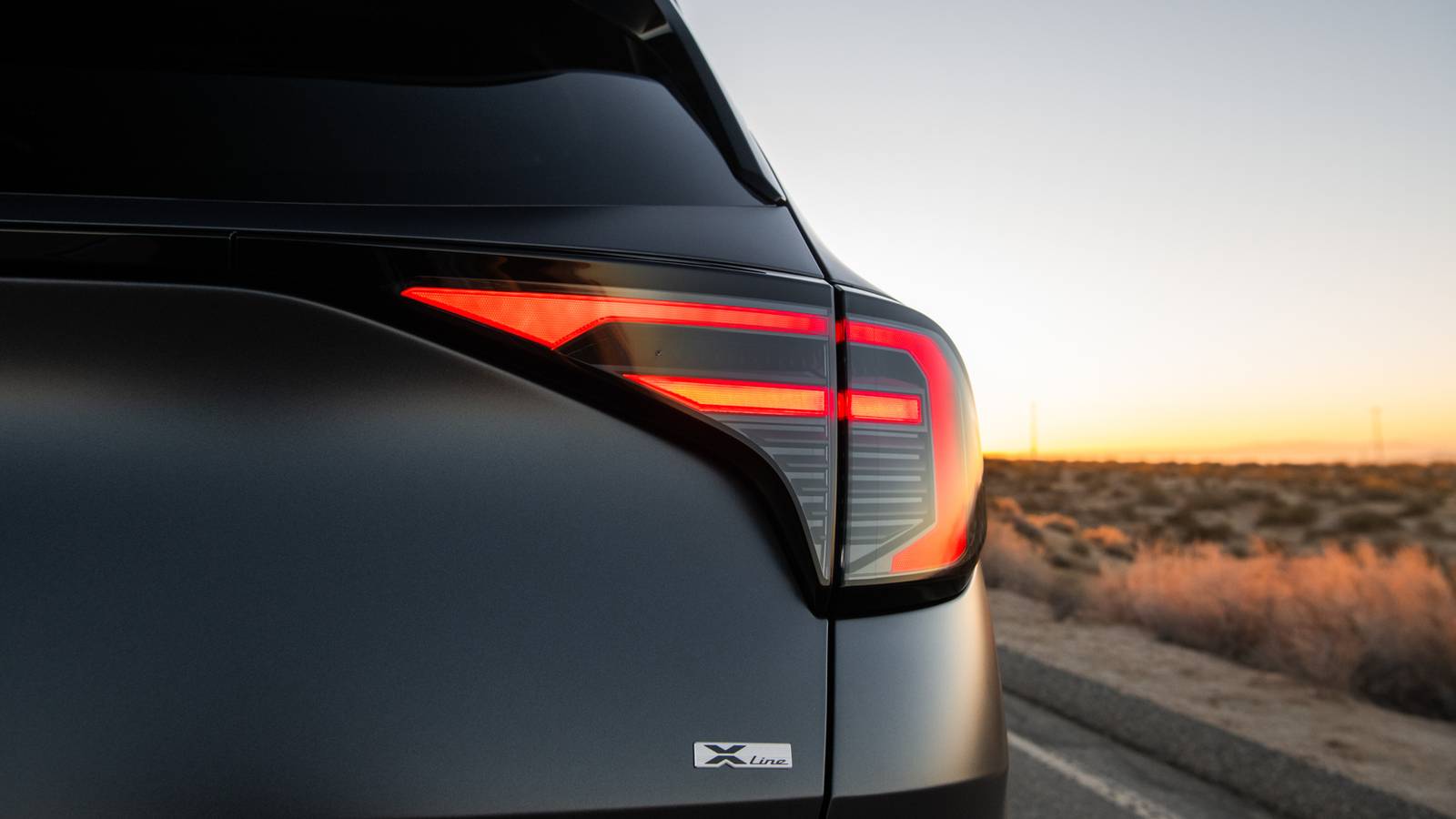
From the side profile, the longer wheelbase (108.5 inches) gives it a planted stance. The overall length of 183.5 inches allows for a strong road presence without entering midsize territory. Available 19-inch wheels on higher trims reinforce its upscale ambitions. At the rear, distinctive lighting signatures and sculpted bodywork give it a more premium aesthetic than its price suggests. In a market where buyers increasingly prioritize style alongside substance, that visual impact matters.

10 Most Practical And Versatile Hybrids For Everyday Life
With EV incentives diminishing, and gas not getting any cheaper, hybrids can save thousands at the pump. Here’s 10 that are great for all buyers.
Interior Quality Is Where The Sportage Feels Surprisingly Premium
First-Hand Impressions Of Technology, Materials, And Comfort

Step inside the Sportage — especially upper trims like the X-Line Limited or Hybrid SX-Prestige — and it immediately feels more ambitious than its mainstream badge suggests. A curved dual-display setup integrates two available 12.3-inch screens — one for infotainment and one for the digital instrument cluster. The design feels modern and cohesive rather than pieced together.
The cabin is nicely soundproofed, keeping road and wind noise to a minimum. It’s a relaxing space that is easy for conversation. Rear passengers can recline their seats with a lever that’s within easy reach so they can get more comfortable or take a little nap.
– Nicole Wakelin, TopSpeed Journalist
In Real-World Use, The Cabin Feels Quiet And Refined

Material quality is impressive for the segment. Available SynTex seating surfaces, contrast stitching, soft-touch panels, and metallic trim elements elevate the atmosphere. Heated and ventilated front seats, a heated steering wheel, and a panoramic sunroof are available — features that often require stepping into near-luxury territory with competitors. Cargo space is generous as well. The Sportage offers up to 39.6 cubic feet behind the second row and over 74 cubic feet with the seats folded — competitive with the CR-V and among the best in class.

There’s thoughtful attention to ergonomics, though the touch-sensitive climate/media toggle panel may take adjustment for drivers who prefer physical buttons. For buyers cross-shopping the CR-V, the Sportage’s interior presentation may feel more upscale and more visually engaging.

5 Great Ways To Configure The 2026 Honda CR-V Hybrid
These five configurations highlight how versatile the CR-V Hybrid can be.
Driving The Sportage Reveals Its Everyday Strengths
Ride Quality, Refinement, And Real-World Usability

Under the hood, Sportage models offer several powertrains. The standard engine is a 2.5-liter naturally aspirated four-cylinder, producing 187 horsepower and 178 pound-feet of torque, paired with an eight-speed automatic transmission. It’s not quick, but it delivers smooth, predictable performance for daily driving.

For buyers seeking more efficiency and power, the Sportage Hybrid combines a 1.6-liter turbocharged engine with an electric motor, producing a combined 232 horsepower. A plug-in hybrid variant increases output to 268 horsepower, offering both improved acceleration and limited electric-only driving capability.
It responds to a heavy foot on the gas with strong acceleration, but it’s not outright aggressive. It provides the power you need, but it’s not a performance rock star.
– Nicole Wakelin, TopSpeed Journalist
Ride Quality Is Where The Sportage Shines

Suspension tuning favors comfort over sportiness, absorbing road imperfections effectively while maintaining composure at highway speeds. Steering is light and easy for urban maneuvering, making it well-suited for everyday commuting.

Noise insulation is strong, and the cabin remains calm even on rougher surfaces. In daily driving scenarios — school runs, grocery trips, long highway drives — the Sportage feels well-rounded and refined. It may not be thrilling, but neither is the CR-V. In this segment, composure and comfort win more buyers than sharp cornering.
Why Buyers May Increasingly Choose The Sportage
Value, Features, And Shifting Consumer Perception

Pricing is where the Sportage becomes especially compelling. The 2026 Kia Sportage starts at $28,790, undercutting the base CR-V. Even well-equipped trims remain competitively priced relative to similarly equipped Hondas. But pricing alone isn’t the full story. Kia backs the Sportage with a 10-year/100,000-mile powertrain warranty, one of the strongest in the industry.

That level of coverage offers reassurance that even the CR-V doesn’t match. Standard and available features — including adaptive cruise control, blind-spot monitoring, lane-keeping assist, forward collision avoidance, and available surround-view camera systems — are comprehensive. Consumer perception of Kia has shifted significantly over the past decade. Once considered budget-focused, the brand now consistently ranks well in quality surveys and customer satisfaction metrics.
The Sportage Is Going Toe-To-Toe With The Segment’s Best

Hyundai Motor Group’s rapid engineering improvements have reshaped how American buyers view the brand. And buyers notice. The compact SUV segment is fiercely competitive, with rivals including the Toyota RAV4, Hyundai Tucson, Mazda CX-5, Subaru Forester, and Nissan Rogue.

But among them, the Sportage may offer the strongest combination of bold styling, premium interior feel, competitive pricing, hybrid availability, and industry-leading warranty coverage. The CR-V still excels in brand trust and resale value. But trust alone may not be enough to guarantee dominance forever.
A Shift In The Segment

The Honda CR-V built its legacy on predictability. The Kia Sportage is building momentum on confidence. In a market where consumers are increasingly willing to cross-shop beyond traditional brand loyalties, the Sportage checks more boxes than ever before. It looks more daring. It feels more premium. It offers competitive — and in some cases superior — warranty coverage. And it undercuts the segment leader on entry pricing.

Will it immediately dethrone the CR-V? That remains to be seen. But the compact SUV segment is no longer a one-horse race — and the underdog is running much closer to the front than many expected. Ultimately, the compact SUV segment is being reshaped by buyers who are no longer defaulting to the familiar choice. Brand loyalty still matters, but design, technology, warranty coverage, and overall value now carry equal influence in purchase decisions.

The Kia Sportage enters that conversation not as a budget alternative, but as a fully realized competitor with mainstream credibility. If current trends continue — especially as hybrid demand grows — the Sportage has the ingredients to narrow the sales gap significantly. The CR-V remains formidable, but for the first time in years, it no longer feels untouchable.