
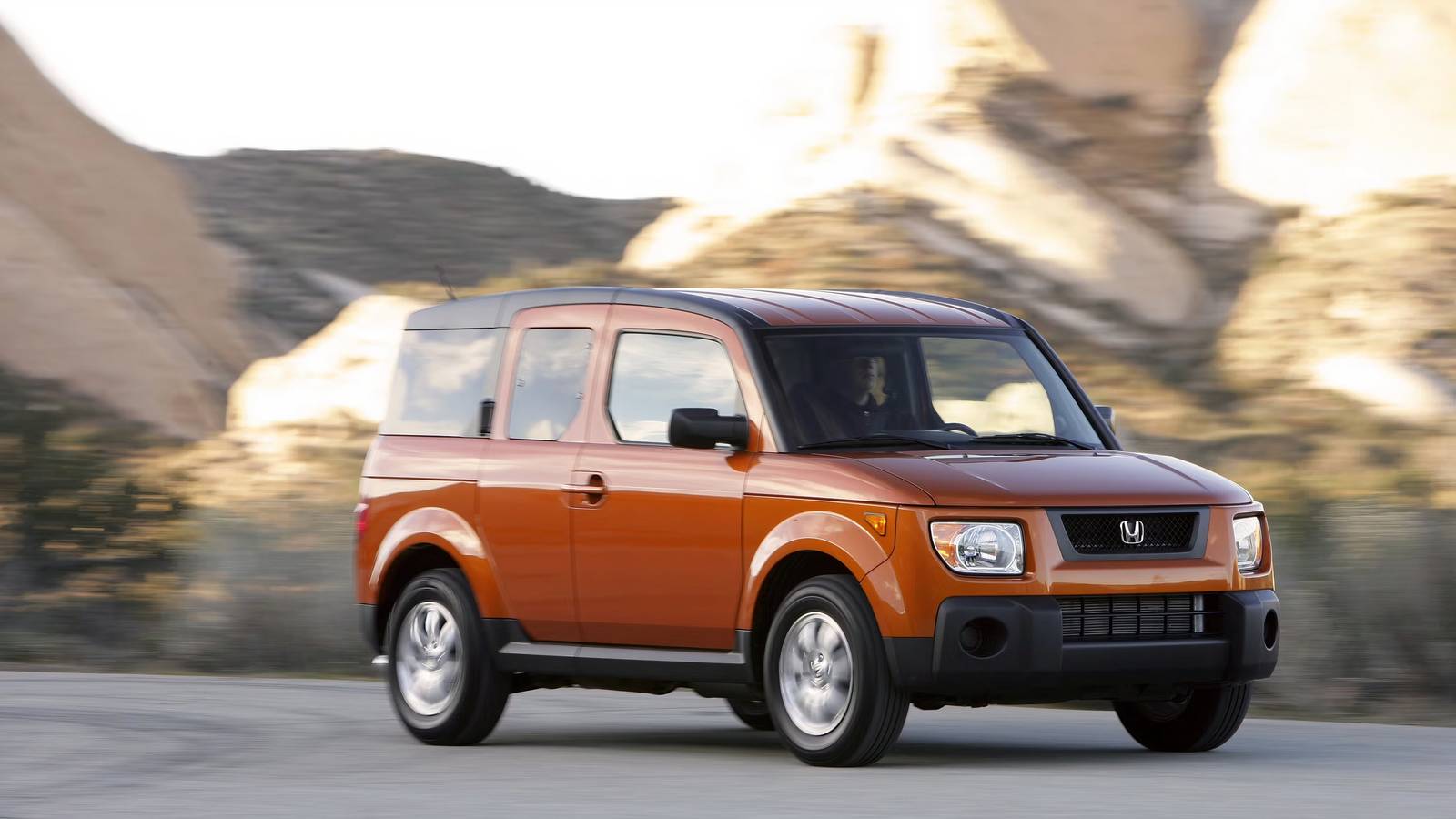
Honda, one of the world’s leading Japanese automakers, is synonymous with practicality. Yet, in the company’s storied history, few vehicles have been as multi-functional as the Honda Element. It debuted in 2003 with clamshell doors, an interior designed for power washing, and a unique marketing campaign targeting young adults with active lifestyles. Throughout its nine-year production run (2003-2011), it sold well, but didn’t break any records. In this relatively short time frame, the Element grew a loyal following. Thus, when it was discontinued without any replacement, a lot of buyers were left a bit confused. Let’s break down what the Element’s intentions were, what it actually became, and why you should still buy one today.


- Base Trim Engine
-
2.4L Inline-4 Gas
- Base Trim Transmission
-
5-Speed Automatic
- Base Trim Drivetrain
-
Front-Wheel Drive
- Base Trim Horsepower
-
166 hp
- Base Trim Torque
-
161 lb-ft @ 4000 rpm
- Fuel Economy
-
20/25 MPG
- Base Trim Battery Type
-
Lead acid battery
- Make
-
Honda
- Model
-
Element
The Honda Element: A Purpose-Built Vehicle

There are vehicles built for practicality, and then there is the Honda Element. As far as design, the Element is one of Honda’s most deliberate vehicles. The premise was simple: build a small SUV for young adults who lived active outdoor lifestyles. Nowadays, that might not sound like a unique target demographic, but in 2002, the concept was novel.
The Makings Of Everyday Excellence

If there is one defining characteristic of the Honda Element, it’s the pillarless entry system. Without a conventional B-pillar between front and rear doors, the Element could open up in a so-called “clamshell” design. The result was a small SUV with a lot of room for activities. Loading and unloading cargo feels so easy compared to standard SUVs, thanks to this design. The wide opening made almost anything accessible, whether that was a kayak, a bike, or other large, awkwardly shaped items.

Interior efficiency improved with the rear seat design, which allowed the seats to fold flat or up against the cabin sides. This creates a large flat storage area that could perfectly fit a bed for car camping expeditions. If the seats are still obtrusive, they can also be removed entirely without much effort. The floor of the Element is just as unique as it is covered in a rubberized plastic surface, which is perfect for work use, dirty gear, and dogs. Yes, use cases like friendly pets were in the minds of Honda engineers when designing the Element, and this connection would only grow clearer over time.
The Powertrain And Platform

Just like the interior, the mechanical underpinnings of the Element were all about optimizing function. There were no fancy optional V-6 engines. The Element offered the 2.4-liter K24 inline-four throughout its entire lifespan, and it was paired with a five-speed manual transmission until 2010 and a four-speed automatic until 2006. Later models offered a five-speed automatic from 2007 to the end of production in 2011. Depending on transmission options, the Element delivered fuel economy figures of around 20 to 22 mpg combined. Most models came with front-wheel drive, but an optional four-wheel drive system was also available. Despite its rugged looks, the Element was designed more for commuting comfort than off-road prowess. In the end, this was the right call from Honda. This was a small SUV built for weekend warriors, not full-time off-road use.

10 Sports Cars From The 2000s That Are Aging Like Fine Wine
Although most sports cars from the early 2000s are old by today’s standards, these examples have withstood the test of time.
Who Actually Bought The Honda Element

As we mentioned, Honda was targeting a young and active buyer with the Element. They assumed the affordable SUV wouldn’t appeal to older buyers who prefer luxury, but once it hit showroom floors, the reality was different from what was anticipated.
The Honda Element Was (Inadvertently) Built For Dogs

If you own a dog or two (or three), you probably already have heard about the Honda Element. Throughout dog parks and trails across America, the word was actively spreading about the allure of the Element. With features like the washable floor, the low loading floor in the rear, and the general rear seat flexibility, the Element was almost too compelling to be ignored.

Honda quickly noticed the growing appeal among dog owners and sought to capitalize on a Dog Friendly optional package that offered items like a spill-resistant water bowl, a dog bed, and even a ramp for older and heavier dogs. The Dog Friendly package was offered for the 2010 model year and could be retrofitted to 2007–2010 models. Honda may not have specifically built the Element for dog owners, but the Japanese brand encouraged and embraced the connection.
The Functional Trade-offs Of The Honda Element

If the Honda Element was anything, it was polarizing. The shoppers who were left the most confused were those expecting a traditional small SUV experience. For example, if you want to open the rear door, you have to open the front door first. This may have been a pro for dog owners, but if you needed to park in a tight urban parking lot, this requirement was something of a minor nightmare. Because the Element had no B-pillar, the roof pillars were substantially thicker and larger and interfered with outward visibility.

The interior was a pragmatic wonderland, but if a Honda CR-V felt economical to you, then the Element was downright utilitarian. There are also technically only four seats, which can be a deal-breaker for buyers who need five seats. The Element handled well considering its shape and size, but its ride quality and sound insulation could be described as average at best. Yet, this Honda is not a refined luxury highway cruiser like a Lexus RX, but rather, a pragmatic SUV that prioritizes utility over everything else.

The Honda That Mechanics Secretly Want To Own
Mechanics prefer well-built, low-maintenance cars that last—like this sedan with the legendary K24 engine.
How The Honda Element Changed Over Its Production

When thinking about the Honda Element, it can be broken up into two distinct groups: pre-facelift models (2006 and earlier) and facelift models (2007+). Let’s discuss the most meaningful changes that occurred during its nine-year production run.
Why The Facelift Honda Element Is A Better Buy

During its initial production run, before the 2007 refresh, the Element received a Poor rating in the IIHS side-crash test. This was because the small SUV did not offer standard side airbags. Honda made curtain airbags standard starting in 2007, which improved the side-crash rating to Good. ABS and stability control also became standard, whereas before, ABS was only standard on the EX trim. As far as safety standards are concerned, the facelift models are the way to go. Pre-facelift models are still worth considering, but remember that EX trim or higher is required to get standard side airbags.
The SC Trim and Late Model Updates

Also introduced in the 2007 facelift was the SC or Sport Concept trim: the most significant variant of the Element in terms of differentiation from a standard model. The Element SC offered stiffer and lower suspension along with a different front bumper, grille, projector headlights, and bespoke 18-inch alloy wheels.

The interior was also unique with SC-specific trim accents and a contrasting tribal print upholstery design. In 2009, interior and exterior elements were refreshed again, the most notable change being the square design of the wheel arches and the addition of an optional rearview camera and navigation system. 2009 was also the last year the manual transmission model was offered. By 2011, the navigation system and SC trim had been dropped, and the Element was officially discontinued.

How Your Next Honda Could Save You Thousands
This is why these three leading Honda models are bestsellers even during economic lulls.

Over two decades have passed since the debut of the Honda Element, and it still remains relevant. The reason is that these vehicles are still desirable to a specific buyer pool that has been actively growing in recent years. Outdoor enthusiasts remain the main aficionados, but anyone who appreciates a straightforward functional design will love what this small SUV has to offer.
Which Year To Buy And Why
If safety is a top priority, opting for a 2007+ model is a no-brainer thanks to the standard side airbags, ABS, and stability control. The 2007 model year also saw a minor increase in performance along with the introduction of the rare SC variant. Without a doubt, the 2007 to 2011 model years are the most desirable options available as they are more well-equipped than the pre-facelift models. Based on our research, average prices for the 2011 Honda Element range from $7,300 to $8,600. If you expand your search to a wider range of model years, we found some options available, ranging from as little as $3,000 to over $10,000 for clean, low-mileage examples. The SC model is considered the most desirable variant, but mileage and condition are still the largest contributors to overall pricing trends.
Common Issues With The Honda Element

The Honda Element utilizes one of Honda’s most reliable engines ever built, the 2.4-liter K24 inline-four. When properly maintained, and sometimes, even when not, these engines are known to reach 200,000+ miles with little to no issues. The automatic transmission, for models equipped with it, is often a weaker point of the Element than the K24 engine. During inspection, careful attention should be paid to the sound and smoothness of the transmission.

The condition of the rubber flooring is also a concern, as it can crack and separate with age. Because of the Element’s unique rear doors, make sure to inspect the rear door hinges and latching mechanisms that can have sealing issues. The entire area of the pillarless entry is worth inspection, as brittle or worn roof and door seals can eventually lead to interior rust or mold in extreme cases. We hope this information helps you decide whether an Element is worth adding to your garage in the near future. Happy hunting!
Sources: Honda, Lexus, Consumer Reports, IIHS, NHTSA