
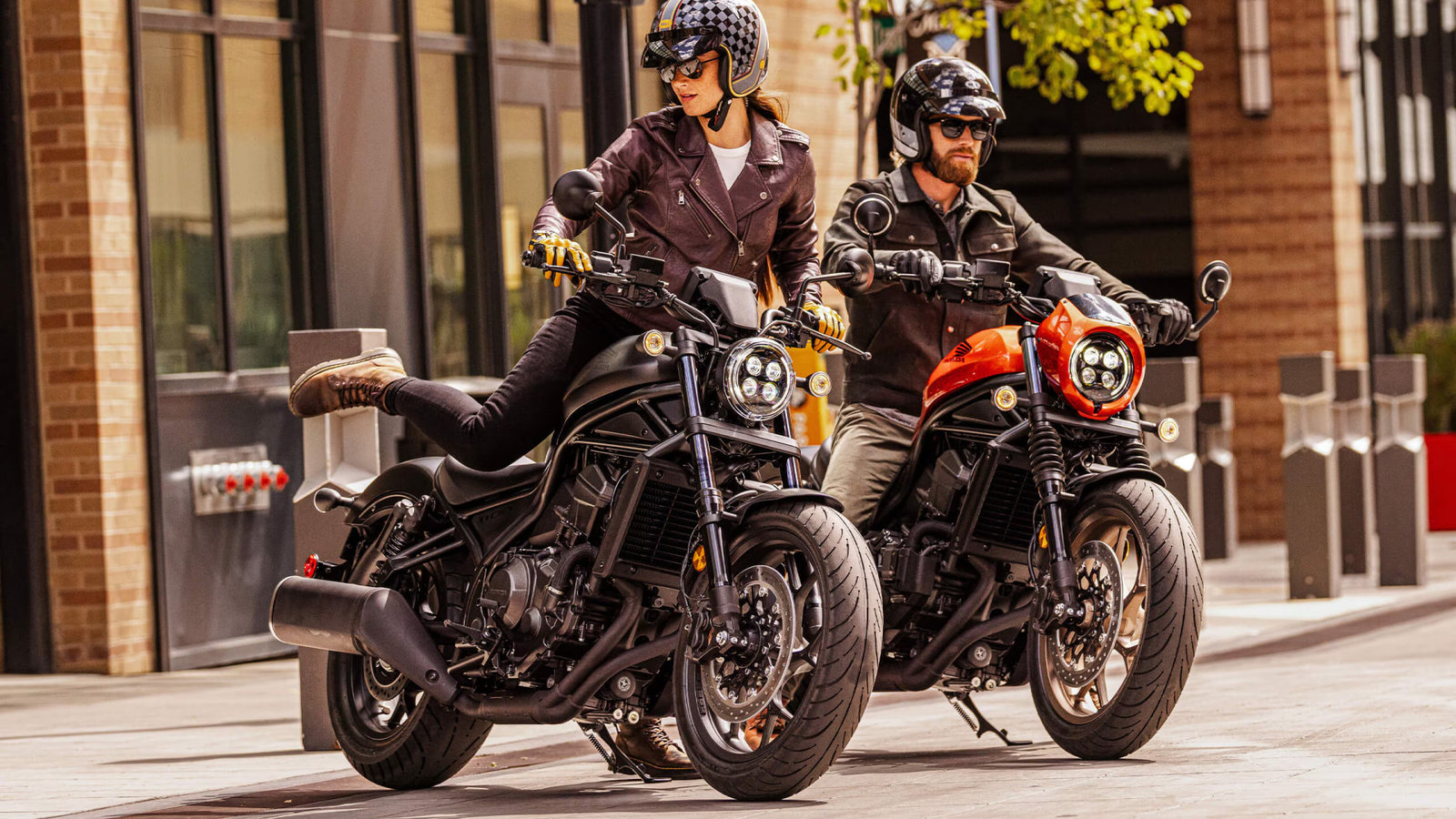
You know that the right number of motorcycles to have is ‘one more’. But in reality, it doesn’t make sense for the vast majority of riders to have more than one bike. That one motorcycle will have to wear many hats, and serve whatever purposes the rider needs.
Whether it is the commute, a lazy Sunday ride, or a multi-day tour, it would truly be nice to have a cruiser that can take on all these roles without fuss. That is exactly what we’re looking for today, and we think we have found the solution. Here’s why the Honda Rebel 1100 DCT is the cruiser that is the ultimate choice for a one-bike garage.
The Honda Rebel 1100 DCT Is The Ultimate Choice For A One-Bike Garage

Honda is known for making versatile motorcycles, but even by Honda’s lofty standards, the Rebel 1100 stands out. It is a full-size cruiser with a large engine, but it is docile enough even for a beginner to swing a leg over and gain confidence. This is helped by the incredibly low seat, the torquey, refined engine, and forgiving handling. It has a breadth of abilities, and it will handle the commute, a weekend ride, or even a tour in a pinch. That is why it is the cruiser that is the ultimate choice for a one-bike garage.
The 2026 Honda Rebel 1100 DCT Starts At $10,399

The Rebel 1100’s appeal goes beyond that of a beginner motorcycle. It is enjoyable even for intermediate riders, or seasoned riders looking for a fuss-free experience. The automatic gearbox is a $700 option, but it elevates the Rebel 1100’s usability, especially in traffic. With no clutch to worry about for beginners, and no clutch lever to tire the left hand, the DCT option makes a lot of sense.
Why We Picked The Honda Rebel 1100 DCT
- Unstressed, torquey engine
- Automatic gearbox
- Full-size cruiser, mid-size money
- Full feature set
- Reliable

10 Cruisers That Will Run Forever With Basic Care
These bikes will give the Energizer Bunny a run for its money – and all they need is basic preventive maintenance done on time.
A Familiar 1.1-Liter Engine

The Rebel 1100 shares its powerplant with a couple of other Hondas, namely the Africa Twin and NT1100. However, it uses the engine in a different, milder state of tune. While the other two have 100 horsepower at their disposal, the Rebel 1100 opts for 87 horsepower at 4,750 revs. The torque peaks at a really low 4,750 RPM. This makes it an extremely flexible engine, with performance that is more exciting than the number suggests.
Six-Speed Dual-Clutch Automatic On Offer

The gearbox is also something Honda derives from the other two models mentioned above. There is a six-speed manual available, but our focus for this article is the automatic gearbox. This is a six-speed dual-clutch automatic, and it has been around for a while. Plus, the lower power and torque outputs will ensure that it is reliable. This automatic does offer manual shift control via buttons on the handlebar, if needed. A chain drives the rear wheel, which keeps costs down but might disappoint owners who would like to ride the Rebel 1100 on multi-day rides.
Honda Rebel 1100 DCT Engine Specifications
|
Engine Configuration |
270° parallel twin, Unicam SOHC |
|
Displacement |
1,084 cc |
|
Power |
87.1 HP @ 7,250 RPM |
|
Torque |
72.2 LB-FT @ 4,750 RPM |
|
Transmission |
Six-speed DCT, chain drive |

10 Cruisers That Balance Fuel Economy With Good Performance
The most efficient cruiser here returns over 60 miles per gallon
Honda Rebel 1100 DCT Chassis

The Rebel 1100 chassis is a diamond frame that uses the engine as a stressed member. This is a modern way of constructing the chassis ,but it also means that customization isn’t as easy as a traditional cradle frame. Suspension consists of telescopic forks and twin rear shocks, with preload adjustment at both ends. An 18/16 inch alloy wheel combination is shod with tubeless tires. There are disc brakes at both ends, with a single floating front brake disc and a really good radially mounted four-piston monoblock fixed caliper gripping it. Things are a little more relaxed at the back, with a single piston caliper gripping the disc. ABS is present at both ends, but is not switchable.
Honda Rebel 1100 DCT Chassis Specs
|
Chassis |
Diamond steel frame |
|
Front Suspension |
43 mm cartridge forks |
|
Rear Suspension |
Twin piggyback shocks |
|
Front Tire And Wheel |
130/70 B18 |
|
Rear Tire And Wheel |
180/65 B16 |
|
Front Brakes |
330 mm disc, radial caliper |
|
Rear Brakes |
256 mm disc |
Honda Rebel 1100 DCT Dimensions And Weight

The Rebel 1100 has some odd choices – the twin rear shocks are at odds with the diamond frame construction. However, this means that the seat height is really low, which is part of what makes it approachable. Another big part is the curb weight – not only is the figure low, but it is also placed low down as well. A reasonable fuel tank size, coupled with great fuel efficienc,y gives it excellent tank range.
The Rebel 1100 is 88.2 inches long, 33.5 inches wide, and 44.3 inches tall. It sits 4.7 inches off the ground, and the seat height is 27.9 inches. The wheelbase measures 33.5 inches. This Honda Cruiser weighs just under 500 pounds – 487 to be precise – and can gulp 3.6 gallons of fuel.

10 Cruisers Made For Long Hauls Without Feeling Boring
From torque-rich V-twins to high-tech sport cruisers, these long-haul machines prove you can tour hard without sacrificing excitement.
Plenty Of Features On Offer

The Rebel 1100 got a major update recently, and the most noticeable difference is the addition of a five-inch TFT color display. This gives access to Bluetooth and navigation, essential features when you’re exploring a new city or are on a weekend ride. A USB-C charging port is also now present. Cruise control is present, thanks to the by-wire throttle. For further usability, you get a 0.7-gallon underseat storage as well. You can have the Rebel 1100 in either silver or black shade.
It’s Got A Handful Of Rivals From Japan

We need to find cruisers that are great all-around products, and at the Rebel 1100’s price point, there are a fair few products that meet that description. However, some of them are old products that lack modern conveniences, which is why we have to leave them out of the conversation. That doesn’t mean that the Yamaha Bolt R-Spec ($8,999), Kawasaki Vulcan 900 ($9,599), and Suzuki Boulevard C50 ($9,299) are bad products; it just means that they don’t fit the brief well enough to be considered seriously.
A Couple Of American Bikes Serve As Strong Competition, Too

That leaves us with two American products, the Harley-Davidson Nightster and the Indian Scout Sixty Bobber. Both undercut the Rebel 1100 DCT on price, but they are base models for their respective brands, while the Rebel is a flagship cruiser. The difference is apparent in the features: the Nightster has analog instrumentation, while the Scout Sixty Bobber doesn’t even have a sixth speed in the gearbox. Neither has a quickshifter. The Indian uses a cradle frame, while the H-D uses a trellis frame with the engine as a stressed member. The Nightster also offers VVT on the intake valves, and traction control and drag-torque slip control. Both have ABS – and the authenticity of V-twin engines.
Sources: Honda Powersports, Honda Global