
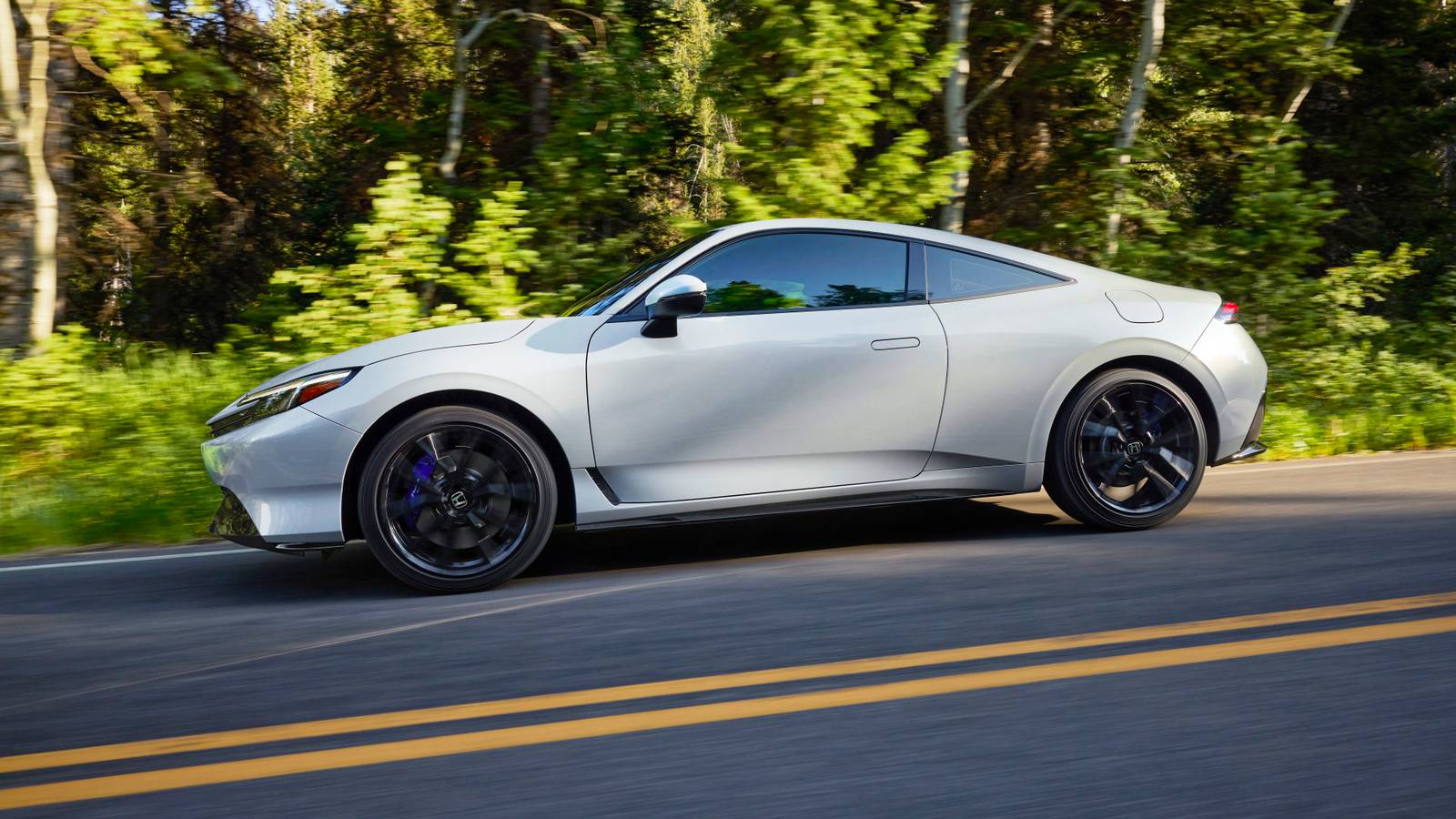
What began as a pre-production concept back at the 2023 Japan Mobility Show, the revival of the Honda Prelude is now in full swing. Fans were hopeful for a sporty two-door Honda that’s both affordable yet fun to drive, but unfortunately, it wasn’t without controversy. For one, the new Prelude is a hybrid, and second, it wasn’t affordable, either. Honda argues that with inflation taken into account, the Prelude is more affordable than the model it replaces, but that sounds more like an excuse than a justification.
Though the Prelude’s revival was met with mixed reactions, the popular nameplate’s comeback means a lot more than you probably think. In my opinion, though the Prelude is expensive, the controversy surrounding this sporty coupe also has to do with certain unmet expectations. Is the Prelude an inherently controversial car, or is it simply misunderstood?

The Fastest Honda Sports Cars Ever Made
What names come to mind when you think of the fastest Honda sports cars ever made? Here are ten that stand out and top the list.
The Prelude In The Past

To understand what the Prelude nameplate stands for, we have to first look at its past. From here, we can start to gain a picture of whether Honda missed the mark on what a Prelude should be.
It Was A VTEC Pioneer

Honda today is heavily built around the VTEC engine. You know, the thing that’ll make you say, “VTEC kicked in, yo.” The camshaft profile change creates the raspier engine note at around 6,000 RPM, as Honda developed VTEC in the late ’80s to combine fuel efficiency with high performance.
And guess what, the Prelude was one of the first Hondas to receive a VTEC engine. When the Prelude first came out, this sporty coupe—which is slightly bigger, a bit more posh, and a bit more cutting-edge than the Civic—had the role of being one of the vehicles where Honda’s greatest engineering marvels would debut. Apart from VTEC, it also pioneered a few new engineering marvels for Honda, such as being one of the first production cars with rear-wheel steering, called four-wheel steering (4WS). 4WS was primarily offered in the third-generation Prelude from 1988 to 1991, and the fourth-generation model (as shown) from 1992 to 1995.
Fun, But Not Too Wild

But if you were expecting that the Prelude would have the same attitude and raucousness as a Civic Type R, then I’m sorry to break it to you, but that’s not what the Prelude was made for. To be a fun, sporty coupe? Absolutely, but not something as hardcore as a Civic Type R. Even in its sportiest Type SH form, the Prelude’s firm ride was still supple. It was supposed to be fun, yet comfortable and usable daily.
At most, the 200-horsepower Honda Prelude Type SH (as shown) felt rapid enough and adequate. The 2.2-liter H22A4 VTEC motor was good enough to pull its weight around, while the suspension tuning was balanced. One of its highlights was its attitude—the distinct high-revving VTEC engine note, plus the fact that you’re encouraged to wring out the engine since, in typical Honda fashion, its torque was concentrated at the higher revs. A four-wheel double wishbone suspension setup enabled excellent body control, but it wasn’t too stiff. In fact, its grand tourer (GT) intentions were already evident in these older-generation models.

I Drove What Is (Probably) The Next Honda Civic Si
Honda’s Next-Generation Hybrid Study is a sign of good things to come for more than just sports cars.
Where The Prelude Stands In 2026

Now that we’ve established what the Prelude stood for in its prior generations, we can evaluate whether Honda missed the mark with the new hybrid Prelude.
Sporty With GT Intents

The Prelude in 2026 uses the Civic’s platform as a foundation, which is already a great chassis to begin with. Honda also cherry-picked parts from the Type R to the Prelude, which was an affordable way for the brand to minimize development costs. These parts include Brembo brakes, the dual-axis strut front suspension that minimizes torque steer (but this car isn’t powerful enough to produce a lot of torque steer anyway), and even its adaptive suspension—albeit with a tamer suspension tune.
This is all in line with Honda’s development premise for the Prelude. They intended this sporty hybrid coupe to have a driving feel that wasn’t necessarily at the same level as a Type R. Instead, though it comes with some of the Type R’s hardware, the chassis tuning is in that happy medium where it promises to feel sharp, yet comfortable, supple, and accessible for daily use. If this level of balance sounds familiar from what we’ve established in this article, that’s because Honda was able to meet the handling balance of the older Preludes.
A Controversial Hybrid

But perhaps its biggest controversy comes from the Prelude having a hybrid powertrain. To be fair, the 2.0-liter e:HEV hybrid system with a lockup clutch-based e-CVT is one of the best hybrid powertrains among mainstream cars, as I’ve reviewed in both the Civic and CR-V. It’s both highly efficient yet sporty, thanks to the Linear Shift Control’s simulated gear shifts. Honda took this up a notch with S+ Shift, as this now allows the paddle shifters to simulate a multi-geared automatic transmission. Linear Shift Control already works for me, so I can only imagine how S+ Shift amplifies the driving feel.
Power-wise, the 200-horsepower hybrid system is exactly the same as past Preludes. The reason this may have been controversial is due to misunderstood expectations. For one, at $42,000, far cheaper but more powerful cars exist. The 315-horsepower Mustang EcoBoost starts at $32,320, while a base Nissan Z Sport with literally twice the horsepower count is only $970 more expensive than the Prelude. No, the Prelude never had a ton of power, so I don’t think Honda missed the mark with the Prelude, but relative to what you could buy for the same amount of money, expectations have therefore been raised to a point that it goes beyond what the Prelude historically stood for.
Specifications
|
Honda Prelude |
|
|
Engine |
2.0-liter four-cylinder hybrid |
|
Horsepower |
200 hp |
|
Torque |
232 lb-ft |
|
Transmission |
e-CVT |
|
Layout |
FWD |
|
Fuel Economy (Combined) |
44 MPG |
|
Base MSRP |
$43,195 |

Honda’s New V-6 Hybrid Tech Will Power Vehicles In The U.S.
No, this motor isn’t coming to the next Accord, but for any larger SUV, it’s perfect.
It Stands As Honda’s Hybrid Halo Car

This leads us to why the Prelude’s comeback in 2026 means more than you probably think. The Prelude may have a bit of controversy, but all the negative feedback is rooted in how the Japanese automaker priced the vehicle. Here’s why.
A Significant But Expensive Comeback

Remember when I said that the Prelude was one of the vehicles that premiered Honda’s wacky engineering methods? In the Prelude’s case in 2026, that would be the S+ Shift. Whether this is innovative enough to leave a lasting legacy like VTEC is up for debate, but you can guarantee that everything they’ve learned in the Prelude will be applied to future Honda hybrids.
The Honda Prelude is a great hybrid sports coupe—just not for the price it’s asking. The misunderstanding and high expectations mostly stem from it being priced close to cars like the Nissan Z or Ford Mustang. Now, if Honda only made a non-hybrid version with a gasoline engine (whether turbocharged or not) and a manual transmission, then I think it’d make the Prelude appropriately cheaper and a true successor. In the end, Honda turned the Prelude into a worthy but expensive hybrid halo car—one that hopefully will be offered in the future with a manual and a lower base price.
Prelude’s Highlights Are Set To Trickle Down

In keeping with Honda’s goal of adding a dose of fun to its electrified offerings, a pioneering technology of the Prelude is coming to one of its core models. Honda has confirmed that it is giving the Civic Hybrid the Prelude’s S+ Shift, which should turn the already sporty hybrid compact sedan into something even more engaging.
Oh, and the Civic Hybrid only starts at a little under $30,000—$12,000 less than the Prelude. Now that also creates an existential crisis for the Prelude. This is perhaps why Honda’s sales goal for the Prelude is modest. With S+ Shift coming to the Civic Hybrid, the main reason why you’d want the Prelude has suddenly been made pointless. Then again, the Prelude’s chassis components from the Type R make it a sharper and sportier car than the Civic Hybrid, but does that justify the huge price gap? That’s up for you to decide.