
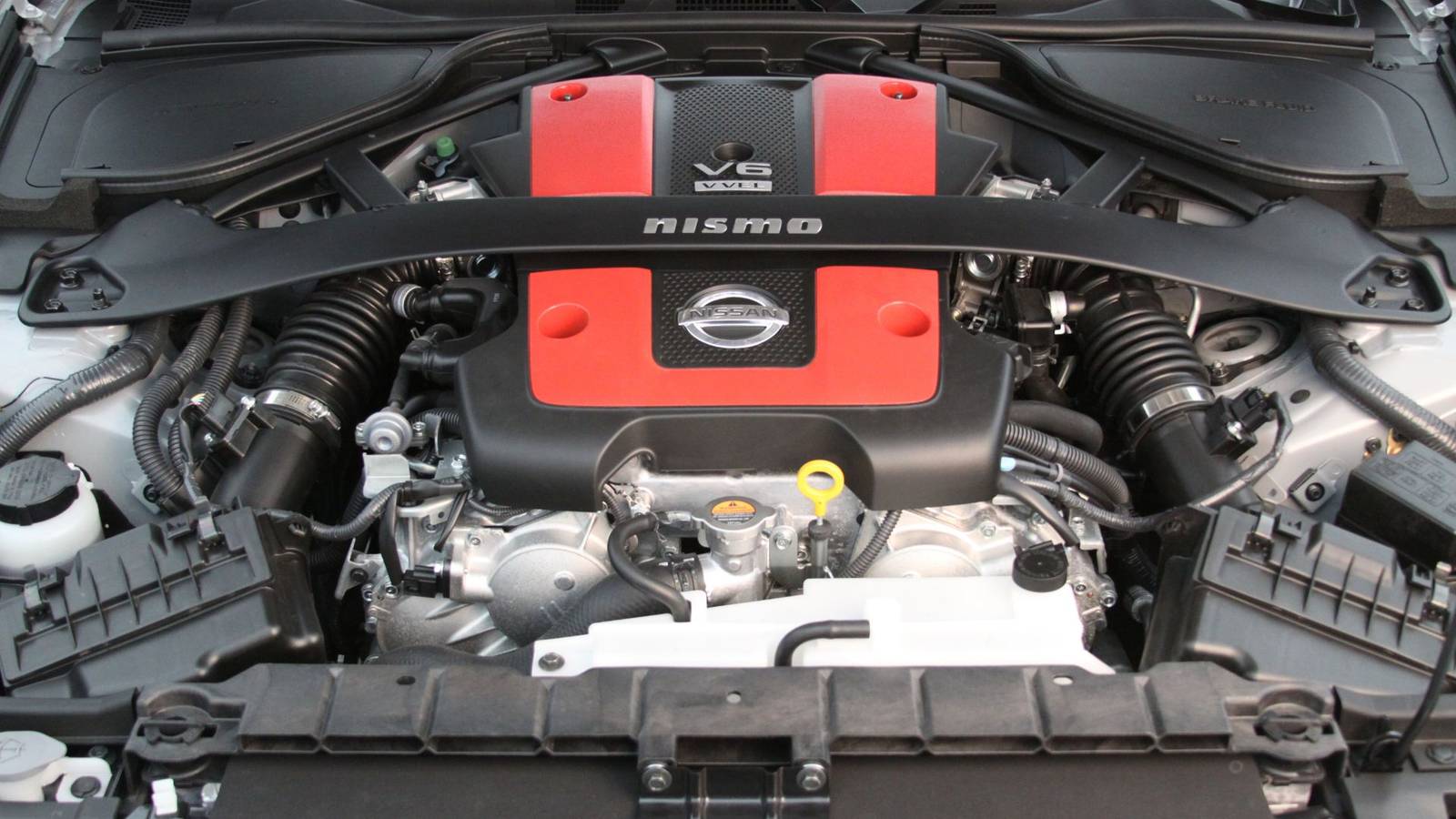
The V6 was first introduced in the US with the 1962 Buick Special, in the form of a 198 cubic inch Fireball 90-degree V6 design. It was known for its smooth power delivery and compact dimensions, while being slightly more efficient than other V engines of the time. This engine layout grew in popularity in the next decade, post oil crisis, which practically forced manufacturers to replace gas-guzzling V8 engines with the more efficient V6 engines in many of their models.
Since then, the V6 engine layout has made its way under the hoods of several cars, including nimble sports cars, luxury sedans, SUVs, and even pickup trucks. But history has a funny way of repeating itself, and that cycle continues with the V6 engine discontinuation, in favor of smaller, turbocharged inline-four engines. This time, there’s more to it than just fuel economy, though. So, let’s look at why carmakers are phasing out V6 in 2026.
V6 Engines Are A Thing Of The Past… Almost

The V6 engine layout has been important to the automotive landscape, and it’s easy to defend this layout over other engine formats. Ask any V6 enthusiast, and they’ll tell you the number of things they love about them, starting from the smooth power delivery, great exhaust note, everyday practicality, and relative efficiency when compared to bigger V8 engines. That’s the reason why, even today, many enthusiasts pick V6 sports cars over the rest.
The Future Of V6 Engines Is Relegated To The Luxury Or Sports Segments

As much as we enthusiasts love V6 engines in modern cars, there’s no denying that, thanks to the V6 engine discontinuation, they are a dying breed today. In the last decade or so, the number of V6 cars in the US has drastically declined, especially in the mass-market segment. Manufacturers are almost always phasing them out in favor of small turbocharged four-cylinder engines or hybrid powertrains. In 2026, most manufacturers have either done away with V6 engines entirely or reserved them for higher-end or sporty variants where character still matters.
The Reasons Behind The V6 Engine Discontinuation

This switch comes from a few factors, with the biggest one being the latest emission rules and CAFE standards, which are effectively forcing manufacturers to switch to V6 engine alternatives that are more efficient. Another factor is the changing consumer preference and rising fuel prices, where even if one may love the idea of the V6, they know their wallet will be happier with a smaller, more efficient engine under the hood. Not to forget, engine tech has come a long way, and even small four-cylinder engines can now produce as much power as their V6 counterparts.
Smaller Four-Pot Engines Aren’t Inferior By Any Means

One way to look at it is that, despite them being phased out, we still get to enjoy the same level of performance from smaller four-banger engines. Some of the best cars today are powered by V6 engine alternatives, like turbo fours, including the 2026 Kia K5 GT, 2026 Honda Civic Type R, 2026 Porsche 718 Cayman S, and 2026 Lotus Emira. The world might eventually move onto EVs, but at least we get to enjoy the small explosions under the hood for now.
Emission Norms And CAFE Standards Are Choking Engines Down

The world is a polluted place today, and personal vehicles are a big part of the reason. So, to reduce CO2 emissions and fuel consumption, governments in most major markets have introduced strict emission norms and Corporate Average Fuel Economy (CAFE) standards that are choking gas-powered engines, effectively forcing manufacturers to pick V6 engine alternatives. In this new landscape, there’s no longer space for six-cylinder engines as they typically consume more fuel and produce higher CO2 emissions than their four-cylinder counterparts.
CAFE Norms Only Intensify This Pressure

CAFE standards intensify this pressure by judging manufacturers not model by model, but across their entire lineup. These CAFE targets are constantly going up, too, forcing the manufacturers to optimize the average fuel economy of their entire lineup. As a result, V6 and V8 engines become easy targets, often being replaced by smaller turbocharged or electrified powertrains. From a regulatory standpoint, V6 character or smooth power delivery simply does not matter; what matters is compliance with emission norms.
Four-Cylinders Offer The Same Performance But Better Fuel Economy

Fortunately, car owners are not left stranded without the V6 engines. Turbocharging tech has come a long way, and manufacturers are now able to squeeze out a lot more power from their four-cylinder engines, which makes V6 engines somewhat obsolete. Yes, V6 engines in modern cars still beat turbo fours in terms of smooth power delivery, but for most drivers, that’s not a priority. Most owners only care about how comfortably their vehicles feel when accelerating, cruising on the highway, or overtaking or merging, which is another reason why carmakers are phasing out V6 engines in favor of turbo fours.

In 2026, manufacturers have come up with some serious V6 engine alternatives, and an excellent example here is the 2026 Mercedes-AMG CLA 45 S Coupe. This car produces a whopping 416 horsepower from its 2.0-liter turbocharged four-cylinder engine. It can go from 0 to 60 in 4 seconds! Its closest rival, the 2026 Cadillac CT4-V Blackwing, produces 472 horsepower from its 3.6-liter twin-turbo V6. Despite being more powerful, the CT4-V Blackwing is just as quick as the CLA 45 S in a 0 to 60 miles per hour sprint. So, when it comes to V6 vs turbocharged engines, the latter is no longer too far behind.
|
Models |
Engine |
Power |
Torque |
0-60 MPH |
Top Speed |
|---|---|---|---|---|---|
|
2026 Mercedes-AMG CLA 45 S |
2.0-liter turbocharged inline-four |
416 HP |
369 LB-FT |
4 seconds |
168 MPH |
|
2026 Cadillac CT4-V Blackwing |
3.6-liter twin-turbo V6 |
472 HP |
445 LB-FT |
4 seconds |
189 MPH |
Buyers Also Want To Keep Fuel Costs Down

Thanks to the ever-rising fuel prices, buyers today are looking to minimize their fuel costs as much as they can by going for the most fuel-efficient models in the market. So, four-cylinder engines make more sense here, as they are cheaper to run than V6 ones. Take the 2026 Genesis G70 for reference, which is available with both an inline-four and a V6 engine. According to the EPA, the four-banger G70 should cost you $2,450 in annual fuel costs as opposed to the RWD V6 model, which raises the costs to $2,900. Unless performance is a priority, the four-cylinder G70 is the more sensible option in the long run.
|
2026 Genesis G70 Powertrains |
2.5-liter Four-cylinder RWD |
2.5-liter Four-cylinder AWD |
3.3-liter V6 RWD |
3.3-liter V6 AWD |
|---|---|---|---|---|
|
Fuel Economy (combined/city/highway) |
24 / 21 / 29 MPG |
23 / 20 / 28 MPG |
20 / 17 / 25 MPG |
19 / 17 / 23 MPG |
|
Annual Fuel Cost |
$2,450 |
$2,550 |
$2,900 |
$3,050 |
Hybrids Are There To Bring Fuel Costs Further Down

Manufacturers today are also offering hybrid powertrains that feature an inline-four engine mated to an electric motor or two, which are far more efficient and sometimes more powerful than their gas-only counterparts. The 2026 Honda Civic Hybrid is a good example of a V6 engine alternative here. It produces a respectable 200 horsepower while offering 49 miles per gallon. That’s almost twice as much as the Toyota Camry V6, which returns only 26 miles per gallon while being 0.4 seconds quicker than the Civic Hybrid.
V6 Engines Are More Complex And Expensive To Produce

There’s a reason why manufacturers stick to one engine for years, if not decades. It’s because producing an engine that’s powerful and reliable is an expensive affair. Here, V6 engines happen to be more expensive than simpler four-cylinder ones. V6 engines in modern cars have more moving parts and are more complex in design compared to single-bank engine layouts, which include inline-fours and inline-sixes. For example, a V6 engine has two separate cylinder heads, camshafts, exhaust manifolds, and much more, essentially translating to twice as many top-end parts.
V6 Engines Aren’t Inherently Smooth Either

V6 engines are known for their smooth power delivery, but they aren’t necessarily smooth. They don’t have the inherent primary and secondary balance that’s present on inline-six or flat-six engines, leading to residual vibrations. This imbalance is usually absorbed by engine mounts and counter balancers, which smooth out the engine but add to the engine’s complexity and cost even more. Inline-four engines aren’t that balanced, either, but given their single-bank design, they typically tend to be easier to design and produce.
You End Up Paying For It With Higher MSRP And Maintenance Costs

Manufacturers are unlikely to absorb the costs for the consumers, and these R&D and manufacturing costs often trickle down to the buyers in the form of higher sticker prices on the cars. At the same time, the more moving parts and V6’s complex yet compact design make them harder to work on and repair, which further adds to the overall maintenance costs of the models. Add to that their relatively poor fuel economy, and it’s easy to see how these engines can burn a hole in your wallet over time.
You Can Still Enjoy V6 Models In 2026

Manufacturers haven’t completely phased out V6 engines just yet, and the market still has many V6-powered cars on sale across segments to fuel the V6 vs turbocharged engines debate. Some great sedan options include the 2026 Audi A6, 2026 Genesis G80, and 2026 Lexus IS. SUV options range from the 2026 Acura MDX to the off-road-ready 2026 Ford Bronco Raptor, and the pickup truck range includes the 2026 Honda Ridgeline and 2026 Toyota Tundra. Sports cars include the 2026 Lotus Emira and 2026 Nissan Z.

This list grows endlessly when you look at the used market, which includes some awesome picks, like the Volkswagen Touareg VR6 Sport, Lexus GS 350, Nissan 350Z, Kia Sedona, and much more. Put simply, V6 engines still survive, but they’re no longer the default choice for mainstream cars. That role is taken up by turbo fours and hybrids. Instead, the future of V6 engines is reserved for segments where character and performance beat efficiency numbers, like luxury sedans, large SUVs, pickup trucks, and some sports cars.
Source: OEMs, FuelEconomy.gov