
In the late ’80s, German luxury carmakers Mercedes-Benz and BMW were untouchable in their segment. Their only competition was each other, and they watched one another like hawks. So they did not see the threat from Japan coming until it was there. This threat was the first Lexus, Project 1, that finally launched the luxury brand Toyota had been building since the early ’80s. Project 1 may as well have been German. It was quiet, free of vibration, and so overengineered that it forced Merc and BMW back to the drawing board. The luxury landscape had changed.
Project 1 was the Lexus LS 400, and it could compete directly with Mercedes-Benz and BMW in luxury, refinement, and solid dependability. But at the heart of this new luxury competitor lurked a new V8 engine, a piece of engineering so robust it shaded over to the obsessive. Toyota did not just want to build a powerful engine; they wanted it to last forever. Decades later, a journalist named Matt Farah brought home Toyota’s vision. He bought a high-mileage LS400 and drove it past the 1,000,000-mile mark on the original engine internals. This is the story of how a billion-dollar investment led to this V8 powertrain that took Mr. Farah past a million miles and became the gold standard for internal combustion.
The Billion Dollar Project: Engineering The Engine

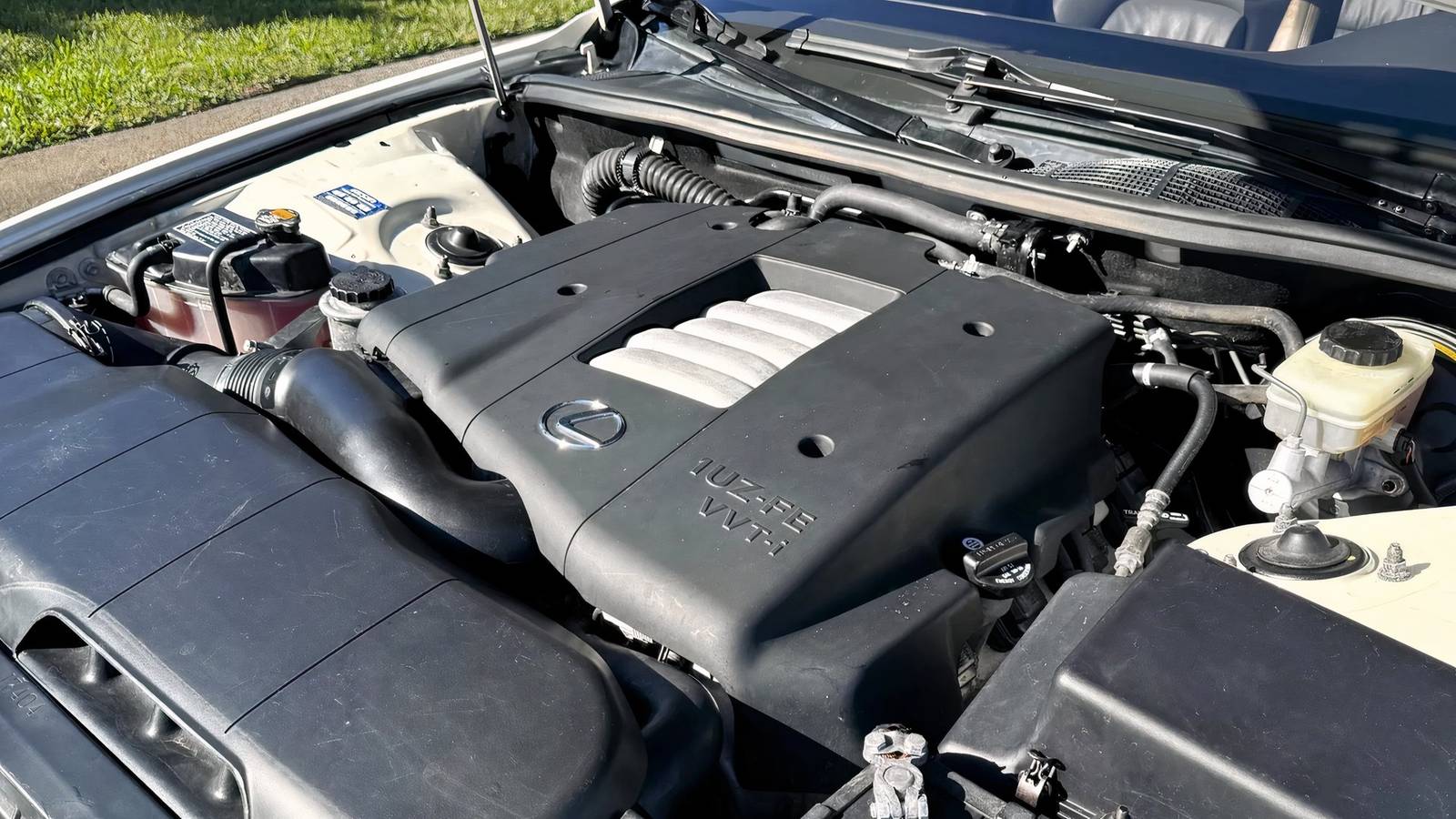
Toyota Chairman Eiji Toyoda was a man on a mission when he told his team to build the world’s best luxury car. This was a starting-from-scratch project because there was nothing to use as a baseline to incrementally improve. The budget was $1 billion, an astronomical amount for the time. There were 1,400 engineers and 2,300 technicians working on the project. The 1UZ-FE engine was at the heart of the project. It was a clean-sheet masterpiece designed to be better than the best V8s from Stuttgart and Munich in NVH (Noise, Vibration, and Harshness), weight, and longevity.
Racing Roots

The 1UZ-FE may have been designed for a luxury sedan, but its DNA comes from the winner-takes-all world of international motorsport. Toyota used the experience it gained from CART and Le Mans engines to design the block. This was a six-bolt main bearing design, a configuration more common to high-stress racing engines or heavy-duty diesels. This gave the rotating assembly immense structural rigidity, which kept the crankshaft perfectly aligned for hundreds of thousands of miles and minimized internal friction and wear.
Keeping It Quiet
To achieve the champagne tower smoothness used in the launch commercial, Toyota used tolerances unheard of in mass production. The 1UZ-FE has an aluminum block with a 90-degree V-angle, which was perfectly balanced to cancel out primary vibrations. Every component, including the resin-coated pistons and DOHC valvetrain, was designed to operate with perfect precision. This resulted in an engine that did not feel as if it was running at all, even when the car was going over 100 mph.

Buying A Used Lexus Sports Car: What To Watch Out For In The LC 500
Here is what you should bear in mind if you are looking to buy a used Lexus LC 500. They are great Lexus sports cars, but they do have their foibles.
The Million-Mile Lexus

The Million-Mile Lexus was not a marketing headline, but rather a real-world testament to the UZ engine’s durability. The 1996 LS400 that Matt Farah bought went viral because it ticked the odometer to seven figures without any major engine issues. Most engines age like people do, bit by bit. Rings will become worn, gaskets start to fail, or heads will warp. The UZ engines are different. They were over-specified. Each part was made stronger than it had to be, made to fit better than needed. This allowed the engine to operate within its mechanical limits, even in high-stress use.
Thermal Management And Metallurgy

Heat cycling causes metal fatigue, and this kills engines over time. Toyota countered this from the beginning by using high-grade aluminum alloys and sophisticated cooling that kept temperatures uniform across the block and the heads. The earlier 1UZ-FE had forged steel crankshafts and connecting rods, compared to the cast iron and cheaper alloys commonly used. They made the engine keep going, even when the rest of the car was worn out.
Simple Sophistication

The early non-VVTi 1UZ-FE were non-interference engines, despite their DOHC 32-valve sophistication. This meant that if the timing belt were to snap, as it often does in high-mileage vehicles, the pistons would not hit the valves and wreck the engine. This meant a snapped belt became a roadside repair rather than an engine replacement. The engine also ran at a low stress-to-displacement ratio. On the one hand, you had a 4.0-liter V8 making a max 290 horsepower, while on the other, the internals are never pushed to thermal or mechanical breaking points.

Can You Imagine A V8-Powered Toyota Tundra To Rival The Raptor?
This could be the Ford’s worst nightmare.
Expanding The Legend: From the 1UZ To The Heavy Duty 2UZ

The blueprint was there in 1UZ-FE, a quiet and sophisticated V8. It was time to build the heavy-duty version. The 2UZ-FE is the 4.7-liter found in the Land Cruiser, Sequoia, and Tundra back then. No champagne glasses for the 2UZ; this 4.7-liter workhorse was all about raw utility and unstoppable reliability. Toyota switched the block from aluminum to cast iron, creating a V8 that was just about indestructible, capable of dealing with heavy loads for decades, no matter how hard the terrain.
Old-School Cast Iron

Cast iron is an original metal, old as civilization itself, and heavy, strong, and lasts forever. The cast iron block of the 2UZ-FE was chosen to give durability to trucks and SUVs. It is heavy, but the iron block gave better bore stability under the high torque loads used in towing. Owners of the Land Cruiser 100-series often report on 300,000 to 500,000 miles of heavy use with nothing but routine oil changes and timing belt replacements.
Evolving Into The 3UZ

As the millennium approached, Toyota refined the original 1UZ into the 4.3-liter 3UZ. This introduced Toyota’s version of Honda’s i-VTEC, the Variable Valve Timing with intelligence (VVT-i). Even with the added complexity of variable timing, the 3UZ-FE maintained the engine series’ bulletproof reputation. It is regarded as one of the best engines ever made, bringing a balance between the over-engineered engines of the early ’90s and the power and efficiency found in engines in the 21st century.

10 Practical Cars That Are Secret Sports Car Killers
Sports cars advertise their performance, but some cars are more covert about their unfettered power
The Last Of The Overbuilt V8s

Today, we have smaller turbos and various kinds of electrification, and that is the way the world of cars is going. These engines and motors are efficient, but they can never replicate the feel of any of the UZ engines. The 1UZ and 2UZ come from a different time when engineers were given access to the company’s bank account and told to build something that would last longer than they would. The million-mile Lexus is the tangible proof of what happens when you spend a billion dollars seeking perfection.
Much In Demand

Cars with UZ engines are hot on the used market. Early used LS400s and Land Cruisers are expensive because of their powertrains. The 1UZ is popular for engine swaps in drift cars and off-roaders because it is light, but can handle loads of boost and heavy use on stock internals.
Closing The Loop

The Lexus LS is now in its final year and will be discontinued. Even the legendary V8s have been replaced by 3.5-liter V6 turbos in 2018. Time marches on, and with it, technology. But the original 1UX and the million-mile Lexus it powered will live on in the lore of great engines. And the UX engines, because they are so indestructible, will be around for a few decades and many more millions of miles.
Sources: Toyota, Lexus, CarEdge