
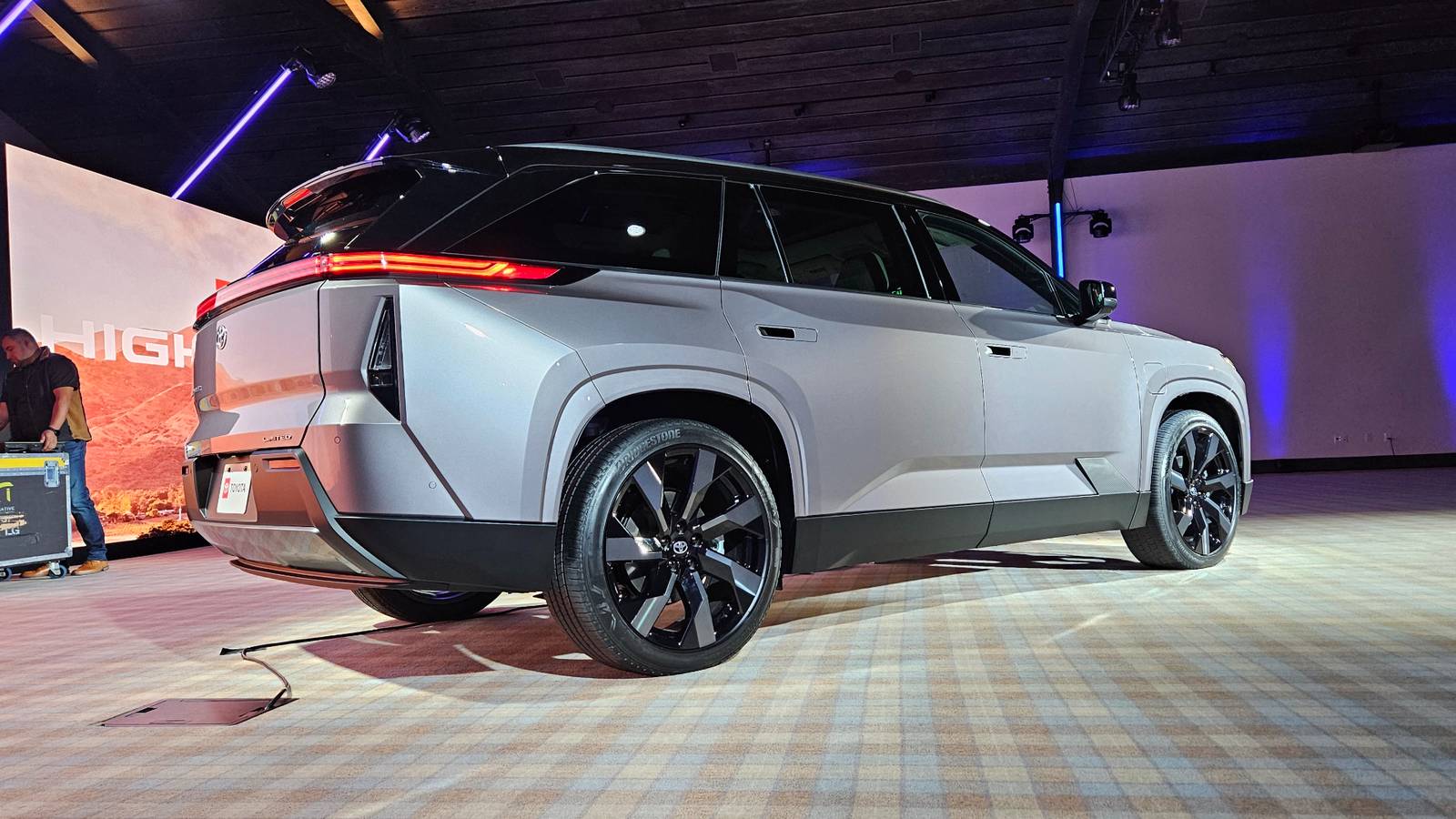
Is it possible for an automaker to have too many SUVs in the lineup? If one automaker seems unfazed by the question, it’s probably Toyota. From the compact C-HR and Corolla Cross to the spacious, upscale Sequoia and Land Cruiser, Toyota offers 11 car-based crossovers or truck-based SUVs in the U.S. — way more than any other brand.
And here comes another — a three-row all-electric crossover that could have made an even dozen except that Toyota opted to repurpose an existing nameplate. The 2027 Toyota Highlander will be EV only and cannot be had with a crankshaft or a tailpipe. The brand could have just dreamt up a new name for this EV and kept the gasoline-powered Highlander in the lineup, but instead the company showed restraint.

Toyota’s First EV Built In U.S.

On sale later this year, the all-new Highlander will be Toyota’s first three-row EV and the first EV assembled in the U.S., at Toyota’s sprawling complex in Georgetown, Kentucky. Even the battery modules will be domestically sourced from Toyota’s new battery plant in North Carolina. With so much local content, the Highlander will avoid a significant tariff hit. Toyota’s other EVs (C-HR, bZ and bZ Woodland) come from Japan.
The 2027 Highlander will ride on a new modified version of the Toyota Next Generation Architecture-K (TNGA-K) platform that underpins the Grand Highlander and Lexus TX SUV, as well as the current ICE Highlander, which ends with the 2026 model year.



Toyota’s Cautious Approach
This three-row crossover will be Toyota’s fourth EV in the U.S., perhaps quieting criticism that Toyota was slow-rolling battery-electric vehicles while other major OEMs were quicker out of the gate. Actually, taking the cautious approach may have saved Toyota from burning mountains of cash in failed EV investments, as is happening to some of its rivals.
There will be just two trim levels: base XLE (with front- or all-wheel drive) and top-of-the-range Limited (with AWD standard).
Up To 320 Miles Of Range

Toyota says the base 77.0-kWh battery pack has an estimated range of 287 miles with XLE FWD, while range falls to 270 miles with XLE AWD. You can also spend a little more for a 95.8-kWh battery that should deliver an estimated 320 miles of range in either XLE AWD trim or Limited AWD.
FWD Highlanders will be rated at 221 horsepower and 198 pound-feet of torque, while AWD versions will crank that up to 338 horsepower and 323 pound-feet.
EV As Mobile Power Source

With its standard North American Charging System (NACS) port, the new Highlander will have access to thousands of Tesla Level 3 DC fast-charging stations nationwide. Toyota says the new EV can fast charge from 10 percent to 80 percent capacity in around 30 minutes, under ideal conditions. A dual-voltage 120V/240V cable will be included, for slower Level 1 and Level 2 AC charging.
Toyota says the Highlander will be their first EV with vehicle-to-load (V2L) technology to serve as a mobile power source, potentially powering appliances at a tailgate party or at home during a power outage.
Designing For ‘Sophisticated Adventure’

Since its arrival, the Highlander has been about daily functionality and maximizing space. Let’s be honest, it’s been visually dull, and Toyota Chairman Akio Toyoda wants no more boring cars. So the design team tried to “capture a sense of sophisticated adventure” in styling the new EV.
“Our design mission was to create a new Highlander that pursued the robust proportions of an SUV while also capturing the sophisticated, high-tech aspects of all-electric performance,” said Chief Designer Masayuki Yamada. The team needed to balance aerodynamics, interior space and capability “so it is equally suited for elegant urban or outdoor enthusiast lifestyles.”
How Does It Stack Up To Current Highlander?
The 2027 Highlander is bigger than the ICE model it replaces. It’s nearly four inches longer overall (198.8 inches), and the wheelbase stretches more than eight inches (to 120.1 inches). It’s also 2.3 inches wider (to 78.3 inches). Despite its upsized footprint, the roofline is actually lower by nearly an inch (to 67.3 inches in height), leveraging a lower aerodynamic profile like other electric crossovers, like the Chevy Equinox EV.
14-Inch Screen Is Standard

Standard features in the base XLE grade include 19-inch rims with aero caps, semi-flush electronic door handles, 14-inch multimedia touchscreen, 12.3-inch digital gauge cluster, 64-color ambient lighting, SofTex fabric seating, heated front seat and steering wheel and paddle shifters for regenerative braking.
Stepping up to Limited Grade gets a head-up display, ventilated front seats, heated second-row seats, traffic jam assist, panoramic view monitor, lane change assist, and front cross traffic alert.
Seating For 6 Or 7

The design team’s goal was to achieve an interior that conveyed “elevated comfort” with an open, airy feeling. It will seat six adults comfortably with two captain’s chairs in the second row and two seats in the third. A bench is available for the second row, if room for seven is a priority.
Soft-touch materials are plentiful throughout the cabin, and the soft ambient lighting and off-white upholstery in the Limited model on display at tonight’s reveal in Ojai, California, is upscale enough to nearly rival Lexus. Pricing information will come later in the year, closer to launch.

Made In America, Driven In Japan: Toyota’s Bold Move Explained
These three models assembled in U.S. plants will make the long trek to the home market in Japan. Is there a chance to do it profitably?
Toyota’s Risky Business
Toyota’s strategy to realign the Highlander as an EV carries a certain amount of risk. The ICE Highlander arrived in 2001 and quickly became a top player in the growing segment for upsized crossovers. But when the stretched Grand Highlander arrived in 2023, that new entry was capturing most of the sales volume while the standard Highlander faded, finding a mere 56,000 new owners last year in the US.
Can Toyota sell that many Highlander EVs in a year? We’re about to find out, but Honda sold more than 39,000 Prologue EVs without even trying that hard in 2025 — a down year for the EV market in America.
Source: Toyota