
In the last decade, electric vehicles have come a long way. If there is still one core issue with them, it’s that charging still takes too long. With a gas tank, you fill up in a matter of minutes, and you are gone, but even the quickest chargers are still going to take about 20 to 45 minutes. This is not the only issue, but for many new car buyers on the fence, that gap remains a dealbreaker.
Automakers have promoted many solutions to this problem, but one of the most prevalent is solid-state batteries (SSBs). One of their largest benefits over traditional lithium-ion batteries would be exponentially shorter charge times. The real question was never whether SSBs would eventually get there, but rather who would be the ones to crack the code first, and when.
Time Is The EV Industry’s Greatest Hurdle

Ever heard of range anxiety? If you are an EV owner, you haven’t heard about it; you’ve felt it. Yet, nowadays, EVs get 300 to 500 miles on a single charge, a massive improvement from ten years ago. What is still unresolved for many mainstream buyers is the time cost of charging. Even with Level 2 charging, patience is a requirement, and people today are short on patience. That single factor has kept many would-be EV owners on the fence.
We Have Mastered Lithium-Ion

Compared to the batteries of a decade ago, today’s lithium-ion units are so advanced that we have basically tapped out the upper limit of what is possible. The most important aspect of a lithium-ion battery is the liquid electrolyte at its center, which is responsible for its technological limitations. The faster you charge a lithium-ion battery, the more heat it produces and the faster it degrades. That’s why automakers recommend keeping your daily charging below 80 percent to protect long-term battery health.

This is a massive trade-off that is unfortunately built into the chemistry itself, and no level of software optimization can change the fundamental physics. While uncommon, the liquid electrolyte is also the reason EV fires are so destructive, as it runs through every cell and contributes to a chain reaction.
Why Charging Optimization Is The Final Gateway

Recent studies have shown that charging inconvenience, not range, is the primary hesitation for many consumers considering EVs. Then there is the consideration that homeownership is almost a prerequisite to EV ownership. That’s why a 20-minute fast-charging time sounds okay until you have somewhere to be, your kids are screaming in the back seat, you’re in Montana in the winter, and there are still two cars ahead of you. Extreme weather is one of the most vicious, life-sapping factors affecting lithium-ion batteries, and another consideration for those who live in year-round all-weather conditions. The industry has reached a turning point: a major revolution, not evolution, will be required for the next generation of EVs.

10 Gamechanging EVs From The Last Five Years
These 10 EVs each nudged the EV market forward in design, affordability, range or tech, and made the market shift around them in the process.
Solid-State Batteries So Far Have Been Empty Promises

Ten years ago, major OEMs were talking about how they were already getting ready to ramp up production of SSBs. Ten years later, nothing has changed. What could be taking them so long when everyone knows that this will be the technology of the future? The concept of the SSB is simple: swap the flammable and problematic liquid electrolyte for a solid material, and you have just solved one of automotive engineering’s greatest hurdles.

Faster charging, higher energy density, better safety, longer-lasting, better extreme-weather performance. On paper, SSBs are not an evolution of lithium-ion tech, but a full-blown revolution. Simple, right? Well, not so much. The problem is turning that technology into a vehicle-ready, mass-manufactured product — something no major automaker has yet to achieve.
The Empty Promises We Have Heard So Far

If you took a shot every time a solid-state timeline was missed, you’d be drunk in a matter of moments. Toyota, the largest automaker in the world, has been one of the biggest proponents of SSBs. It has been announcing progress on its developments for years now, but still has no marketable product. From what we know, its timeline for mass production is 2027 at the earliest, and that’s not the first time that timeline has changed.

Honda has poured massive resources into its SSB program and is also targeting a production debut in 2027. QuantumScape, which is partnered with Volkswagen, has been developing a ceramic separator technology for years and just recently completed an automated pilot production line. Stellantis has partnered with Factorial Energy for SSB tech and is set to release a demo fleet of Dodge Charger Daytona EVs this year. BMW teamed up with Solid Power for its effort, while Samsung SDI has published some promising results, but again, no marketable product.

Who will be the one to make the breakthrough? Well, what happened at CES 2026 in Las Vegas may be exactly what the EV market has been waiting for. A Finnish startup almost nobody had heard about came through and announced that the wait was over. Its name? Donut Lab — and it has put the world’s first production-ready SSB on the road.

This Game-Changing Motorcycle Has A Cunning Solution To Your Range Woes
This innovative battery technology promises to eliminate range anxiety and charging woes for electric motorcycle riders.
Donut Lab Put An SSB Into A Production Vehicle

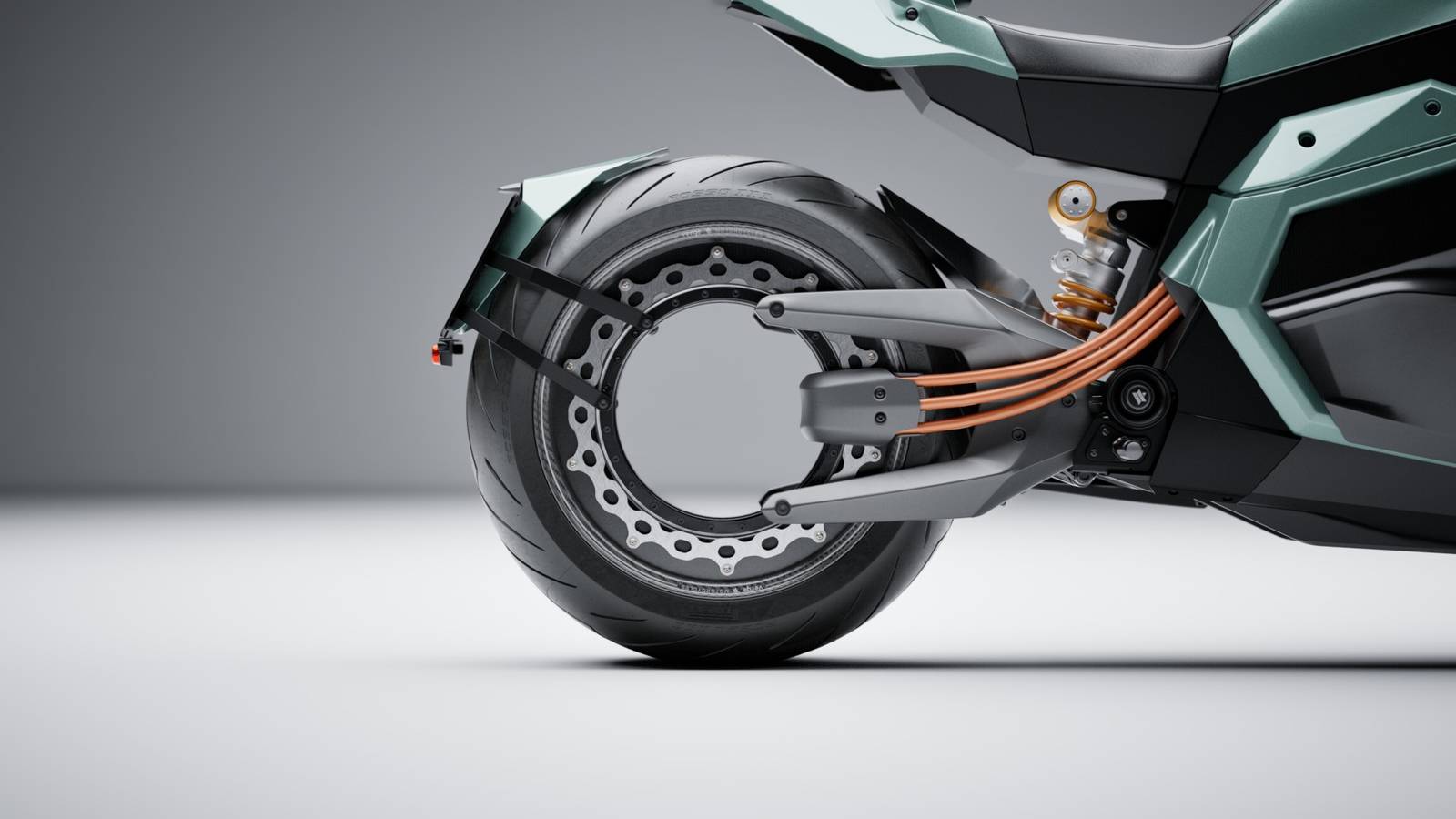
Who the heck is Donut Lab, and do they sell donuts? Not exactly. Donut Lab is a Helsinki-based startup that builds in-wheel electric motors. What is an in-wheel electric motor? Well, this futuristic piece of engineering is being used in Verge Motorcycles’ lineup. At CES 2026, the small Finnish company took the convention hall by storm. The startup claims its liquid-free battery cells and modules are available now at gigawatt-hour production capacity for companies worldwide. CEO Marko Lehtimäki stated clearly that the answer to when SSBs would be available in OEM production vehicles would be “now, today, not later.”
The First Challenger In The SSB Race

Our first proof of concept for SSBs is Verge Motorcycles’ TS Pro. The standard bike matches the previous lithium-ion model’s 217-mile city range, but a larger battery option, no bigger than its predecessor, can achieve up to 370 miles. This is the first time this technology is readily available in a road-going vehicle you could buy right now — something no other competitor has achieved. 370 miles of range is an unprecedented distance for a motorcycle, but it will come at a cost: $34,900. Deliveries are expected for Q4 2026, and considering how long we have had to wait, that doesn’t feel that far away.

10 Electric Motorcycles With The Highest Range
If you’re looking to go the distance without gasoline, these are the electric bikes you should look at
What The Numbers Actually Mean For The Future

The potential Donut Lab is offering is the type of stuff that can put the industry on its head. Donut Lab states that its cells can reach an energy density of 400 watt-hours per kilogram, which is a big jump compared to the 250 to 300 watt-hours per kilogram found in today’s most advanced lithium-ion batteries. Another benefit of SSBs is adding range without adding weight or lighter battery packs with the same range.

Compared to the battery pack you would find in a Tesla today, the Donut Lab unit is about twice as energy-dense. The real spotlight is, however, charging performance. An 80 percent charge can be achieved in as little as five minutes and can last up to 100,000 cycles without losing capacity. Oh yeah, and the 80 percent cap that has been hamstringing EV owners for decades — gone forever.
How Independent Analysis Backs Up These Claims

Donut Lab’s claims may seem bold, but it did not ask the public to just take its word for it. The Finnish company submitted its SSBs to a series of independent testing companies and, from what we know, their data backs up the company’s claims. A fast-charging test with Donut Lab SSBs showed zero to 80 percent in just about five minutes. They also tested thermal stability and showed the batteries operating at over 100 percent of capacity retention, even when exposed to extreme conditions at 176 degrees farenheight and 212 degrees farenheight. Try that with a lithium-ion battery pack, and the whole research center would experience catastrophic thermal runaway.

A third independent test, performed by the VTT Technical Research Centre of Finland, showed the cells retained 97.7 percent of their charge after remaining idle for ten days. That dispelled another common misconception about the limitations of SSBs. Finally, temperature stability has dramatically improved, with Donut Lab’s SSBs retaining more than 99 percent capacity in temperature ranges from -22 degrees farenheight to 212 degrees farenheight. This means that cold-weather range loss and expensive and complex liquid-cooling systems for battery packs may be a thing of the past.
The Race Has Started, But The Finish Line Is Still Not In Sight

Donut Lab’s achievements are already remarkable, but the scale of the SSB landscape is massive. Almost every major OEM is still fighting tooth and nail to be the first to the finish line. Toyota says 2027, with its solution being sulfide-based electrolytes that could provide 600+ miles of range and 10-minute charging times. QuantumScape has signed more than one development deal with major automakers and has completed a pilot SSB production line. Stellantis is set to run a real-world fleet test this year.

In China, GAC Group launched its first SSB production line, signaling that the breakthrough is close. Donut Lab has been the first to kick off the race, but where will they be once the big guns step in? Despite this, the Finnish startup has proven that persistence and a marketable product are more than half the battle. We have heard a lot of lip service in the last decade, but Donut Lab’s achievements are a step in the right direction.
Sources: Donut Lab, Honda, QuantumScape, Stellantis, BMW, Toyota, Volkswagen