
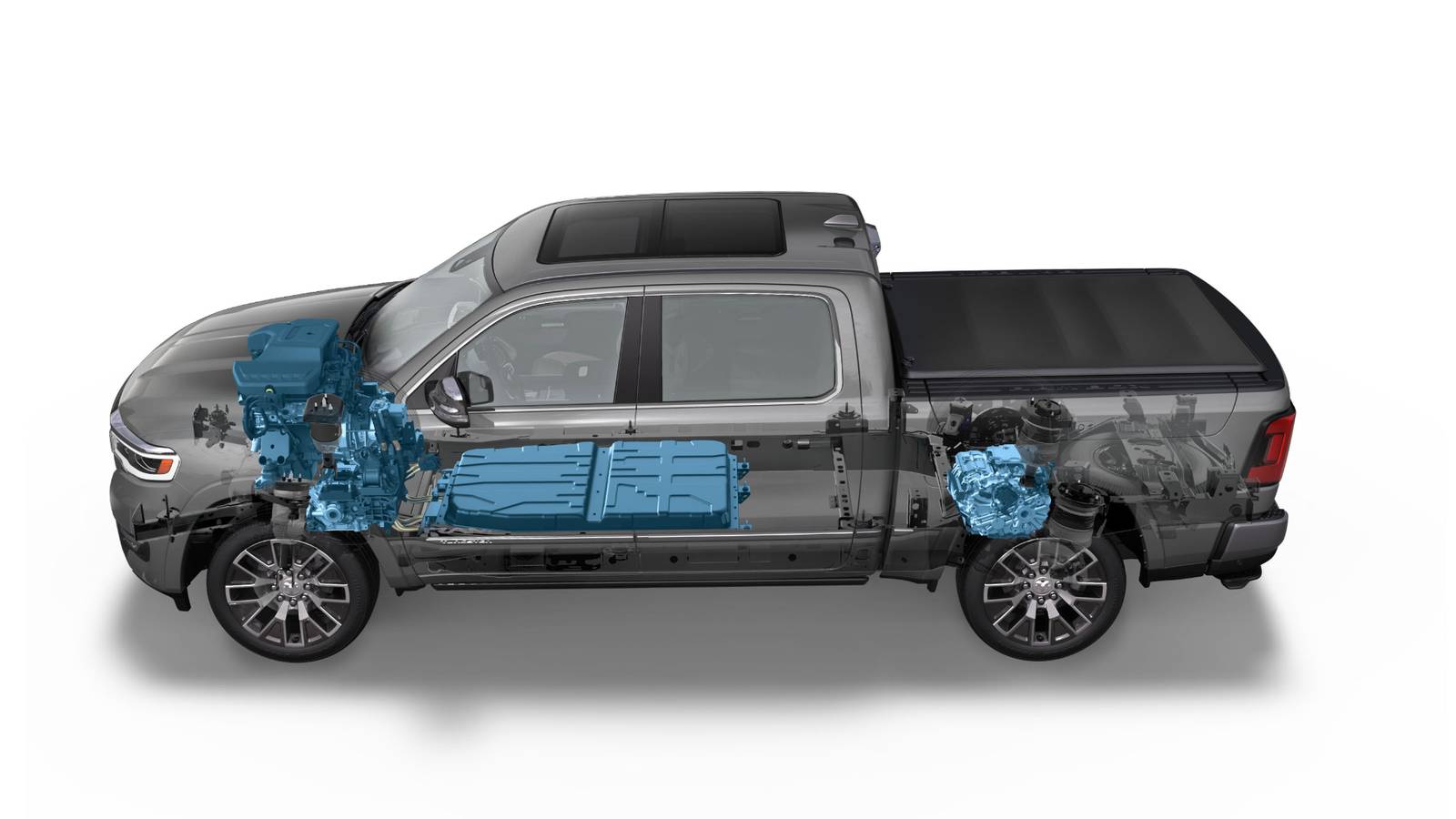
The product planners at Ram Trucks were feeling validated when their rivals at Ford in December announced the all-electric F-150 Lightning will be replaced by an extended-range F-150 using an internal-combustion engine to charge a high-voltage battery that drives the wheels.
Ram had made that same decision months earlier, but they canceled the all-electric Ram pickup well before the first one rolled off the assembly line. A salable all-electric Ram full-size pickup was never produced.

Exec Spills Powertrain Sales Trends For Ram, GM, Ford Pickups
One brand sells about 80% of its full-size pickups with V8s, while the others are quite a bit lower, relying on a broader mix of six-cylinder engines.
Ram, Ford Race To Be First

The 2026 Ram 1500 REV, using a 3.6-liter Pentastar V6 to power a 92-kWh battery, is expected in showrooms this year and will be the first of its kind in the U.S. market, if Stellantis can find room for it on the assembly line at its plant in Sterling Heights, Michigan, Ram CEO Tim Kuniskis told TopSpeed on the sidelines of the Detroit auto show, which runs through Jan. 25.
There isn’t much time to waste if Ram truly wants to be first, as Ford could have its extended-range F-150 ready as soon as late this year, as a 2027 model-year offering.


Find 2026 Ram 1500 and more cars for sale on our Marketplace
All EV Shortcomings Are Fixed

It’s easy to understand why the concept of an all-electric pickup truck essentially failed, despite the prodigious torque and near-silent operation. General Motors, Ford, and Tesla saw disappointing sales for their offerings in the past few years as owners complained of depleted range in cold weather and when towing, on top of inadequate public charging and the extra cost for a vehicle with such a large battery.
But Kuniskis believes the upcoming Ram REV addresses all the shortcomings that so many EV truck intenders could not accept.
Won’t A 92-kWh Battery Be Costly?

“Now I’m going to get some pull from customers saying, ‘Hey, this gives me all the cool stuff of electrification and none of the downside,'” Kuniskis says. That means no more worries about cold weather or charging or range because the Pentastar V6 can provide all the power needed to run the truck, he says.
But how much market demand will there be for a truck that bears the weight and expense of a high-voltage battery that is nearly as large as the 98-kWh power pack in the standard-range F-150 Lightning?
Gotta Plug In For Max Benefit

Although battery costs are falling, Stellantis is likely to pay $10,000 or more for each 92-kWh battery going in the Ram 1500 REV, which makes it challenging for the automaker to keep the sticker price down while at least breaking even.
But the only way customers will regularly see the REV’s full advertised range of 690 miles is if they regularly plug it in to achieve the estimated 150 miles of all-electric range, without help from the onboard Pentastar V6. Also, without plugging in, power output will fall well below the advertised 647 horsepower, but the 615 pound-feet of torque is expected to remain unchanged.
Why Buy PHEV And Not Plug In?

So this brings us back to the question that has haunted the market for plug-in hybrids (technically similar to a range-extended EV) since they rolled in more than a decade ago: Will people plug them in?
General Motors CEO Mary Barra told journalists last week that the problem with PHEVs (or range-extended EVs) is consistent research showing that people buying them don’t plug them in, regardless of the higher sticker price.
Level 2 Charger Is Best for REV 1500

In addition, because a plug-in hybrid has a smaller battery and is designed to boost range incrementally, by about 50 miles, it can generally charge fully overnight when plugged in to a standard 120-volt wall socket. A 240-volt Level 2 charger isn’t necessary, unless you need to charge your plug-in hybrid faster.
But the Ram REV’s 92-kWh-battery is enormous compared to the batteries in today’s PHEVs. A Level 2 charger would be most useful for the Ram REV because a standard wall socket likely couldn’t produce enough juice to top off the battery overnight.
‘They Will Plug Them In’

Taking all this into account, Kuniskis still sounds optimistic for the Ram REV’s prospects. “If you force the technology, and you push a higher mix of (range-extended pickups) than the customer pull is going to be, (customers are) never going to plug them in,” he says.
“If you let the market decide and you let free demand take over, those are customers that sought out that (plug-in) technology. They will plug them in… The only thing that works in this industry, over 100 years, is customer pull. When you try to push something on them, yeah, either they don’t buy it or they don’t plug it in.”

Ram Confirms New Dakota, But These Two Other Products Likely Come First
2026 Ram 1500 REV takes over for all-electric pickup, and how about a three-row range-extended SUV with a familiar name?
Rated To Tow 14,000 Pounds

Stellantis should be conducting consumer clinics to find out how much they are willing to pay for a range-extended full-size Ram pickup, how often they plan to plug in and how often they expect to tow something sizable. The REV is rated to pull an impressive 14,000 pounds.
Answers to those questions could determine the viability of the business case for the Ram 1500 REV. We should hear more about pricing and the timeline for ordering in the coming months.
Source: Stellantis