
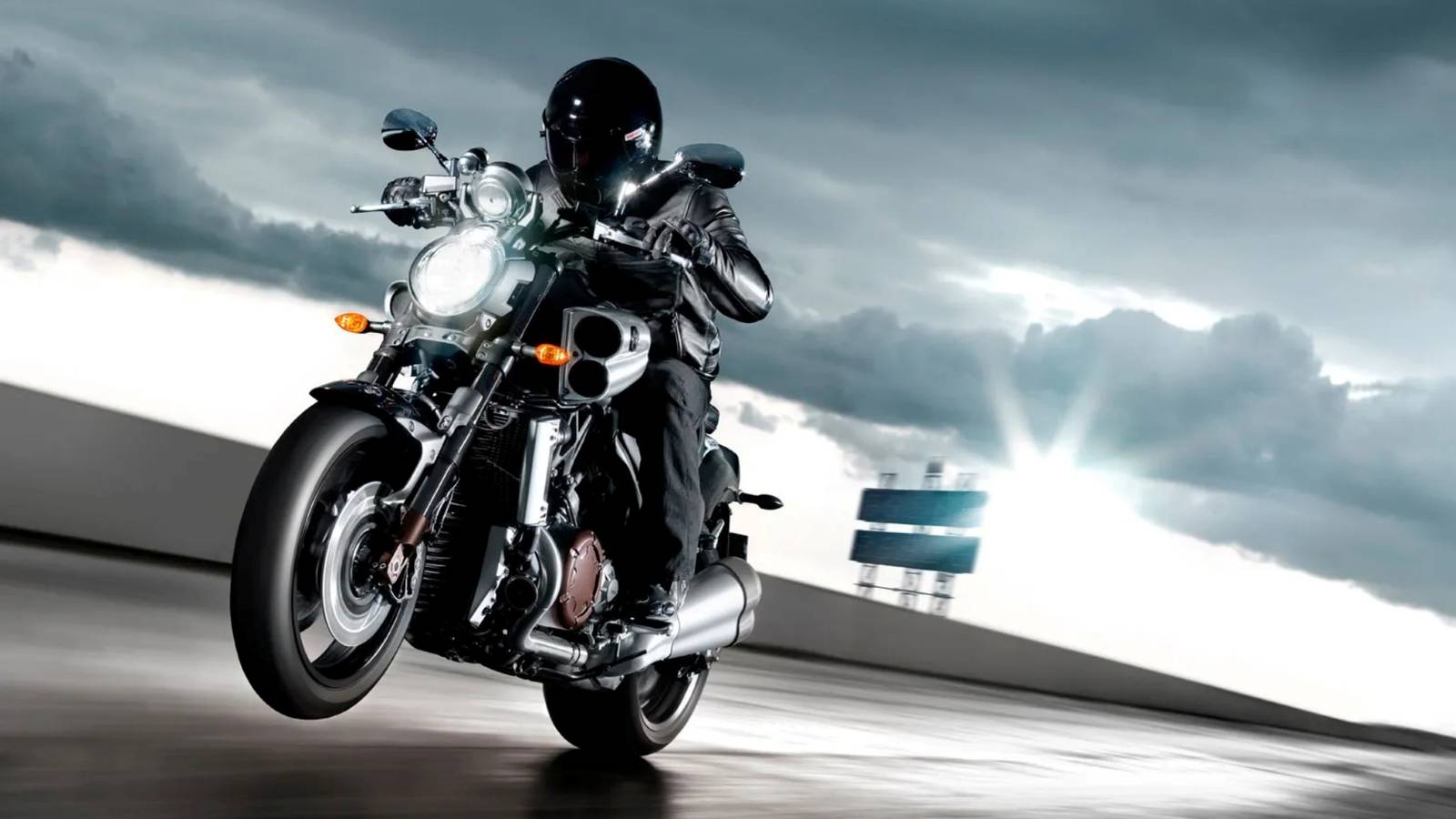
Cruisers are supposed to be easygoing, laid-back bikes. But that’s not always the case today. There is a subsection called ‘power cruisers’ that uses the form of the cruiser, but also wants to get everywhere in a hurry. The king of the hill when it comes to power cruisers today is unquestionably the Diavel.
Ducati has thrown everything at it, making a Frankenstein of a motorcycle that looks great and goes even faster. In fact, it is one of the quickest-accelerating motorcycles on the planet today. However, it can’t claim to be the first cruiser to do these things. There was another product that was exactly like this; a cruiser that looked great and offered ballistic performance. In fact, years later, it is still more powerful than the Diavel.
The Yamaha V-Max Is The Yamaha Power Cruiser That Rivals The Ducati Diavel At A Lower Price

It is only six years since the V-Max was last sold as a new model in the US market. If you’re lucky, you might find one for a really low price, but don’t expect it. The V-Max, especially the second generation, still has the performance to teach the Diavel a thing or two. Yes, even the Diavel V4 RS! The V-Max is an oddity like no other. Yamaha is usually a very conservative manufacturer and doesn’t like to take risks. The V-Max is the biggest exception to its usually stodgy worldview, and boy are we grateful for it!
Yamaha V-Max Price: $20,420

V-Maxes hold their value exceedingly well. When they were last on sale new, they retailed for approximately $18,000, and examples from that model year are now available for $20,420. This is due to the product being a very reliable one, plus V-Max owners usually take care of them since they are more often than not fans of it. The Diavel V4 is priced at $27,995, with the Diavel V4 RS priced a little higher, at $39,995. Thus, the V-Max is the Yamaha power cruiser that rivals the Ducati Diavel at a lower price.
The Yamaha V-Max Has Over 190 Horsepower

Yamaha isn’t known for making V4 engines. That said, there have been V4-powered Yamahas fairly regularly in its history, like the RD500LC, Venture Royale, and the Royal Star Venture. The V-Max is nothing like these others, choosing the layout because it needed the compact packaging, but this was not a simple torque or power monster.
Since we’re talking about the 2020 V-Max, we’re going to limit ourselves to the second-generation fuel-injected engine and not the first-gen V-Max. This is powered by a 65-degree V4 that displaces 1,679 cc, has a compression ratio of 11.3:1, and generates 200 horsepower at 9,000 RPM and 123 pound-feet at 6,500 RPM. It has a five-speed gearbox and final shaft drive, unlike the Diavel’s chain drive. A slipper clutch is present as well.

10 Powerful Cruiser Bikes From The 2000s That Are Worth Buying Today
These powerful cruisers from the 2000s cost as low as…
This engine has a by-wire throttle and Yamaha’s patented YCC-I system. This system lengthens or shortens the length of the intake funnels depending on the revs for better torque delivery – long intakes at low revs, and short ones for high revs, with the transition occurring at approximately 6,650 RPM. Traction control is present, which is a good thing.
A little perspective is necessary here: 1,679 cc puts its displacement somewhere in the range of a large V-twin cruiser’s displacement. The horsepower figure is one that any liter sport bike would be proud of, and the peak torque figure matches that of the Honda Gold Wing, a full-size tourer. The Diavel V4 doesn’t have a weak engine, but the stats don’t jump off the page the way the V-Max’s do.
Yamaha V-Max Chassis

The V-Max is a cruiser, and it is not usual for a cruiser to have a diamond frame, much less one made from aluminum. But that’s exactly what the V-Max has. It also has a swingarm and bolt-on subframe made of the material. The suspension consists of 52 mm conventional forks with a link-type rear shock. Its front forks are adjustable, with 5-step preload, 20-step compression, and 17-step rebound damping adjustment. The rear shock has a remote reservoir, 11-step preload, 12-way compression, and 18-way rebound damping adjustment.

10 Powerful Cruiser Bikes From The 1990s That Are Worth Buying Today
Fancy an investment in a cruiser from the golden age of motorcycling? We’ve got 10 cruisers that you should consider
The Brembo brakes are serious equipment: at the front, there are twin 320 mm floating wave discs paired with radial monobloc six piston fixed calipers and a radial master cylinder, while a 298 mm wave disc paired with a single piston caliper mounted under the swingarm. ABS is present but is not switchable. An absolutely enormous 200 mm wide rear tire is mounted to the V-Max in an effort to deal with the engine’s brute force.
Yamaha V-Max Dimensions

This is a big, heavy motorcycle. It is over 94 inches long, with an almost-67-inch wheelbase. The seat is relatively high for a cruiser at 30.5 inches, but it should be comfortable for most. Ground clearance is 5.5 inches, the underseat fuel tank holds 4 gallons, and the curb weight is 683 pounds wet.
Yamaha V-Max Features

The V-Max has a very interesting instrument cluster. There are two distinct units. One is a handlebar-mounted circular pod with an analog rev counter dominating it. An LCD in the bottom right corner displays the speed. On top, mounted on the outside of this pod, is a shift light like you’d find on old tuned cars with aftermarket tachometers. Perfect for drag racing, eh?
There is a second tank-mounted dot matrix instrument cluster that displays the fuel gauge, coolant temperature, odometer, dual tripmeters, gear indicator, and clock. There are other, more interesting parameters that can be displayed, like throttle valve opening, intake air temperature, a stopwatch, and a countdown clock! We especially like the way the fuel and temperature levels are indicated with the help of color. There is a halogen headlamp, an LED tail lamp, and an engine immobilizer.
A lot of the V-Max’s features aren’t the kind that can be seen. There is a lot of engineering that has gone into making that gem of an engine. The pistons are made of aluminum, the con rods are of the fracture split kind, the cylinders are ceramic coated and thus don’t need liners, the crankcase covers are made of magnesium alloy, and it has two radiators, each with its own fan.

10 Powerful Cruisers Beginners Should Be Afraid Of In 2025
The most powerful cruiser bike on this list packs a muscle car V8; literally!
Yamaha V-Max Competition

The V-Max had many renowned competitors during its production run, but the most memorable was undoubtedly the Harley-Davidson VRSC V-Rod. This was a power cruiser that wanted exactly the same thing as the V-Max: domination of the drag strip. The Triumph Rocket 3 also deserves a hat tip here. However, we are comparing the V-Max to the Diavel, and they went head-to-head as new bikes for a good ten years from 2010, when the original Diavel was launched.
Today, the Diavel also has a V4 engine that produces prodigious power and torque, and it is significantly lighter than the Yamaha. It also benefits from a six-axis IMU. The more sophisticated electronics and light weight make it easier to live with and quicker than the Yamaha almost everywhere, but put both on the drag strip, and the OG will still show the upstart who’s boss.
Yamaha V-Max Vs Ducati Diavel V4
|
Model |
Yamaha V-Max |
Ducati Diavel V4 |
|
Price |
$21,649 (MY 2020) |
$27,995 (new) |
|
Engine |
65° V4 |
90° V4 |
|
Displacement |
1,679 cc |
1,158 cc |
|
Power |
200 HP @ 9,000 RPM |
168 HP @ 10,750 RPM |
|
Torque |
123 LB-FT @ 6,500 RPM |
93 LB-FT @ 7,500 RPM |
|
Curb Weight |
683 pounds (wet) |
492 pounds (wet) |
Source: Yamaha Global Ducati USA