
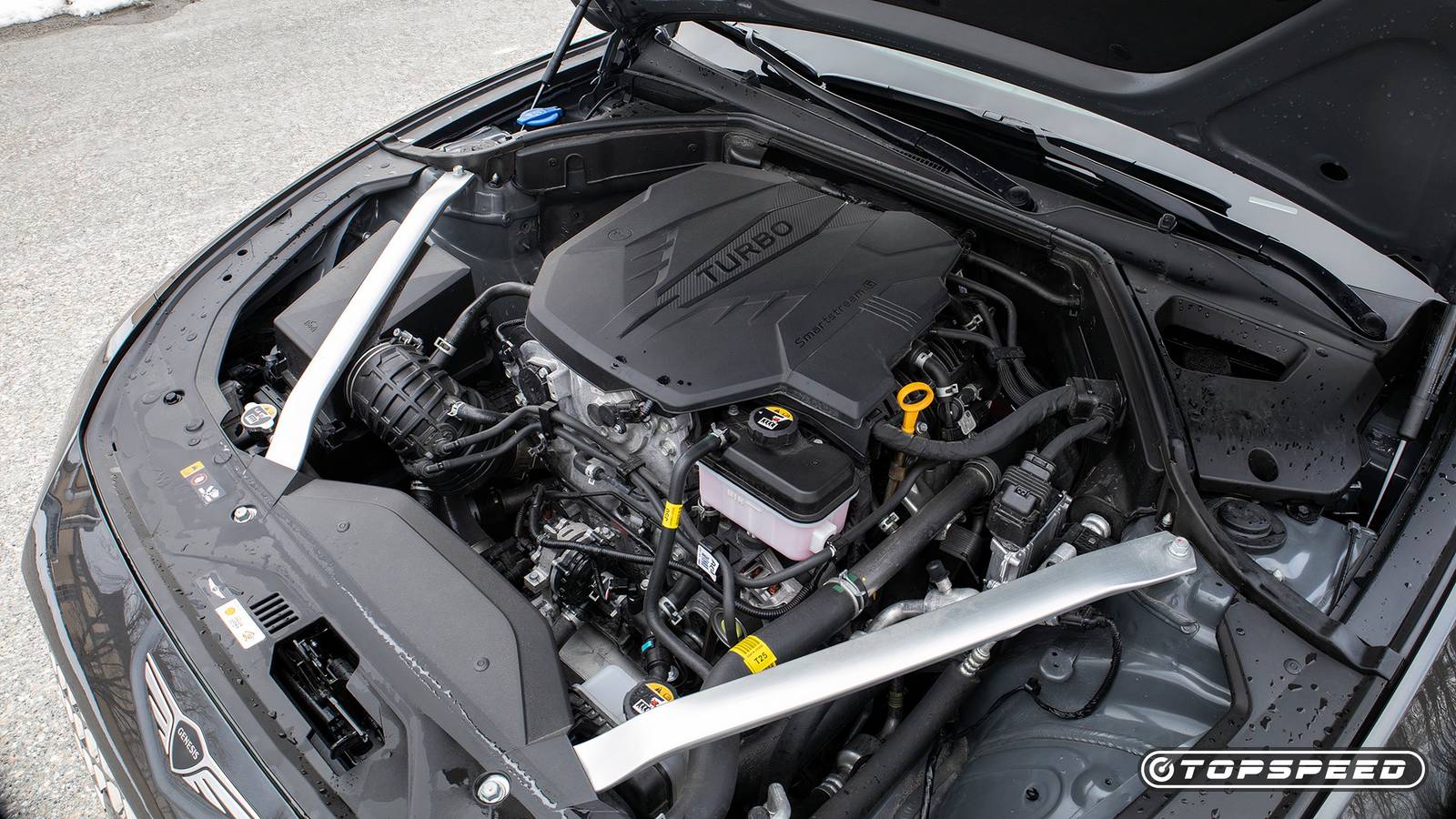
With the proliferation of turbocharged engines in newer vehicles, from commuter-friendly sedans to work trucks, we have never had more capable powertrains available at our disposal. As a result of increasing emissions standards, most automakers have replaced their naturally aspirated V-6 engines with more compact and fuel-efficient turbocharged inline-four engines. Yet, few turbo-fours on the market are capable of being faster than their larger predecessors, except for a select few.
One of the most underappreciated powertrains in this regard is the 2.5-liter turbocharged Smartstream FR G2.5T inline-four found in several current-generation Genesis models. Yet, is this turbo-four engine capable of challenging Genesis’ flagship twin-turbo V-6 platform in terms of performance? Follow along as we break down all the key details about the Smartstream 2.5T inline-four, an engine capable of outperforming most V-6 engines.
How The Genesis 2.5T Holds Up In Stock Form

Currently, the 2.5-liter turbocharged Smartstream FR G2.5T inline-four is one of the most utilized engines in Genesis’ current vehicle line-up. In the 2026 Genesis G70, this engine produces 300 horsepower and 311 pound-feet of torque. These figures aren’t just good for a turbo-four; they’re among the best in the luxury segment. How does this stout turbo-four match up with its bigger and beefier V-6 sibling? Let’s compare them directly to get a better idea.


Find 2026 Genesis G70 and more cars for sale on our Marketplace
A Head-To-Head Comparison Of Two Genesis Engines

We know that the Genesis 2.5T engine can make quick work of most, if not all, naturally aspirated V-6 engines with its stock performance figures. That is why we have presented an even more difficult challenge for this stout turbo-four: matching the capability of its bigger brother, the 3.3-liter twin-turbo Lambda II RS T-GDi V-6 found in the higher trim levels of the Genesis G70. This 3.3-liter engine produces 365 horsepower and 376 pound-feet of torque and is currently only available in the Genesis G70. This 3.3-liter twin-turbo V-6 platform already has a successor introduced in 2020, the 3.5-liter twin-turbo Smartstream FR G3.5T V-6, but it is not available on the G70 model. Thus, for the sake of comparison, we will be sticking to the older 3.3-liter Lambda II V-6.
The Twin-Turbo V-6 Is A Bit Quicker Than The Turbo-Four

On paper, the Genesis 2.5T is down about 65 horsepower and 65 pound-feet of torque. In real-world performance, the 2.5T in the AWD Genesis G70 produces about a 5.9-second zero-to-60 MPH time. That figure is respectable, but far out of the range of the AWD Genesis G70 3.3T, which achieves the 60 MPH sprint in about 4.5 seconds. A 1.4-second difference in a 60 MPH sprint time is pretty significant.
The twin-turbocharged, 3.3-liter V-6 remains a gem of a powerplant, one with enough horsepower and torque on tap to take the fight to, say, a BMW M340i or an Audi S4.
– William Clavey for TopSpeed
The 3.3T V-6 doesn’t just make more power than the turbo-four, it makes more power everywhere in the rev range. Down low, the displacement of the boosted V-6 offers faster acceleration while the twin-turbo system provides even more top-end range. What would it take to close the gap between these two turbocharged Genesis performance platforms? Let’s take it a step further.

What Nobody Tells You About Owning A Modern Turbocharged Engine
Turbochargers promise performance, but at what price? Uncover the trade-offs and challenges of owning a modern boosted engine.
What Some Simple Bolt-Ons Can Do For The Genesis 2.5T

There is simply no way the Genesis turbocharged 2.5T inline-four can match the Genesis twin-turbo 3.3T V-6 pound-for-pound in stock configuration. Yet, with a little bit of low-effort modification, the Genesis 2.5T can unlock a whole different tier of performance capability. If all you want out of your Genesis 2.5T is just a little more spice than comes available from the factory, it is the perfect engine. Let’s break down some of the common modifications with this turbocharged engine that are worth throwing your hard-earned money at.
Plug-And-Play Options With The Genesis 2.5T

In the aftermarket, there are several different options for increased power output from your Genesis 2.5T engine. The simplest and most efficient route, without a doubt, is opting for a piggyback tune. This tune will allow for extensive tunability of the Genesis 2.5T platform, including several different available performance maps according to your modification list. Installation can typically be achieved in a matter of minutes, and removal is just as easy once you know where everything goes. The base tune, map 1, provides a four psi boost over stock, and maps are included for 91 octane, 93 octane, and E85 fuel mixes. With an optional wireless adapter, all relevant tuning parameters can be adjusted on-the-fly from the associated free app available on both iOS and Android systems.
Performance Expectations And Realistic Power Gains

Depending on the dyno setup, average output figures for a Genesis 2.5T engine as found in the Genesis G70 are about 250 to 260 wheel horsepower and 297 wheel pound-feet of torque. With Map 1 in the 91-octane configuration, these figures jumped to 284 wheel horsepower and 334 wheel pound-feet of torque. With an E20/91-octane blend on Map 4, figures of 319 wheel horsepower and 376 wheel pound-feet of torque were achieved.

These figures are with the tune and fuel only, no additional bolt-on modifications. With additional supporting modifications such as E30 fuel and an intake, power figures of 350 wheel horsepower are achievable. 350 wheel horsepower is a huge performance improvement, considering how little time and effort are required for modification. Despite the increase, this boost alone will not be enough to truly close the gap between the Genesis 3.3T V-6 and the 2.5T inline-four engines. To achieve this lofty goal, it will require pushing the Genesis 2.5T engine to the extreme.

The Turbocharged Four-Cylinder That Outperforms Most V8 Engines
This turbocharged I4 proves you don’t need eight cylinders to make the big power figures.
Pushing The Genesis 2.5T To Its Limits

While pushing a 2.5-liter turbo-four to reach the capability of a 3.3-liter twin-turbo V-6 is far from logical, that doesn’t mean it’s not possible. At a certain point, you will begin to question the dubious value proposition of this feat, and this is about that point. To close the gap between these two engines, serious modifications will be required, including upgrading the stock turbocharger. Let’s expand on that.
How To Close The Gap To The Genesis Twin-Turbo V-6

If you recall, we are attempting to close a 1.4-second difference in zero-to-60 MPH times between these two turbocharged Genesis engines. Even with a full bolt-on 2.5T running E40 fuel producing about 350 wheel horsepower, this would only drop our estimated zero-to-60 MPH time to 5.04 seconds. A sub-four zero-to-60 MPH time alone would be great, but we want to see if we can get to that ideal 4.5-second mark or faster.

According to our calculations, to achieve about a 4.5-second zero-to-60 MPH time with the 2.5T engine, a power output of about 440 wheel horsepower should be expected. That is an insane amount of power for any turbo-four engine, regardless of modification. Those estimated power figures far exceed what can be achieved with just simple bolt-on modifications. Yet, with a bolt-on hybrid turbo upgrade, this figure and greater can be realized.
Practicality, Feasibility, And Other Considerations

With a hybrid turbo upgrade, figures of 450+ horsepower are possible with the Genesis Smartstream 2.5T inline-four platform. However, this upgrade requires a full list of prerequisite modifications to make this power figure viable, let alone reliable. The biggest limitation in this regard is cost, as a fully-supported hybrid turbo setup is a big step up from simple bolt-ons. At this point, any semblance of a value proposition goes out the window.

450 horsepower may be possible with an off-the-shelf tune pending the necessary supporting modifications, such as fueling, cooling, and exhaust upgrades. However, above 500 horsepower, custom tuning is certainly required, and that alone is a massive expense of both time and money. While it certainly is possible to get the Genesis 2.5T to match the power output and road performance of the Genesis 3.3T V-6 engine, the rational route would be to avoid falling into this rabbit hole altogether.

As we mentioned from the start, modifying a turbo-four to match the capability of a twin-turbo V-6 is somewhat of a silly proposition. The Smartstream 2.5T inline-four can achieve this goal, but at a certain point, it stops making financial or logical sense. If you want an extra boost out of your Genesis 2.5T, bolt-on modifications such as a piggyback tune and E85 fuel blends will provide a healthy bump in power output without much financial sacrifice.

350 to 380 horsepower can be reliably achieved without much headache and will provide a meaningful jump in performance when compared to stock. The best part about these bolt-on modifications is that they are non-permanent and can be easily removed for whatever reason, even if you want to sell the car one day. Another pertinent detail is that voiding your factory warranty is always a concern when performing aftermarket modifications, as is dealing with your local smog regulation laws.
Sources: Hyundai, Genesis, MuchBoost, Burger Motorsports