
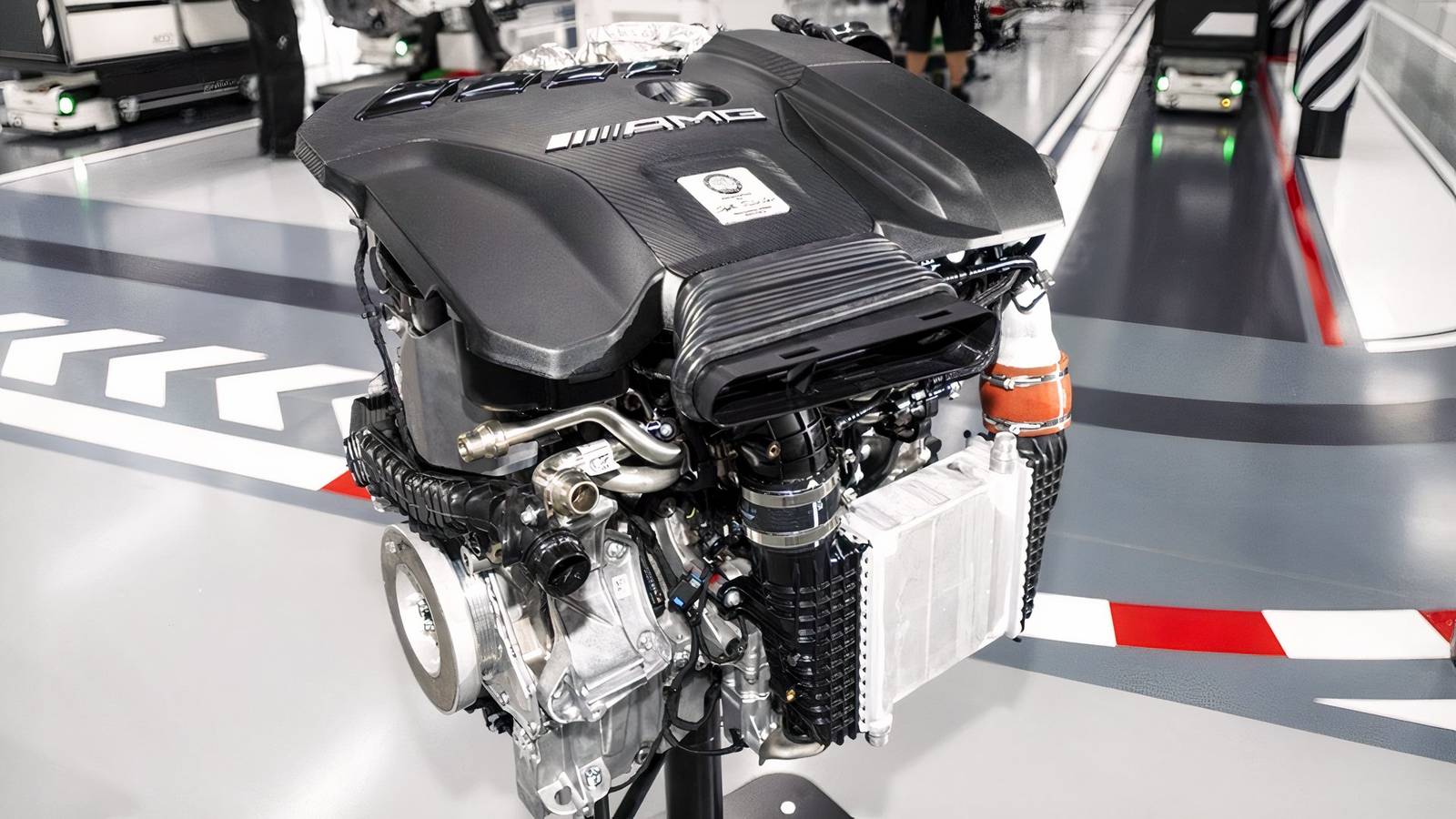
There’s an adage among hot rodders and old-school performance enthusiasts. It goes a little something like “there’s no replacement for displacement.” It’s a reference to the times of big-displacement, big-power V8 engines like the ones hobbyists and racers would build for street and strip use. However, it’s not 1971 anymore. It’s 2026, and, as it turns out, there really might be a replacement for displacement.
Doubt it? I invite you to take a look at Mercedes-AMG’s turbocharged, power-dense four-banger: the M139. When Mercedes-Benz introduced the mill in 2019, it produced 416 horsepower. It was instantly the world’s most powerful production four-cylinder engine. Since then, variants of the M139 have made seemingly impossible power outputs from a 1,991-CC displacement. In peak setup, the hybrid version will produce a properly muscular 671 horsepower. That’s the sort of potency once reserved for big, supercharged V8s.
The Mercedes-AMG Turbo Inline-Four Is V8 Strong

Mercedes-Benz and Mercedes-AMG announced the M139, a turbocharged inline-four-cylinder engine, back in 2019. The big headline wasn’t that Mercedes-AMG had a new engine in its repertoire, but rather what the little 2.0-liter mill produced in terms of power output. The Affalterbach-built AMG engine produced up to 416 horsepower and 369 pound-feet of torque. That’s almost 209 horsepower per liter of displacement. Put simply, it was instantly the most powerful series production four-cylinder on Earth. In the less potent configuration, the M139 produced 382 horsepower and 354 pound-feet of torque.

And Mercedes-AMG didn’t stop there. Continuous development of the little four-pot heart resulted in the M139l engine. Mercedes-AMG touted that the M139l mill is the “ first series production unit in the world to feature an electric exhaust-gas turbocharger,” something the brand borrowed from the AMG Petronas Formula 1 team. Using that electric turbo, a 4.8-kWh lithium-ion battery pack, and an AC electric motor, Mercedes-AMG vehicles with that hybrid application can produce up to 671 horsepower and 752 pound-feet of torque. That’s less than 40 horsepower shy of the output of the original Dodge Challenger SRT Hellcat and its supercharged 6.2-liter V8. Make no mention of the fact that a non-hybrid M139 weighs less than half as much as a naturally aspirated 6.4-liter HEMI V8. Not too shabby.


Find 2025 Mercedes-AMG C63 Sedan and more cars for sale on our Marketplace
‘One Man, One Engine’

Perhaps you’ve seen some Aston Martin, AMG, or high-performance Corvette engines with little plaques. Typically, those little plaques proudly display the information about how the engine went from parts to a complete unit. Mercedes-AMG does the same thing with the M139. Like the “63” series powerplants, the technicians at the Affalterbach plant build each M139 by hand, culminating in a little plaque with the builder’s signature.

It’s all part of Mercedes-AMG’s “One Man, One Engine” philosophy. A “driverless transport system” with its own power supply ferries the engine and tools around with each technician as they move about the Affalterbach factory floor. At a glance, it looks like a fancy engine-stand-table-combination on wheels. But it does allow an AMG worker to assemble one of these high-performance engines without being tethered to a single spot in the plant. One technician, one complete M139 four-cylinder engine.

Best Of The Best: Greatest Mercedes-AMG Models Of All Time
The combination of Mercedes and AMG has been one of the greatest partnerships in automotive history. Here are the greatest Mercedes-AMG models.
Some Of The Quickest Four-Pots

As you might expect, the power-dense AMG four-cylinder returns some seriously quick acceleration times. For instance, in the Mercedes-AMG CLA 45 S, the turbocharged 416-horsepower four-cylinder engine will motivate the Merc to 60 mph in around four seconds. Add a hybrid system to the mix, and the numbers get even crazier. In testing, the 671-horsepower C 63 S Performance hit 60 mph in just 3.3 seconds on its way to an 11.2-second quarter mile.
M139 Engine Specs
|
Displacement |
1,991 CC |
|
Bore X Stroke |
83.0 X 92.0 MM |
|
Induction |
Twin-Scroll Turbocharger With Roller-Bearing Compressor And Turbine Wheels |
|
Redline |
7,200 RPM (2019) |
|
Compression Ratio |
9.0:1 |
|
Engine Weight |
353.8 LBS |
It’s not just four-cylinder mills in Mercedes-AMG products, either. The 2026 Lotus Emira also packs an AMG-sourced 2.0-liter four-cylinder engine, despite sporting a Lotus badge. Paired with Colin Chapman’s beloved lightness, a manual-equipped Lotus Emira will scoot to 60 mph in just 4.3 seconds. That kind of speed is possible with 360 horsepower on tap, less than the comparable M139 engines in the AMG Mercs.

The Largest Engine Ever To Power A European Supercar
This naturally aspirated 8.3-liter V16 stands as the largest engine ever fitted to a European supercar.
Enough To Set Records In The C-Class And The GLC

The Mercedes-AMG M139 engine is potent enough without the addition of hybrid assistance. However, the hybridized M139l variant in the C 63 S E-Performance and the GLC 63 S E-Performance are enough to break records in the four-cylinder passenger car and SUV markets. As mentioned, the C-Class with all the extra firepower will hit 60 mph in 3.3 seconds. That makes the C 63 S E-Performance one of the quickest accelerating four-cylinder passenger cars on the market. That’s quick enough to smoke a litany of V8-powered performance cars.
Mercedes-AMG C 63 S E-Performance Specs
|
Engine |
Hybrid Turbocharged 2.0-Liter I4 |
|
Transmission |
9-Speed Automatic Transmission |
|
Horsepower, Torque |
671 HP At 6,750 RPM, 752 LB-FT |
|
0-60 MPH |
2.9 Seconds |
|
Quarter Mile |
11.2 Seconds At 121 MPH |
For instance, the now-discontinued Jaguar F-TYPE SVR required 3.5 seconds to do the deed, despite having all-wheel drive and a supercharged 5.0-liter V8. Oh, and that Hellcat? The 797-horsepower Dodge Challenger SRT Hellcat Redeye Widebody required 3.6 seconds to make the same sprint. Oh, the limitations of traction. Even the larger SUV doesn’t slow down much. In testing, the Mercedes-AMG GLC 63 S E-Performance, despite all the extra poundage, hit 60 mph in 3.5 seconds. Like the C-Class, that sort of speed establishes the GLC variant as one of the quickest hybrid four-cylinder SUVs you can buy.

2024 Mercedes-AMG C63 S E Performance: Everything Confirmed So Far
An F1-derived hybrid and turbocharging tech make this the most powerful C63 AMG yet, and here’s all you need to know about it.
A Replacement For Displacement?

Granted, there are concessions when you go with half the number of cylinders. But let’s face it: most of them are subjective. Perhaps the most referenced: the soundtrack. Music is a debatable topic. So are the soundscapes produced by our favorite cars. More often than not, enthusiasts tend to wax lyrical about the orchestral sylings of bassy V8s or high-strung, flat-plane 12-cylinder mills. And it’s difficult to disagree with that fact.

But Mercedes-AMG has a record-breaker in the M139 and M139l engines, even without eight cylinders or cavernous displacement. In earnest, the “no replacement for displacement” adage might not have much of a leg to stand on. Especially with the turbocharged Mercedes-AMG inline-four in the conversation.
Sources: Mercedes-AMG, Mercedes-Benz