
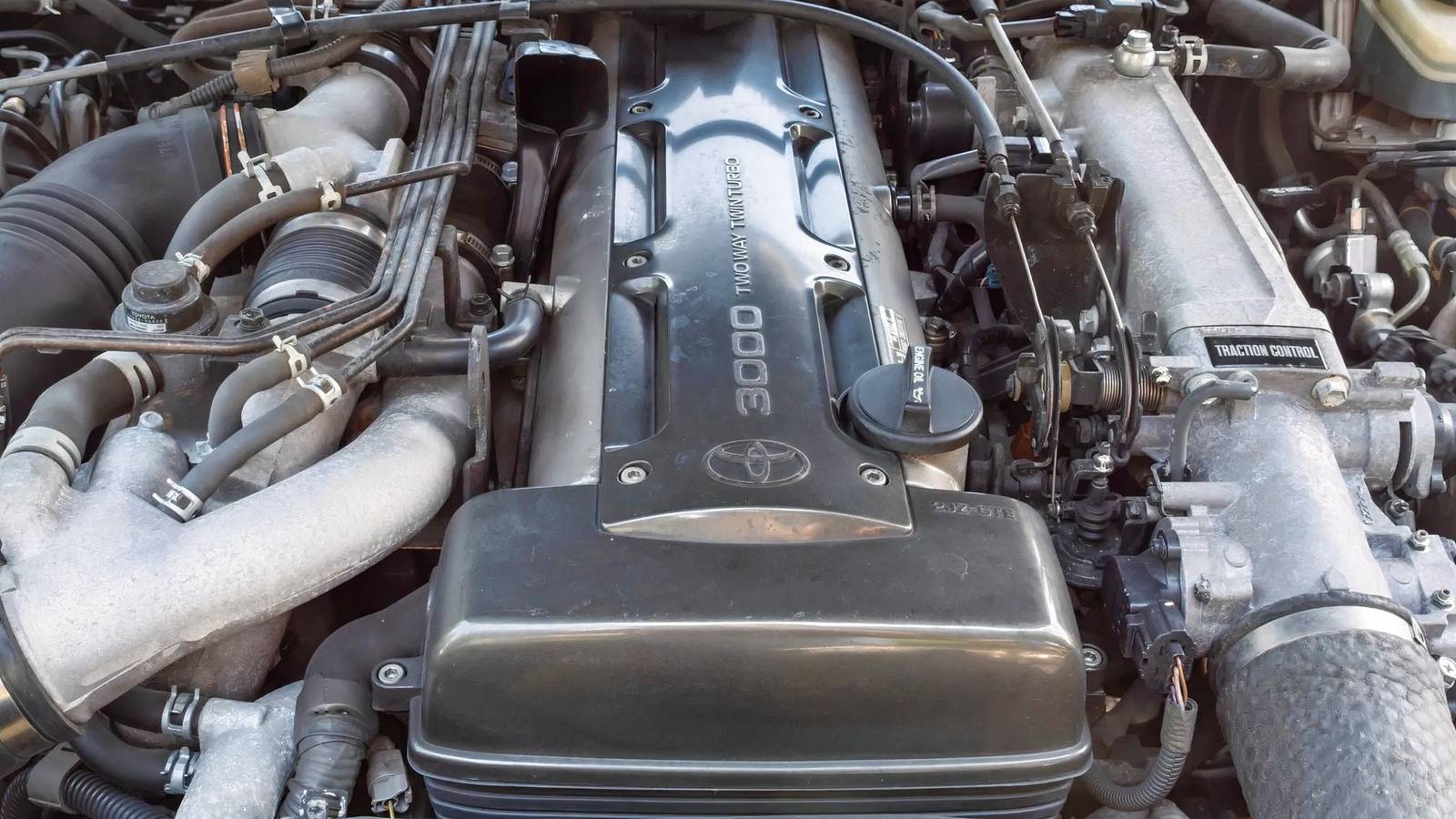
Auto industry engineers can spend years, millions of dollars, and countless hours developing a capable powerplant. An engine designed to scream up to the redline and summon smiles time and time again without failing. With reasonable amounts of boost, tough, robust materials, and factory emissions controls in place, these performance icons can delight at the drag strip or circuit and drive home immediately after.
And yet, builders, hobbyists, and enthusiasts will take one look at a stock engine and ponder what sort of mad science they can apply. Just how much power could you possibly wring out of this lovingly engineered assembly of iron, aluminum, rubber, and moving parts? Well, in the case of this beloved Toyota performance engine, the number is often 750, 900, or even 1,000 horsepower without failing spectacularly.
What Makes A Great Performance Engine?

There’s no one perfect performance engine. Just take a look at some of the favorites among car builders. The LS family of fuel-injected GM small block engines. At this point, builders have been carefully (and sometimes not-so-carefully) assembling 800, 900, up to 1,000-horsepower examples of the mill. Sometimes, power output figures reach well beyond that. Still, aside from being criticized by car-culture hipsters as a “mainstream” swap-and-build option, modified LS engines will often give up their hydraulic lifters or expose piston ring seal issues.

In short, a good performance engine should live at the intersection of tunability, power, weight, and, of course, durability in the face of a high-horsepower build. Ideally, a decent performance mill should stand up to the demands of forced induction and added boost without surrendering under the pressure. But, as we mentioned, no engine is perfect, and increasing heat, boost, and demand can sometimes lead the most stout of performance engines to failure.
Toyota Has A History Of Building Badass Engines

Today, Toyota is one of the highest-volume automakers in the world. That doesn’t mean the brand shied away from producing some properly sharp performance engines. In fact, Toyota developed a smooth, ear-candy-esque 3M inline-six so nice, it was featured in a James Bond film back in the late ‘60s. Fast forward a handful of years, and Toyota was responsible for outstanding engines like the 2ZZ-GE, 7M-GTE, and the orchestral 1LR-GUE V-10 from the Lexus LFA.

That said, Toyota’s not done. For the 2027 model year, the Japanese marque is prepped to roll out the GR GT, an all-new halo car with the Ford Mustang GTD and other bleeding-edge, motorsport-developed cars in its sights. Under that hood? A twin-turbo V8 mated to an electric motor. It’s science fiction compared to the 2000GT of yesteryear. But there’s one other Toyota engine so coveted and revered by builders and super fans that they routinely build them to stratospheric horsepower figures. And it’s not to be found under future GAZOO RACING halo cars.

10 Legendary Toyota Engines That Refuse To Die
These are the engines that built Toyota’s legacy of reliability.
The Toyota 2JZ: A Power-Mad Legacy

If you’re a fan of Japanese performance cars, especially those of years past, you’re likely acquainted with the Toyota 2JZ. Hell, if you’ve watched the inaugural chapter of “The Fast and the Furious,” you’ve watched action film characters fawn over the performance potential of a MkIV Supra before turning it into a Ferrari-beating street machine. As it turns out, there’s a good reason for the Hollywood reverence. For starters, Toyota took the Nissan RB approach to heart and used a cast-iron block to handle the stock horsepower of its well-balanced inline-six, and then some.
Toyota 2JZ-GTE Specs
|
Engine Designation |
Toyota 2JZ-GTE (North American Market) |
|
Displacement, Type |
3.0-Liter I6 |
|
Aspiration |
Twin-Turbocharged |
|
Block Material |
Cast Iron |
|
Bore, Stroke |
86 MM, 86 MM |
|
Weight |
507 LBS |
|
Stock Horsepower, Torque |
320 HP At 5,600 RPM, 315 LB-FT At 3,600 RPM |
Not unlike the Nissan RB26DETT, the 2JZ-GTE makes use of oil-squirting jets to cool the pistons during operation. As a result, the pistons cool and lubricate that much more easily, supporting the extra demands of a high-horsepower build. If that wasn’t enough, the 2JZ-GTE features a forged crankshaft, a non-interference valvetrain, and an oiling system and cooling system capable of supporting a serious build. Later versions of the North American-market 2JZ had a horsepower rating of 320, though the engines are capable of more. Much more. Of course, to build big power, you might want to change a few things, like the turbochargers and internals.

10 Classic Japanese Sports Cars That Can Be Daily Driven
Boasting a mix of sporty credentials and everyday usability, these JDM classics are awesome daily drivers.
1,000-Horsepower Builds
320 horsepower was far from what Toyota’s underrated performance prodigy engine could belt out with the right tweaks. With less invasive enhancements, a healthy 2JZ-GTE can make big power. And a fully built 2JZ can hit that magic 1,000-horsepower figure. As it turns out, with some larger turbochargers, an aftermarket wastegate, an upgraded intercooler, a tunable electric control unit (ECU), some seriously high-performance fuel system components like the pump and injectors, and a host of other power-building parts, a modified 2JZ-GTE producing 750 to 1,000 or more horsepower is entirely conceivable.

Still don’t believe it’s possible? Think again. In one case, a car builder named Mike built a 1,000-horsepower 2JZ-GTE using an arsenal of parts from Brian Crower. Mike even stuck with the factory-forged crankshaft. In yet another instance, professional Formula Drift driver Dan Burkett, aka “RAD Dan,” built a BorgWarner-turbocharged 2JZ pumping out 1,017 horsepower at the rear wheels of his track-going Supra.
A Popular Swap Option
As you might imagine, and not unlike the Nissan RB family of performance engines, the 2JZ was (and still is) a fan-favorite option for all kinds of engine swaps. In some cases, builders keep things in the family. In the Toyota family, that is. Take this example of a 2JZ-swapped Toyota GR86, for instance. Instead of keeping things stock with the grumbly flat four you’d normally find under the GR86’s hood, owner Jeff Woodruff made sure the 2JZ heart transplant produced 500 wheel horsepower. Then you have the more unorthodox stuff. Builders will sometimes swap the twin-turbocharged Toyota inline-six into all sorts of wild stuff, like classic Mercedes-Benz sedans and little pickup trucks. It’s a crazy world out there.
Not Just In The Toyota Supra

It’s no secret that most of the 2JZ-GTE’s street cred is courtesy of the collector-favorite Toyota Supra MkIV. However, you could find the naturally aspirated 2JZ-GE and twin-turbocharged 2JZ-GTE in several other cars from that era. The twin-turbo GTE variant was only present in a couple of models, like the MkIV Supra and the Japanese-market Toyota Aristo. The naturally aspirated GE variant, however, lived under the hood of the Lexus IS 300, Lexus GS 300, Lexus SC 300, and Toyota Cresta, to name a few.

Five Forgotten Inline-Four Engines That Last Over Half A Million Miles
Forgotten through the passage of time, these unbreakable inline-fours deserve more appreciation.
The Legend That Lived On

Alas, time marches on, and it marches on without the 2JZ. Toyota stopped building the cast-iron inline-six engine in 2007. Before you weep for Toyota’s meaty mill, the 2JZ’s legacy lives on. Even after Toyota discontinued the JZ family of engines, you could get a car with a Supra badge and a turbocharged inline-six in the Toyota GR Supra from 2020 to 2026. And despite the “nice BMW” jokes from critics, the MkV Supra is a pretty spectacular successor to the mighty 2JZ and the MkIV Supra, thanks to the exceptional BMW B58 taking the helm.
Sources: Toyota, DSport Mag, Engine Specs, MotorTrend, Bring a Trailer