
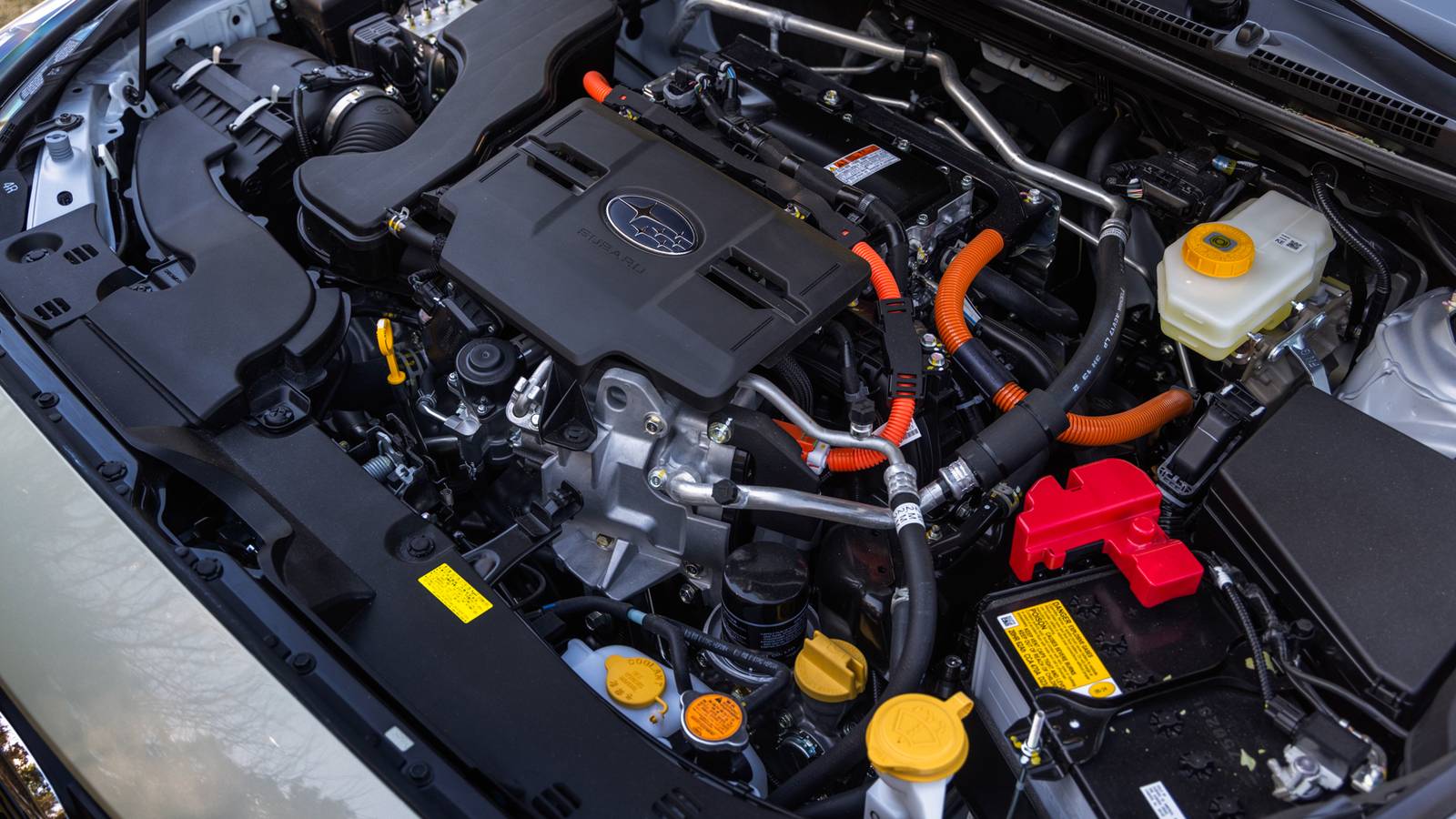
Engine reliability is a fundamental aspect to consider if you are shopping in the mainstream car market, especially if it is for a car that you intend to use as a daily driver. This is a primary reason why cars like the Toyota Camry and Honda Accord continue to achieve strong sales, despite the wave of crossovers and SUVs that aim to meet the more demanding versatility and practicality needs in the U.S.

Available Models
Subaru
- Founded
-
15 July 1953
- Founder
-
Chikuhei Nakajima
- Headquarters
-
Ebisu, Shibuya, Japan
- Owned By
-
Subaru Corporation
- Current CEO
-
Atsushi Osaki
There’s one engine that benefits from an incredibly high reliability standard, but fails to hit the same sales records as its Japanese counterparts. This likely stems from the poor reliability reputation of its predecessor and other market factors. The Subaru FB25D may not be the most emotional engine available, but it has so far benefited from a strong track record of reliability since the brand introduced it just shy of seven years ago.
Subaru Doesn’t Steal The Spotlight, But It Deserves To

Subaru‘s performance in the U.S. over the last five years reflects a strong post-pandemic recovery, followed by a recent period of stabilization and transition. Severe supply chain constraints affected the Japanese brand’s performance in the region, resulting in a sales dip to 556,581 units in 2022. Over the two years that followed, Subaru’s performance appears to have sharply rebounded, driven by record-breaking demand for the Crosstrek and a refreshed Forester. This performance decreased by 3.6 percent in 2025, which reflects an annual sales figure of 643,591 vehicles. This is the year that Subaru balanced a shift toward domestic production in Indiana and faced broader economic complications, including new tariff policies.
Despite these fluctuations, Subaru has maintained an impressive streak of month-over-month growth and high dealer profitability, largely due to its production discipline and a loyal customer base that has kept its market share steady at approximately 4 percent. While impressive, these figures pale in comparison to Toyota’s 2,157,811 and Honda’s 1,430,577 unit sales over the same period, ultimately reflecting Subaru as an overlooked product.
Subaru’s Focused 2026 Catalog

Subaru’s 2026 U.S. lineup continues its aggressive push toward electrification and rugged utility, as it introduces the all-new Trailseeker EV and the adventure-focused Uncharted, alongside staple models like the Crosstrek, Forester, Outback, Ascent, Legacy, WRX, BRZ, and the updated Solterra EV.
The brand has largely streamlined its internal combustion offerings around the FB25D, which is its current-generation 2.5-liter naturally aspirated Boxer engine. This is the primary powertrain choice for four core models, namely the Crosstrek, the base-level and Premium Forester, and the Outback non-turbo trims. Performance enthusiasts still have the turbocharged 2.4-liter flat-four in the WRX and Ascent, and the 2.4-liter naturally aspirated engine in the BRZ. However, the FB25D serves as the mechanical backbone for the majority of Subaru’s high-volume sales in 2026.

A Closer Look At The Last Great Japanese Value Hatchback
In a world of expensive performance cars, this is the last great affordable Japanese budget hatchback you can buy in 2026.
Subaru’s Refined Flat-Four Champion

The FB25D is a 2.5-liter, naturally aspirated, horizontally opposed four-cylinder Boxer engine featuring direct injection. In the 2026 Crosstrek, the brand’s most popular option with this engine applied, it produces 180 horsepower and 178 pound-feet of torque, which is enough to get you from 0 to 60 MPH in 8.2 seconds before hitting a limited 120 MPH top speed.
When equipped in the slightly larger and heavier 2026 Forester, the FB25D maintains the same output figures but sees a marginal dip in off-the-line performance, with a 0 to 60 MPH sprint typically clocking in at 9.2 seconds in its heaviest trim, the flagship Wilderness. Despite the weight difference, the Forester’s top speed stretches to 127 MPH.
The Genius Of The FB25’s Design

Subaru designs the FB25D drivetrain with longevity in mind by applying a high-pressure die-cast aluminum alloy block and heads to minimize weight while maintaining thermal stability. Its core configuration is an open-deck flat-four, which prioritizes superior cooling and reduced vibrations over extreme structural rigidity. This is a primary design principle if you want to apply high-boost tuning.
The 2026 iteration features polymer-coated piston skirts and lighter connecting rods to reduce internal friction by 28 percent compared to older generations. Reliability is further anchored by a chain-driven valvetrain, which replaces the cheaper but faster-degrading rubber belts of the past. There’s also a Thermo Control Valve that replaces traditional mechanical thermostats to optimize engine warm-up and fuel atomization.

The Most Underrated Subaru SUV Currently On Sale
The Subaru Forester is one of the best SUVs in production, but still isn’t competing with the Honda CR-V or Toyota RAV4. Why?
The Crosstrek Flies The FB25 Reliability Flag

Using the 2026 Subaru Crosstrek as a reference, we can see that this engine is helping it improve the brand’s reliability reputation. iSeeCars issues this model with an 8.1/10 overall score, which includes 7.6/10 for reliability, 8.7 for retained value, and 8.0/10 for safety. The publication suggests that this model will live for 13.6 years or 165,900 miles, with a 24.8 percent probability of reaching 200,000 miles.
J.D. Power issues the same model with an 86/100 consumer-verified overall score, consisting of 85/100 for quality and reliability, 78/100 for the driving experience, and 89/100 for resale, with a 91/100 score for the dealership experience.
Other Issues Affecting New Subaru Models

Subaru’s 2026 models equipped with the FB25D engine are covered by a standard factory warranty consisting of a three-year or 36,000-mile new vehicle limited bumper-to-bumper warranty and a five-year or 60,000-mile powertrain limited warranty, specifically protecting the engine block, internal parts, and valvetrain from manufacturing faults. The FB25D itself has maintained a solid reliability record, apart from an excessive oil consumption issue affecting early models. Some Subaru products with this engine fitted have faced specific non-engine recalls.
Most notable is the recall affecting 2026 Forester units due to potential rear gate stay bracket failures that could cause the tailgate to collapse. Many 2022 to 2026 models were involved in a massive software recall for rear-view camera images that could freeze or display blank screens. Additionally, certain 2025 models carry over concerns regarding incorrectly manufactured 18-inch alloy wheels and loose child seat anchor bolts, though these are typically resolved free of charge by dealership service departments.

Why Toyota Had To Adopt This Technology From Subaru
The untold story of Toyota’s reliance on Subaru’s groundbreaking feature
How To Take Care Of Your FB25

To keep the FB25D operating at peak efficiency, Subaru mandates a strict maintenance interval of 6,000 miles or six months, whichever comes first. This baseline service includes a full synthetic oil change that transitions toward 0W-16 for 2026 models to maximize fuel economy. You also have to conduct a tire rotation and a multipoint inspection. Major milestones occur every 30,000 miles, requiring a brake fluid flush and engine air filter replacement, while the more intensive 60,000-mile service adds a spark plug replacement and a fuel filter inspection.
Given the engine’s direct-injection design, many technicians also suggest periodic intake valve cleaning to prevent carbon buildup, which can occur if the car is frequently driven in severe conditions like heavy stop-and-go traffic. Finally, the long-life Subaru Super Coolant typically doesn’t require its first replacement until 11 years or 137,500 miles, though regular level checks are vital to prevent the Boxer engine’s sensitive aluminum heads from overheating.
Subaru’s EJ25 Set A Poor Foundation

The Subaru EJ25 is the predecessor to the FB series. This also takes the form of a 2.5-liter horizontally opposed Boxer engine that, despite all its issues, has become a cult favorite for its performance. Most notably, it is a point of frustration for many Subaru owners due to specific design flaws. Its most notorious issue is head gasket failure, particularly in naturally aspirated versions like the EJ25D and EJ253, where the original single-layer composite gaskets would degrade over time, leading to external coolant leaks or internal mixing of oil and coolant.
Beyond gaskets, the turbocharged variants, namely the EJ255 and EJ257 found in the WRX STI, often suffered from piston ring failure, where the thin walls between piston rings would crack under high heat and pressure, causing massive oil consumption and power loss. Owners also frequently encountered oil starvation caused by a fragile oil pickup tube that could crack and stop the flow of lubrication, as well as the high maintenance requirement for a timing belt that necessitated a costly replacement every 105,000 miles to prevent catastrophic engine interference.
Sources: iSeeCars, J.D. Power, and the NHTSA