
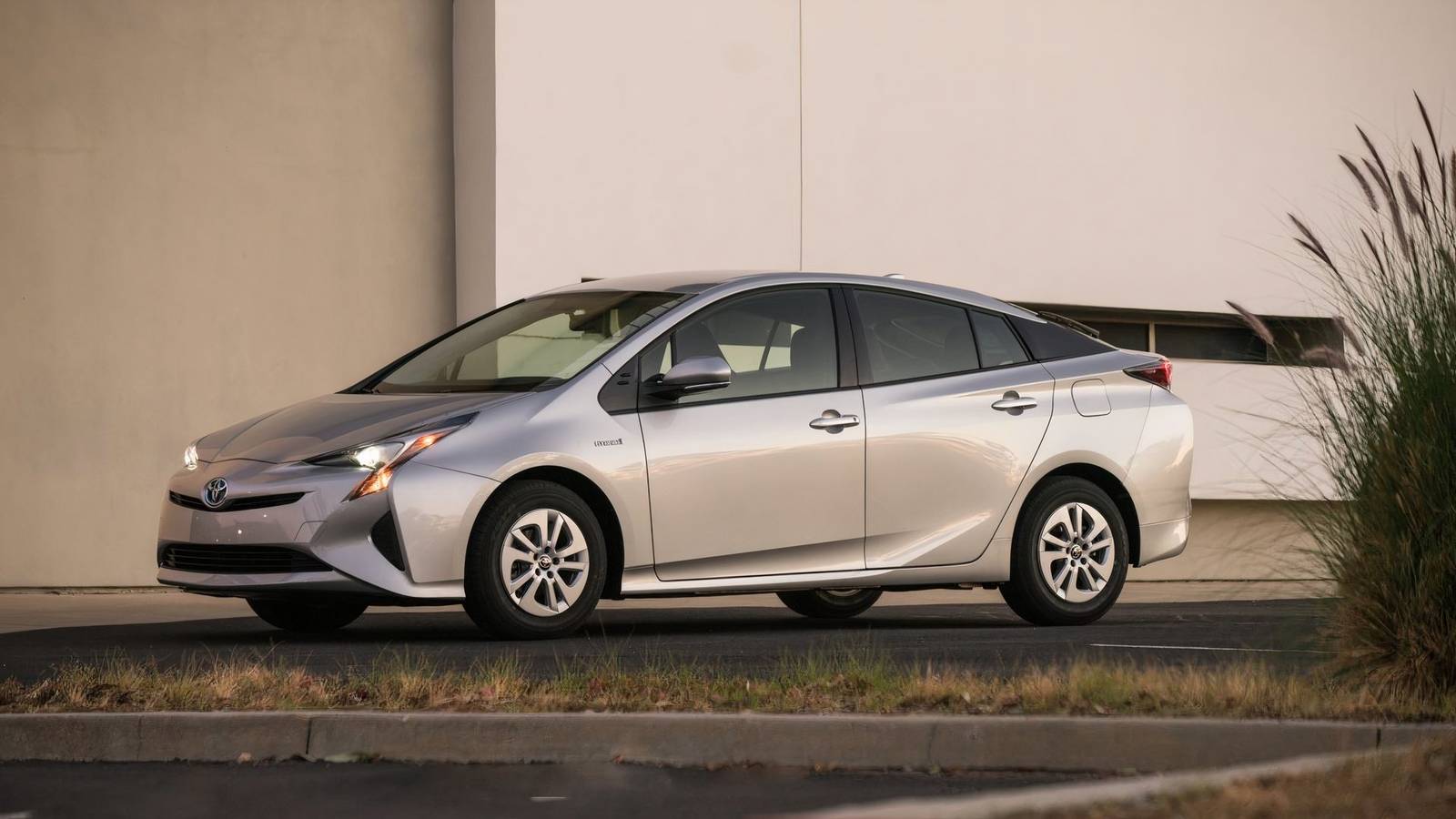
The previous-generation XW50 Toyota Prius is already more than 10 years old, but despite this age, it remains an exemplary and modern hybrid vehicle option with efficiency standards that surpass the current-generation model. As a result, it’s a highly sought-after model, especially among hypermilers who want to stretch their monthly fuel bill as far as possible.
The 2016 Toyota Prius has the benefit of being a highly reliable and low-cost used option, resulting in it maintaining an impressive level of value, even after 10 years. The Prius has always been a niche proposition in the U.S., primarily due to its compact proportions and awkward exterior design, but it has also always represented the best that the Japanese brand has to offer from its electrification department.
How Much A 2016 Toyota Prius Sells For Today

According to J.D. Power, the 10-year-old Toyota Prius models now sell for anywhere between $12,453 to $16,308, depending on the specification, mileage, and condition. When new, the base Two trim sold for $24,200, while you would have paid $30,000 for the top-of-the-range Four Touring. The publication issues this model with 83/100 for quality and reliability, 88/100 for the driving experience, and 80/100 for resale.

iSeeCars indicates that you can expect to lose $10,085 or 35.6 percent of the aforementioned value over the next five years and 60,000 miles. This is pretty much on par with the depreciation levels that its main rivals are subject to. On the reliability front, the same model earns a 13-year or 177,288-mile average lifespan estimate with a 34.8 percent probability of reaching 200,000 miles.


Find 2016 Toyota Prius and more cars for sale on our Marketplace

According to Kelley Blue Book, a 10-year-old 2016 Toyota Prius stands out as a financial anomaly in the used car market. It’s one of the few examples of its time that retains as much as 45 to 50 percent of its original MSRP. Most decade-old vehicles plummet to 30 percent of their value or less.

The publication credits this impressive value retention to its status as the debut year of the fourth-generation model. This introduced a more modern driving TNGA-based platform and remarkable fuel consumption results from the EPA’s testing. 2026’s current economic climate is likely to result in fuel price volatility. The previous-generation Prius’s efficiency resultantly makes it a high-demand commodity for commuters and budget-conscious buyers. Furthermore, the 2016 model has hit a value plateau because its reputation for 250,000-mile reliability is so well-established that it depreciates much slower than competitors like the Ford Fusion and Hyundai Ioniq.

The Real Cost Of Replacing A Toyota Prius Battery In 2025
This is how much you can expect to spend to have your Prius’s battery replaced.
Reliability Contributes To Value Retention

Kelley Blue Book‘s data also confirms that the fear of hybrid battery failure has largely vanished, as refurbished replacements are now affordable and original units have proven their longevity. This has transformed the Prius from a niche eco-car into the gold standard for near-bulletproof used car ownership. Ultimately, the 2016 Prius is regarded as a seemingly inflation-resistant investment. It offers the safety tech of a modern car and the fuel economy of a new hybrid, but at a fraction of the cost, ensuring its resale value remains anchored even as it enters its second decade of service.
Comprehensive Features Across The Range

Toyota’s four trims for the 2016 Prius are what we would call well-balanced and spaced out, resulting in a diverse model line that caters to multiple potential consumer preferences. The base Two and Two Eco trims feature LED headlights, 15-inch alloy wheels, single-zone climate control with pollen filtration, cloth upholstery, manually adjustable front seats, a 60/40-split rear folding bench, all-electric windows, and several cupholders scattered throughout the cabin.

In terms of entertainment, you get a 6.1-inch touchscreen infotainment system with Bluetooth connectivity and a conventional six-speaker audio system. The Three only adds a rear windshield wiper, seatback pockets, and a tonneau cover for the trunk. Upgrading to the Four introduces auto-on headlights and rain-sensing wipers, 17-inch alloy wheels, SofTex upholstery, heating for the front seats and steering wheel, and an auto-dimming rearview mirror. You also get a wireless smartphone charger and access to a couple of optional packages for the interior and exterior. The top-of-the-range Four Touring trim benefits from a heads-up display, adaptive front headlights, and an 11.6-inch touchscreen infotainment system connected to the premium JBL audio system.

The Toyota Hybrid Crossover That Outsold The Prius In 2024
This relatively new hybrid crossover option was a big hit for the Japanese brand last year.
Modest Power Outputs And Performance Delivery

The XW50 Toyota Prius features a basic naturally aspirated 1.8-liter four-cylinder engine connected to a single permanent-magnet synchronous electric motor that drives the front wheels. This is its previous-generation HEV system, but you can still find it in the current-generation Toyota Corolla Hybrid. The result is a rather lethargic 121 horsepower and 120 pound-feet combined output, which gets the hybrid sedan from zero to 60 MPH in around 10.6 seconds with a 112 MPH top speed.
Toyota Prius Performance Specifications
| Powertrain | 1.8-Liter Four-Cylinder And One Permanent Magnet Synchronous Motor |
| Transmission | Direct-Drive eCVT |
| Horsepower | 121 HP @ 4,000 RPM |
| Torque | 120 LB-FT @ 4,200 RPM |
| Driveline | Front-Wheel Drive Or All-Wheel Drive |
| 0-60 MPH | 10.6 Seconds |
| Top Speed | 112 MPH |
The Best HEV Consumption You Can Enjoy

The fourth-generation Toyota Prius also excels at returning amazing fuel consumption that even outdoes the current-generation Prius. The EPA estimates that you can expect to enjoy combined fuel efficiency ratings as high as 58/53/56 MPG on the city/highway/combined cycle if you opt for the Eco trim, together with a 633-mile range from the 11.3-gallon tank and compact battery pack. Over five years, you can expect this model to save you up to $4,250 in fuel costs, while spending $850 on fuel every year and $1.43 to drive 25 miles. You’ll find yourself spending $36 to fill the 11.3-gallon tank up.
EPA Estimated Range And Fuel Consumption
| Eco | Front-Wheel Drive | All-Wheel Drive | |
| Fuel Consumption (City/Highway/Combined) | 58/53/56 MPG | 54/50/52 MPG | 51/47/49 MPG |
| Range | 633 Miles | 588 Miles | 519 Miles |
| Five-Year Fuel Savings | $4,250 | $3,750 | $3,500 |
| Annual Fuel Cost | $850 | $950 | $1,000 |
| Cost To Drive 25 Miles | $1.43 | $1.54 | $1.64 |
| Cost To Fill The Tank | $36 | $36 | $34 |
The standard front-wheel-drive derivative returns a marginally worse 54/50/51 MPG result and a 588-mile range claim. This model saves $3,750 in fuel costs over five years and costs $950 to refuel a year and $1.54 to drive 25 miles. The all-wheel drive model brings in a 52/50/48 MPG result with a 530-mile range estimate. This model saves $3,500 in fuel costs over five years and costs $1,000 to refuel every year. You’ll spend $1.64 to drive 25 miles and $34 to fill the smaller 10.6-gallon tank.

Toyota’s Forbidden Fruit In The U.S. Channels The Spirit Of The Prius C
Toyota’s JDM compact HEV hatch is a stylish forbidden fruit.
The Alternative Prius C And V Offerings

The 2016 Toyota Prius C and Prius V have both defied standard 10-year depreciation curves, though for very different reasons. The Prius C was originally Toyota’s budget-friendly city hybrid hatchback, boasting an MSRP of $19,560 for the base One derivative. Today, you can pick an example for anywhere between $9,000 and $12,000, reflecting a 45 percent value retention rate from the original value. The Prius C’s enduring popularity is driven by urban commuters who prioritize its compact footprint and 53 MPG city EPA-estimated consumption, making it one of the most cost-effective used vehicles for navigating crowded 2026 urban environments.

The larger 2016 Toyota Prius V wagon has evolved into a cult classic in the used market. Originally, this model would have cost you $26,675 for the base Two derivative, but the range now fetches between $13,000 and $16,000, representing an impressive 50 percent value retention. Toyota’s decision to eventually discontinue the Prius V in favor of larger SUVs means it occupies a unique niche in 2026 as the premier choice for families who need massive cargo capacity without the high fuel costs of a crossover.

While the Prius C is valued for its thriftiness, the Prius V commands a premium due to its rare utility-to-efficiency ratio. Both models significantly outperform the industry average for decade-old cars, which typically retain only 30 percent of their value. Their success in 2026 highlights a broader market trend: as new car prices remain high, these reliable, 10-year-old hybrids have transitioned from risky older cars to highly liquid financial assets that offer a hedge against inflation and rising fuel costs.
Sources: Kelley Blue Book, J.D. Power, the EPA, Edmunds, and iSeeCars