
In the modern supercar world, performance has become theatrical. Crackling exhausts, oversized wings, hyper-aggressive styling, and relentless noise dominate the conversation. Speed is no longer enough — it has to be loud, often obnoxious and intimidating, and broadcast on social media. Against that backdrop, the Porsche 911 Turbo feels almost out of place, yet more relevant than ever.
This is a supercar defined not by spectacle, but by the quiet authority of the Stuttgart crest and the engineering discipline behind it. The latest Porsche 911 Turbo, based on the 992-generation platform, doesn’t chase attention. It doesn’t need to. Instead, it delivers world-class performance with an ease that borders on casual, wrapped in a design that signals intent without demanding validation. It’s a supercar defined not by ego, but by engineering discipline — and that’s precisely what makes it special.

- Base Trim Engine
-
3.6-liter Boxer-6 Twin-Turbo Hybrid
- Base Trim Transmission
-
PDK 8-speed auto-shift manual
- Base Trim Drivetrain
-
All-Wheel Drive
- Base Trim Horsepower
-
701 hp
- Base Trim Torque
-
590 lb-ft
- Make
-
Porsche
- Model
-
911 Turbo
- Segment
-
Sports Car
Relentless Performance Without Excessive Drama
Why The 911 Turbo’s Speed Is Often Described As Effortless Rather Than Aggressive

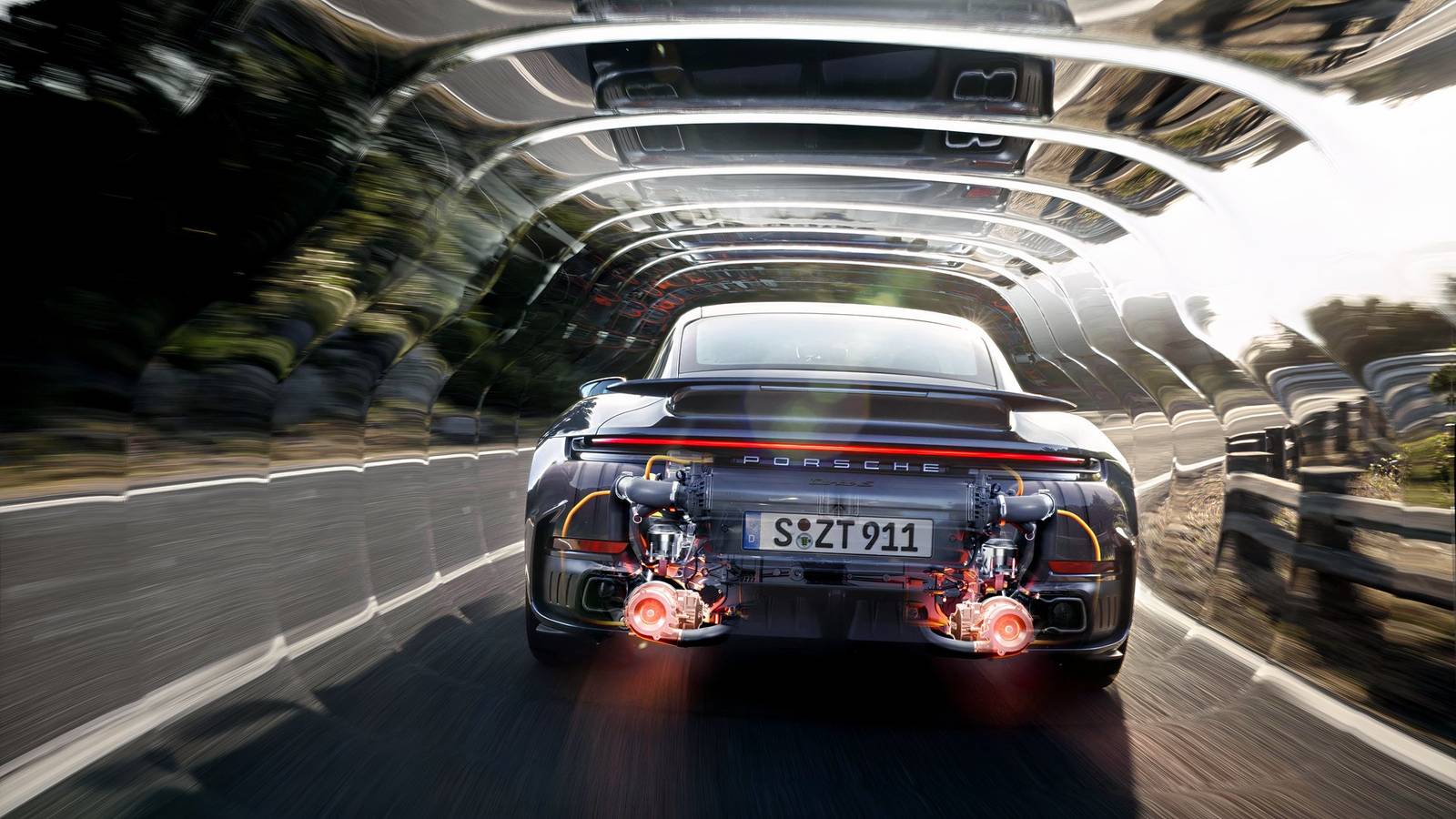
The numbers place the latest Porsche 911 Turbo S in a different performance conversation altogether. At its core is a redesigned 3.6-liter flat-six, replacing the previous 3.7-liter unit and now paired with Porsche’s fully integrated T-Hybrid system. This setup incorporates electrically assisted turbochargers — with electric motors spinning the turbo shafts for immediate response — along with an electric motor positioned between the engine and Porsche’s eight-speed PDK dual-clutch transmission. Power is supplied by a compact 1.9-kWh high-voltage battery, all working in unison rather than as separate systems.

The result is a combined output of 701 horsepower and 590 pound-feet of torque, delivered with a focus on responsiveness and consistency rather than dramatic spikes. Porsche claims the hybrid assistance significantly sharpens low- and mid-range response, effectively eliminating traditional turbo lag and allowing power to build smoothly across a broader rev range. While the added hybrid hardware increases curb weight to around 3,829 pounds — roughly 180 pounds more than before — Porsche offsets this through targeted weight savings elsewhere and continued refinement of chassis stiffness, grip, and overall balance.

Performance figures reflect that holistic approach. Zero to 60 mph is quoted at approximately 2.5 seconds, placing the Turbo S firmly in hypercar territory, while top speed stands at a claimed 200 mph. Perhaps more telling is its Nürburgring Nordschleife lap time of 7:03.92, around 14 seconds quicker than the outgoing model — a reminder that the Turbo S’s evolution is about total performance, not just straight-line numbers. In its latest evolution, the 911 Turbo also reflects Porsche’s measured approach to electrification. Rather than reshaping the car’s identity, hybrid assistance is introduced as a tool to enhance response and efficiency, supporting the Turbo’s long-standing reputation for seamless, effortless performance rather than redefining it.

The Turbo S has been fine-tuned for an immediate surge of power rather than a dramatic build-up, and when you add the all-wheel-drive system to the mix, boom, you have remarkable composure. And one thing to note is the confidence the 911 Turbo S exudes for most performance cars at those speeds; it can actually overwhelm most of them, but the Turbo S does something different, and that’s putting power down in a controlled and understated way. It serves as a reminder that true performance confidence doesn’t need noise or intimidation to make its point.

Best Of The Best: Greatest Porsche 911 Models Of All Time
Within the 911 lineage, certain models stand out as definitive highlights with milestones that pushed the boundaries of design, technology, and speed.


Find 2026 Porsche 911 Turbo and more cars for sale on our Marketplace
A Supercar Designed To Inspire Confidence
How Usability And Stability Shape The Turbo Driving Experience

The defining trait of the 911 Turbo has always been confidence. Where many supercars demand respect — sometimes bordering on fear — the Turbo invites trust. Much of the trust in the steed comes from Porsche’s obsessive focus on chassis balance and stability. What was once seen as a liability — the rear engine layout— has, over time, proven critics and purists wrong.

Through decades of refinement, Porsche has continuously evolved the 911’s formula, turning that unconventional layout into a genuine dynamic advantage rather than a compromise. Combined with rear-wheel steering, adaptive suspension, and intelligent all-wheel drive, the Turbo S has been designed to remain surefooted and planted across a wide range of speeds and conditions.

On the open road, that formula has translated into a driving experience widely regarded as being intuitive rather than nerve-wracking. Reviews consistently comment on the precision behind the wheel, braking performance without abruptness, and a suspension that adapts easily between comfort and control. The result is a car that can be driven quickly without demanding constant risk management from the driver.

That usability is entirely intentional. Porsche designs the Turbo to deliver extreme performance while remaining accessible to drivers who are not professional racers. It is quick enough to rival far more dramatic supercars, yet forgiving enough that its performance can be enjoyed well beyond the racetrack. In a segment where many cars are engineered primarily for bragging rights, the 911 Turbo’s confidence-inspiring reputation gives it a distinctly mature character.

10 Of The Best German Performance Cars That Deserve Your Attention
Germany has long been synonymous with high-performance automotive engineering, and for good reason.
An Interior Built Around Function, Not Flash
Why Porsche’s Cabin Design Favors Clarity Over Spectacle

Step inside the 911 Turbo, and the philosophy becomes immediately apparent. This is not a cabin designed to overwhelm or distract. Instead, it’s built around clarity, ergonomics, and purpose. A timeless elegance that melts your heart away. The latest 992 interior blends modern technology with classic Porsche cues. A digital instrument cluster takes center stage; gone are the analogue-styled gauges. Although old-school will always be cooler, contemporary is the way to go. The infotainment system blends in well, the controls appear logically arranged, and essential functions are readily available even at speed.

Material quality is characteristically Porsche — top-notch, durable, and purposeful rather than showy. Leather, aluminum, and subtle trim accents create a premium environment without resorting to gimmicks or excessive ambient lighting. The sporty seats are designed to balance comfort and support, reinforcing the 911 Turbo’s dual nature as both a long-distance cruiser and a serious performance machine.

What stands out most is how livable the cabin feels. Visibility is excellent for a supercar, and storage space is genuinely usable. This is an interior designed for people who actually drive their cars, not just display them. In an era where spectacle often takes precedence over substance, the 911 Turbo’s interior feels refreshingly honest.

Porsche 911 Turbo S To Go Hybrid: The Biggest Transformation Since 1974
The 911 Turbo S evolves, promising to redefine performance and challenge sports car norms.
Why the 911 Turbo Makes Sense Beyond The Numbers
An Everyday Drive Without Losing Supercar Credentials.

One of the most compelling aspects of the 911 Turbo is how convincingly it fits into everyday life. Despite its performance credentials, it is widely regarded as neither fragile nor impractical by supercar standards. Its engineering brief has always placed usability alongside outright speed.

In Comfort mode, the ride is designed to remain compliant even on imperfect road surfaces, while the cabin is engineered to stay quiet and refined at cruising speeds. The drivetrain’s calibration allows the car to feel relaxed during everyday driving, a trait often highlighted as a key advantage over more temperamental exotic rivals.

That versatility is where the 911 Turbo quietly outclasses much of its competition. Rivals like the McLaren 720S deliver spine-twisting performance but demand meaningful compromises in daily use. The Audi R8 offers character and theater but lacks the Turbo’s all-weather confidence, while Ferrari’s Roma — arguably the closest philosophical competitor — prioritizes style and emotion over outright usability. As Richard Hammond has previously noted, the difference with Porsche is usability.

It’s a supercar you can drive every day, not one that asks for excuses — a contrast he’s often drawn when comparing Porsche to more emotionally driven brands like Ferrari. Pricing in the U.S. reflects the Turbo’s positioning in that hierarchy, with the 2025 911 Turbo starting at roughly $197,200, while the 2026 Turbo S climbs past $270,000 before options.

That places it firmly in supercar territory, yet still below several rivals that offer less real-world flexibility. Crucially, the 911 Turbo is consistently described as a supercar that doesn’t need to be reserved for special occasions. Its everyday usability doesn’t dilute its credibility — it reinforces it.

Best Bang For Your Buck Modern Porsche 911 That Money Can Buy
If you are in the market for a bargain supercar killer, it’s hard to do better than the 996 generation 911 Turbo
The Supercar For Drivers Who Don’t Need To Prove Anything
Why The Porsche 911 Turbo S Might Tickle Your Fancy

The Porsche 911 Turbo has always existed slightly outside the spotlight. Yet time and again, it proves to be the most complete. Its presence is undeniable, but it never shouts. Its performance is devastating, but never intimidating. It offers luxury without excess, speed without drama, and confidence without ego. In a world where supercars increasingly feel like status symbols rather than driving tools, the 911 Turbo stands apart by remaining true to its purpose.

It is fast because it needs to be, refined because it should be, and usable because that’s what makes it special. That quiet confidence is why, decades on, the Porsche 911 Turbo remains one of the most compelling performance cars money can buy — and why it continues to appeal to drivers who value substance over spectacle.
Sources: Porsche USA, Porsche Newsroom