
Back in the 90s, sports bikes were exploding in popularity. Some targeted top speed, while others went for track performance. Manufacturers were flocking to motorsport in an effort to get their respective bikes into the shop window, and speed was selling motorcycles like never before. The main shop window was effectively WorldSBK racing.
It offered us the opportunity to see bikes that we could legitimately go out and buy from a dealership all compete out on track. To stay competitive at this level, manufacturers were forced to innovate and add some incredible tech to these bikes over the years. Today, sports bikes may not be quite as popular as they once were, and the bikes competing in the WorldSBK championship are a bit different from what we have access to. But the bikes we can go out and buy are truly incredible.
To give you the most up-to-date and accurate information possible, the data used to compile this article was sourced from Aprilia. Whereas, the opinions are our own.
Halo-Model Superbikes Offer Manufacturers The Opportunity To Innovate

Between the 90s and early 00s, one manufacturer really stood out in terms of on-track performance. Ducati won one championship after another, and, while expensive, you were able to walk into a Ducati dealership and buy a bike that was virtually track-ready. The latest Panigale V4 S continues this tradition, only with a degree more reliability to go along with its performance. BMW arrived at the superbike party pretty late, but it is fair to say that when the S 1000 RR did arrive, it changed the game. It brought a level of sophistication to the world of superbikes that was previously unheard of. The latest M 1000 RR offers all the bells and whistles, along with a little added lightness.

The New BMW M 1000 RR And M 1000 R Are Here To Tremble The Liter-Class Segment
Along with the M range, the S 1000 RR and S 1000 R also receive a refresh
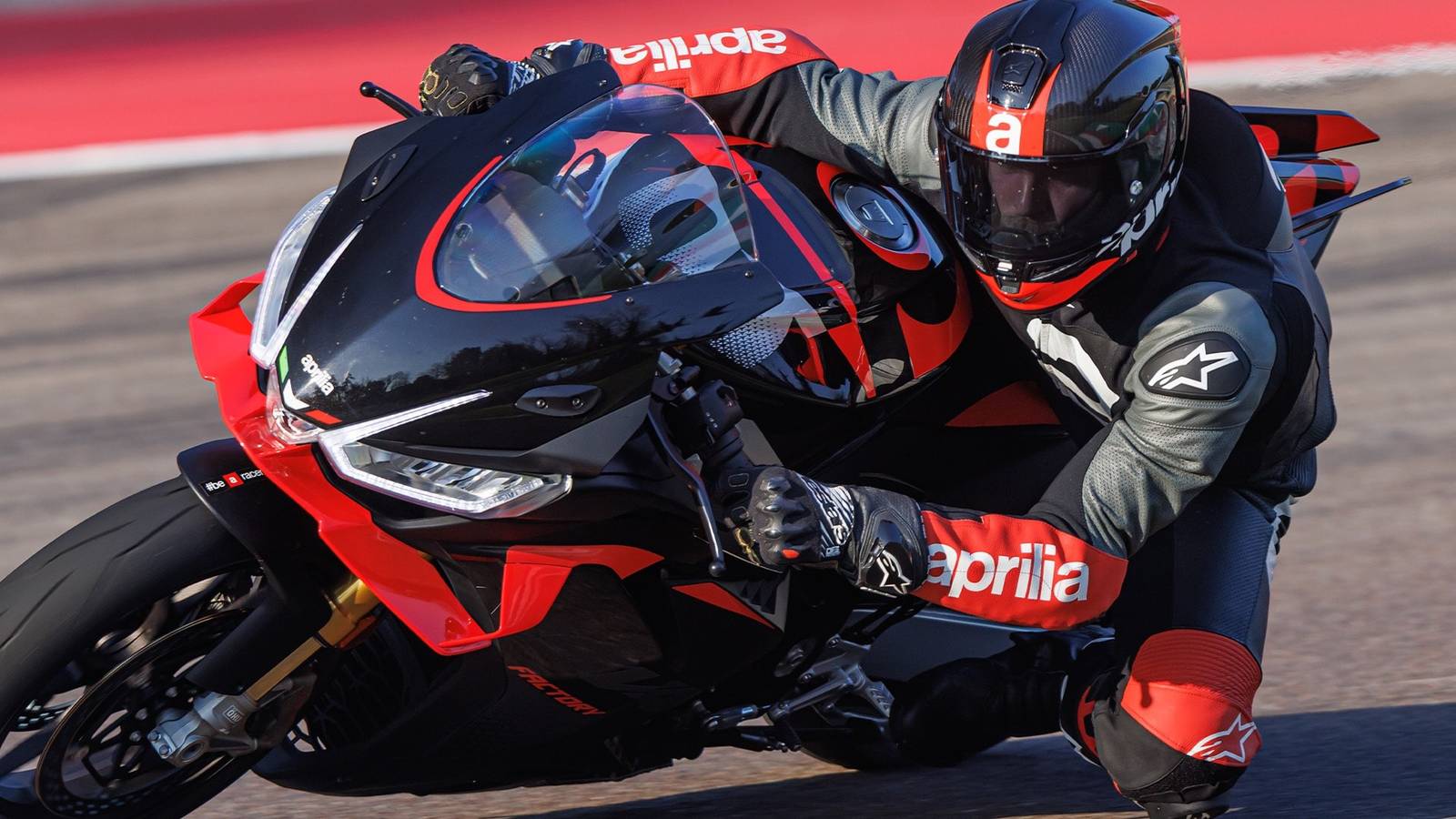
The Aprilia RSV4 Factory Combines Precision, Stability, And Performance
MSRP: $26,499

While the other bikes may have their merits, it is the Aprilia RSV4 Factory that really captures the imagination. It rolls all the best characteristics of those two amazing bikes into one glorious V4 superbike. Back when this relatively small manufacturer from Noale first entered WorldSBK, nobody expected such an inexperienced team to win the Championship in their first full racing season. This had a lot to do with all the effort put into developing Aprilia’s first V4 engine. It was good then, and all these years later, it is better than ever.

The Sports Bike That Feels Like A Ducati Without The Price Tag
Italian? Check. V4 engine? Check. More powerful and cheaper than the Panigale? Check and check!
Powered By The World’s Narrowest V4 Engine

After limping along with an old Rotax V-twin for some years, Aprilia took the plunge and developed the V4. It is fair to say that the Piaggio Group bet everything on this lump. Over the years, it has paid for itself, not only because it goes into this incredible superbike, but because of what it did for the brand. Up until it carried the RSV4 to those four WorldSBK titles, Aprilia sports bikes were always the alternative choice. This engine put the brand on the map and proved that Aprilia was now a genuine threat to the establishment.
Italian Charm Isn’t Always Charming

Reliability issues plagued early models, and several customers were left disappointed. Not just with the bike, but also with the service after being forced to go without their expensive superbike for long periods of time. This lump has received almost 17 years of development, and is now very much the finished article, making an astonishing 220 horsepower. Aprilia – and, by extension, the Piaggio Group – have also improved their service. Unfortunately, dealer support is still limited, and parts availability is still no guarantee.

10 Reasons To Buy The 2025 Aprilia RSV4 1100 Over The 2025 BMW S 1000 RR
Aprilia’s latest salvo is so impressive, we’d pick it over the current king of liter superbikes.
The RSV4 Factory Gets Semi-Active Suspension

This is more or less the same twin-spar aluminum chassis that carried the bike to four championships. Compared to some of the competition, it might seem a little dated, but in reality, it is still as good, if not better, than those bikes that are all now more expensive. It is relatively simple compared to some of the other superbike options, but it works. Not only does it give the bike its precise handling, it also keeps the weight right down.
But the base model has the same chassis and is not the reason you would buy the Factory version. The reason why you would spend money on the Factory version is for its track-ready semi-active suspension and electronic steering damper. It is fully customizable and will allow you to get the bike perfectly set up for whichever track you happen to visit. Aprilia has also added a sophisticated electronics package tailored for the track.

10 Motorcycles With The Most Advanced Suspension Systems
Motorcycle suspension systems have come a long way since the pre-war days of coil-sprung druid and leaf spring forks.
An Impressive Electronics Suite Serves To Inspire Confidence

APRC (Aprilia Performance Ride Control) is arguably the main point of difference. Aprilia figured out motorcycle electronics way before other manufacturers, and has since just made minor tweaks and adjustments. On paper, it is all the familiar inclusions you get on a top-spec bike, including ride modes, cornering ABS, lean-sensitive traction control, cruise control, a quickshifter, and a TFT dash. The difference is how much more intuitive the system is, and the fact that it just works in the real world.
While there are other superbikes that are just as good as the RSV4 Factory, it balances performance and technology like nothing else on the market. It also adds a dash of Italian charm, which some will actively hate, and others will love. This is not a motorcycle that will leave anyone on the fence. It is a pure adrenaline machine that is designed mostly for track use. For those riders after a real-world superbike, this is not it. This is a bike you buy if track days are on the agenda.
Chassis, Suspension, And Weight Specifications
|
Chassis |
Twin-spar aluminum |
|
Front Suspension |
Öhlins 43 mm electronically controlled USD fork, fully adjustable (4.9-in travel) |
|
Rear Suspension |
Öhlins electronically controlled monoshock, fully adjustable (4.5-in travel) |
|
Weight |
450 lbs |