
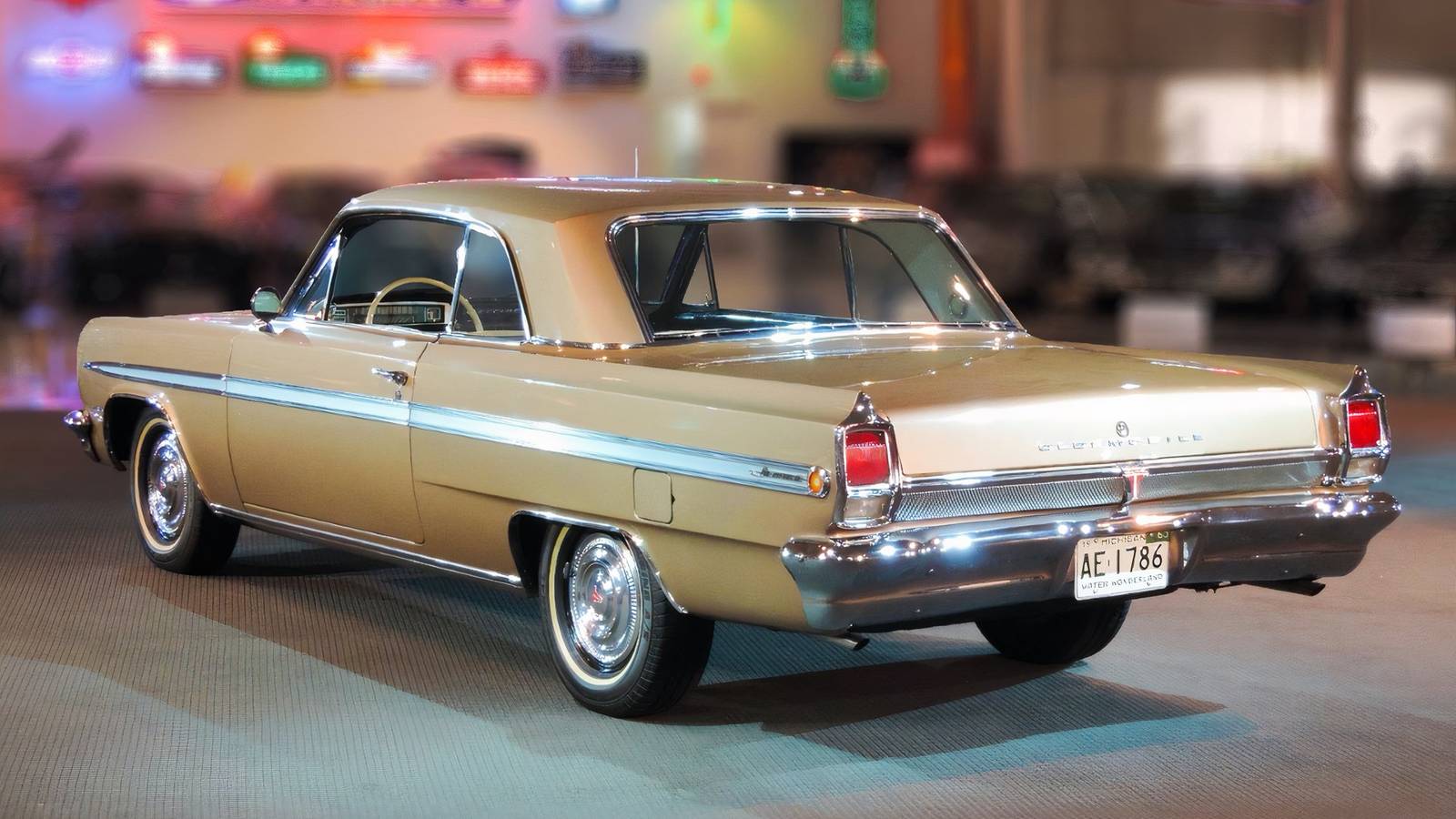
Perhaps because its very name sounds antiquated, Oldsmobile has always been regarded as a fuddy-duddy car brand. The truth of the matter, however, is that Oldsmobile has been a leader in high-performance vehicles, cranking out some of the fastest rides of their time. The 1949 Rocket 88 is regarded as the first muscle car and was a dominant force on the NASCAR circuit. The Cutlass 442 was a GTO killer and one of the baddest rides of the classic muscle car era.
One of the more forgotten Oldsmobile performance cars was the Jetfire, which was the first production vehicle with a factory-installed turbocharger. This proto-muscle car wasn’t fast by modern standards, but it did pack a punch back in the early 1960s, which made it one of the peppier street machines of the day. Turbochargers are commonplace for performance cars in 2024, but back then, this was some radical technology that must have seemed like vehicular voodoo.
Because the Jetfire was only made for two model years, and in limited numbers, it is one of the most illusive GM classic collectibles. Turbocharging was something associated with airplanes, and wouldn’t gain widespread adoption among passenger cars until the 1980s, so the fact that this ’60s Oldsmobile had one makes it not only a novelty, but also a rarity. Despite its scarcity, an Oldsmobile Jetfire is a very affordable, rare classic that would do any collector or enthusiast proud.

10 Surprisingly Cheap Oldsmobiles Available On The Used Market Today
Here are some classic rides that are definitely not your father’s Oldsmobile, because they are cool and affordable.
The 1962 Oldsmobile Jetfire Launches

For the 1961 model year, Oldsmobile introduced its first compact car; the F-85 Cutlass, which was a good two feet shorter than the next biggest ride in their lineup. This was by far the most budget-conscious vehicle Oldsmobile had ever made, and it came with a few innovations.
First, it had unibody construction, which was unheard of back then, and it was only offered with a V-8, while most other vehicles either came standard with or had a six-cylinder option. The next year, Oldsmobile stretched their imaginations further with the turbocharged Jetfire, based on the F-85 Cutlass.
Oldsmobile Jetfire Info:

- Production Years: 1962-1963
- Production Numbers: 9,607 units
- Body Style: Two-door hardtop
- Driveline: RWD
- Original Price: $3,408
- Price Adjusted for Inflation: $35,495
The Jetfire beat the Chevrolet Corvair Monza to market by a couple of months, so it is officially the first production car with a factory turbocharger. In addition to the radical turbo V-8, the Jetfire differed from the standard F-85 Cutlass with several chrome trim accents, including two hood fins and a body-length contrast stripe on either side.
Also, unlike the F-85, the Jetfire was a pillarless hardtop that was only offered in two-door configuration. Costing nearly $300 more than the standard Cutlass, the Jetfire was treading into luxury territory. The Jetfire, for sure, was a sweet-looking ride, but it was the Turbo-Rocket engine that was the main attraction.
The 215 Turbo-Rocket V-8

At 215ci and rated at 215 horsepower, the Turbo-Rocket V-8 was one of the first engines to achieve one horsepower per cubic inch of displacement. This would have been more impressive if it was 427, but it still counts as an accomplishment. This was essentially the Oldsmobile Rockette engine with a Garrett AiResearch turbocharger and carburetor.
One of the wackiest aspects of this engine was that it had a bottle of “Turbo-Rocket Fluid” which was a mixture of distilled water and methyl alcohol that was sprayed into the manifold air stream to cool down the intake charge.
Turbo-Rocket V-8 Specs
|
Engine Type |
90° V-8 |
|---|---|
|
Displacement |
215ci |
|
Bore x Stroke |
3.500 x 2.800 |
|
Compression Ratio |
10.25:1 |
|
Firing Order |
1-8-4-3-6-5-7-2 |
|
Induction |
Turbocharger |
|
Fuel |
Gasoline |
|
Horsepower |
215 HP @ 4,600 RPM |
|
Torque |
300 LB-FT @ 3,200 RPM |
Jetfire Features

The Jetfire was a little more expensive than the base model F-85, but it did have some cool features to justify the added price on top of the Rocket-Fire engine. All Jetfires came with bucket seats and a center console. They were available with either a three-speed Roto Hydramatic automatic transmission or a manual four-speed.
Mounted on the console near the shifter was a pressure/vacuum gauge that supposedly helped the driver maximize the turbo boost. Suspiciously absent in the interior was a tachometer, but it did have an AM radio, which was the cool frequency band back then.

The First Turbocharged Muscle Car Is Now A Collector’s Bargain
This model’s futuristic technology may have contributed to its demise, though buyers can reap the rewards of its failure today.
Driving The Oldsmobile Jetfire

215 Horsepower is not a lot of juice under the hood of a car that weighs about 3,000 pounds, so the Oldsmobile Jetfire, despite being turbocharged, was kind of on the slow side. Taking almost 10 seconds to hit 0-60 and a quarter-mile in the high 16s, this doesn’t seem like a performance ride to modern observers, but it wasn’t far off the standard for the day. To put that into perspective, a 1962 Corvette had a 360-horsepower 327 V-8 and was only about a second faster in the quarter-mile.
Jetfire Power And Performance
|
Engine |
215ci turbo V-8 |
|
Horsepower |
215 HP @ 4,600 RPM |
|
Torque |
300 LB-FT @ 3,200 RPM |
|
Transmission |
Four-speed manual |
|
0-60 Time |
9.2 seconds |
|
Quarter-mile |
16.8 seconds |
|
Top Speed |
110 MPH |
The Jetfire, especially with the four-speed, felt quick to drivers in comparison to almost everything Detroit had to offer in the early sixties. It wasn’t a neck-snapper like the muscle cars that would come in the next few years, but for an average person in 1962, this Oldsmobile was space-age technology and a high-performance vehicle. The problem with the Jetfire wasn’t the acceleration, but rather the fact that the Rocket-Fire engine was wonky and unreliable.
Engine Spark Knock Issues

The point of the crazy “Turbo-Rocket Fluid” reserve in the 215 Turbo-Rocket engine was to cut down on spark knock, which was an issue on hard accelerations with the Jetfire. Basically, this is the fuel not igniting when it should, and it can be anything from a performance robber to a destroyer of engines. Many drivers would forget to refill their Turbo-Rocket Fluid and the result was a scary, unreliable engine. Some owners actually pulled the turbochargers out and replaced them with four-barrel carburetors.
Handle With Care
On top of the engine issues, the Jetfire didn’t handle very well. The steering was unresponsive, and the suspension was like the vehicular equivalent of a blow-up bounce house. In reality, the problems with this car were probably not that bad, but the car-buying public soured on it and Oldsmobile discontinued it after two model years. To collectors now, the Jetfire is a cool-looking classic that is literally a driving piece of automotive history, but back then it failed to resonate with buyers.
The Oldsmobile Cutlass Is A Launching Pad For Performance

The Cutlass, introduced in 1961, became Oldsmobile’s launching pad for performance models. The 1962 Jetfire was a dry run as well as the beginning of fast Cutlass-based rides. In 1964, the second-gen Cutlass grew from a compact to a mid-size and Oldsmobile came up with the 442 as an answer to the Pontiac GTO.
The name stood for four-barrel carb, four-speed transmission, and dual exhaust. Initially, the 442 was a little less powerful than the GTO having a 330ci V-8 engine versus the Pontiac’s 389. All that changed in 1965, when Oldsmobile dropped in a 400ci V-8, and 442 then stood for a 400 cubic inch engine, four-barrel carburetor, and dual exhausts.
1970 442 W30 Power And Performance
|
Engine |
455ci V-8 |
|---|---|
|
Horsepower |
370 HP |
|
Torque |
500 LB-FT |
|
Transmission |
Four-speed manual |
|
0-60 Time |
5.9 seconds |
|
Quarter-mile |
13.7 seconds |
|
Top Speed |
135 MPH |
More importantly, the Oldsmobile was suddenly faster and more badass than the GTO, which is credited as starting the classic muscle car era. The 442 reached the height of its awesomeness in 1970 with the W30 performance package and the 455ci V-8. It was faster than a Chevy Chevelle SS or a GTO Judge, and was one of the few GM muscle cars that could hang with the 426 Mopars.
Oldsmobile continued to produce 442s into the 1990s, but by then they were four-cylinder mockeries of the original GTO-killer. Still, for every year of production, the 442 was the highest-performance trim of the Cutlass.
Hurst/Olds

GM used to have a silly ban on engines over 400ci for mid-sized cars that wasn’t lifted until 1971. Oldsmobile found a clever workaround in 1968 by partnering with Hurst Performance, to build some special edition cars with big honking 455ci V-8s. The result was the Cutlass-based Hurst/Olds, which is one of the most legendary street machines of the classic muscle car era. Everyone remembers these eye-catching limited edition rides from the late ’60s, but might be unaware that they continued to intermittently be produced well into the ’80s.
Hurst/Olds Production
- 1968–515 units
- 1969–906 units
- 1972–633 units
- 1973–1,097 units
- 1974–1,851 units
- 1975–2,535 units
- 1979–2,499 units
- 1983–3001 units
- 1984–3,500 units

These Are The First 10 Production Cars In History With Factory Turbochargers
We may love a good turbo today, but they had to start somewhere – here are the first 10 production cars to boast a turbocharged engine under the hood.
Legacy Of The Historic Oldsmobile Jetfire

Almost nobody buys a classic car to race in, but they do get them to enjoy and show off. An Oldsmobile Jetfire is the perfect car to turn heads at Bob’s Big Boy or the local car show because it is so unique, and it doesn’t matter that it’s not a factory drag car. It is the first factory-installed turbo car that was made in extremely low numbers, so chances are lookie-loos are going to be interested in it.
As an added bonus for collectors and fans, it’s a very affordable piece of history, despite its rarity and significance. Seriously, this is the single most undervalued classic car of all time.
Bring a Trailer has only had a few Oldsmobile Jetfires sold in recent years, but they went between 27,500 and 30,750, which are examples of grand larceny. All the cars appear to be in great condition, so these auction sales really were steals. Hagerty sets the value of a 1962 Jetfire from $15,000 for a project to $47,000 for a cherry-perfect condition car.
J.D. Power seems to think they are even more affordable than that, setting the average retail price at just $26,600. For less than the price of a soulless 2024 subcompact crossover, a killer piece of automotive history can be had, and that’s what’s known as a no-brainer for enthusiasts.