
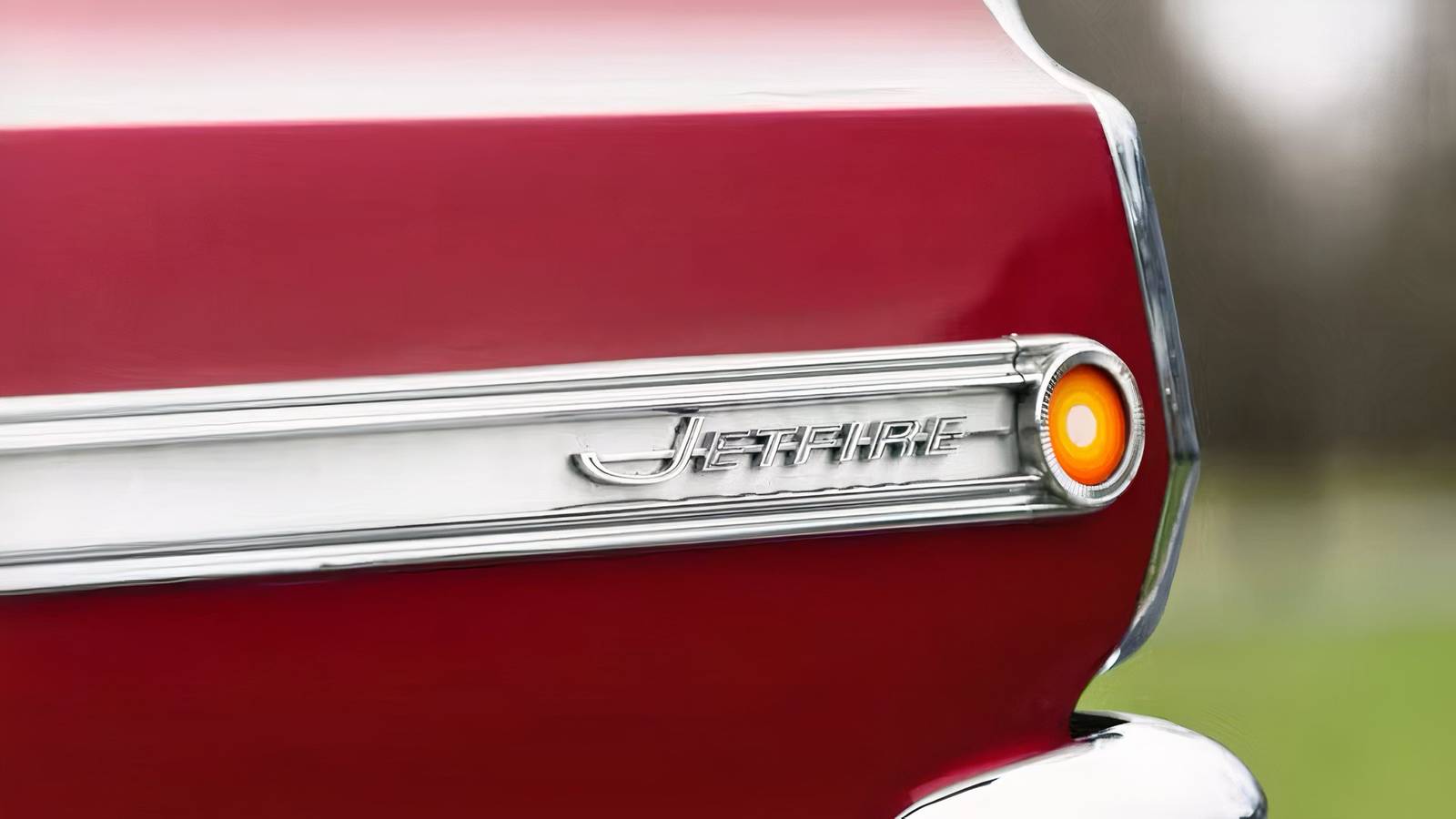
Does anyone still remember Oldsmobile? This defunct American automaker ceased operations over two decades ago and faded from the collective consciousness. Yet, at its peak in the 1960s, they were revolutionizing automotive engineering. One of its greatest achievements was the 1962 Oldsmobile Jetfire, the first production turbocharged car of any kind.
What encouraged Oldsmobile to make the Jetfire in the first place, and what effect did its production have on the automotive industry long-term? Stick around for the answers to that and more as we break down the key details that shaped the American muscle car that used forced induction before anyone else.
Why The 1960s Was A Pivotal Turning Point

Though supercharging had been around since the late 1880s, turbochargers as we know them today didn’t exist until the early 1900s. Turbocharging was first applied in heavy-duty and commercial applications like aviation, ships, and trucks, but its prominence didn’t expand until the technology’s use in World War II. Once the war ended, these military-derived innovations slowly made their way into consumer markets, and by the early 1960s, we saw General Motors pioneering the automotive turbocharging revolution.


GM Introduced Turbocharged Passenger Cars Through The 1962 Oldsmobile Jetfire

The 1962 Oldsmobile Jetfire was the first production turbocharged car, and only a few months later, General Motors would also introduce the turbocharged 1962 Chevrolet Corvair Monza. The 1962 Oldsmobile Jetfire was a variant of the pillarless hardtop coupe, the Oldsmobile Cutlass, that utilized the 215-cubic-inch V-8 engine equipped with a Garrett turbocharger. This turbocharged V-8, also known as the “Turbo-Rocket,” had a 10.25:1 compression ratio and produced 215 horsepower and 300 pound-feet of torque on tap. The equipped Garrett turbo produced five psi of boost at only 2,200 RPM with a blow-through single-barrel carburetor setup. Though this novel induction system provided impressive performance capabilities, it had quirks that certainly played a part in causing its short lifespan.
The Oldsmobile Jetfire Introduced Production Water Methanol Injection

One of the primary limitations of early turbochargers was the heat management issue presented by combining forced induction with high compression ratios. The result of these two forces is known as engine knock, which can often lead to catastrophic failure when cylinder pressure and temperatures get too high. In an era before knock sensors, active timing retardation, or intercooling, alternative solutions were required to prevent engine knock.

Oldsmobile’s solution was a water-methanol injection system, dubbed “Turbo-Rocket Fluid.” This system sprayed the intake manifold with this fluid, producing a cooler intake charge, and as a result, preventing engine knock or detonation. In theory, this water-methanol system solved most, if not all, the problems with early turbocharging, but the reality was much different.

The 10 Most Groundbreaking Turbo Systems Of The Past 20 Years
These are the key vehicles that ushered in the latest in turbocharged innovation.
Why The Oldsmobile Jetfire Was Ultimately A Failure

One of the major problems with the 1962 Oldsmobile Jetfire and its novel water-methanol system was that everyday consumers were totally unprepared to handle such a specialized and high-maintenance system. Even the dealerships then didn’t know what to troubleshoot or repair the new system, but that’s something they didn’t often tell the owners when turnaround times were unexplainable.

Imagine you went to the dealership today, and after you bought a brand-new car, they told you that if you don’t top off a specific fluid every couple of hundred miles, your engine will either blow up or have a 50-percent reduction in responsiveness and power. If you have an issue, they may or may not be able to fix it, depending on how backed up the service department is. That is more or less what happened with the Oldsmobile Jetfire.
Turbo-Rocket Fluid Asked Too Much Of Consumers

If you ran low on Turbo-Rocket Fluid, a specific indicator light on the dashboard would inform you. If you didn’t notice that, then the significant power reduction may be another, more obvious indication. The 50-50 mix of water-methanol required topping off every 200 to 300 miles, and if you didn’t get into boost often, maybe you would make it to 2,000 miles. Those service intervals were simply too inconvenient for the majority of drivers, and the result often was the tank going dry. However, General Motors did think of this, and when the tank was empty, a fluid-reading valve would then activate a blow-off valve that limited boost and prevented potential engine damage.

If peak boost was five psi, this meant you were getting next to no boost in this condition, as the engine had no way to keep itself cool. Another issue was that conservative drivers may not have driven the car hard enough to build boost, meaning the turbo didn’t get sufficient lubrication, leading to premature turbo failures. Even worse was that the water-methanol tank had the tendency to leak or randomly fail. To sum it all up, the fluid was not cheap and could only be purchased at the dealer.

The Turbo-Rocket Fluid controversy resulted in many Jetfire owners removing the troublesome turbo system altogether via a 1965 program offered by General Motors. This program gave Jetfire owners the option of retrofitting a standard four-barrel carburetor system in place for increased reliability. While the power of the Turbo-Rocket was special, its maintenance standards and service intervals far exceeded anything consumers at the time were used to.
These Constant Issues Made The Oldsmobile Jetfire Exceptionally Rare

From 1962 to 1963, Oldsmobile only sold a total of 9,617 Jetfire models before General Motors stopped production completely. The reality was that this beautiful and powerful coupe was simply ahead of its time, and its reliability-plagued notoriety played a large part in its poor reception. Another act of short-sightedness was that Oldsmobile made absolutely no changes to the original Cutlass suspension or chassis to accommodate the significant increase in power. That meant that the Jetfire was a one-trick pony, and a dangerous one at that.

Since the majority of Jetfire owners were completely disillusioned with their purchase and retrofitted a conventional carbureted system, the inventory of original non-retrofitted Jetfire models available today is truly limited. It is estimated that only a couple of hundred Jetfires remain, making this 1960s muscle coupe one of the rarest vehicles from its era ever produced.

10 Turbocharged Cars That Became Legends In The Tuning Scene
These are the standout platforms that revolutionized turbo power potential.
The Modern Equivalent Of The Oldsmobile Jetfire

After how spectacular a failure the 1962 Oldsmobile Jetfire was, no automaker even dared to integrate a water-methanol injection system ever again. And when we say ever again, we mean it, because there has been no production vehicle since that has offered a water-methanol injection system of any kind. However, in 2016, BMW took a leap of faith and produced the 2016 BMW M4 GTS, a limited-production model that featured a water injection system.
The 2016 BMW M4 GTS Is The Modern Jetfire That Actually Worked

Although the 2016 BMW M4 GTS is not the first production car featuring a water injection system, it is one of the most prominent modern examples. Let’s remember that a water-methanol system functions to reduce the intake air temperatures (IATs), aiding in preventing knock and detonation. In the M4 GTS, this high-pressure water injection system alone allows for a 26 percent increase in boost pressure from 17.2 psi to 21.6 psi. The water injection system functions by reducing combustion chamber pressures and, as a result, cylinder temperatures. This means that more advanced ignition timing can be utilized at safer temperatures, which results in a greater range of optimal combustion chamber efficiency.

The 1.5-gallon water reservoir located in the trunk of the M4 GTS functions by injecting water into the intake manifold via an in-line water pump and filter. The system determines how much water to use via a metering valve connected directly to the engine’s high-pressure fuel pump. Simply put, the more fuel injected, the more water is metered in. The water reservoir also pulls additional cold water from the condensation of the A/C system. This water injection system worked well, reducing IATs by up to 25 degrees Celsius, allowing the BMW M4 GTS to produce nearly 500 horsepower out of the S55 twin-turbo inline-six engine.
Where Water-Methanol Injection Is Today

While water-methanol injection may have had an unceremonious death in production applications, this technology did not disappear altogether. In the aftermarket and tuning world, water-methanol systems are prevalent and exist for forced induction, naturally aspirated, and diesel engines. You still may be wondering what the benefit of running the 50-50 mix of water and methanol is as opposed to just water injection, as found on the 2016 BMW M4 GTS. Water injection provides charge cooling, while methanol is an octane booster that effectively raises resistance to knock, often comparable to high-octane race fuels. For comparison, race gas is at least 100 octane and can be much higher depending on the variant. While the upkeep of a water-methanol system may have been too much to ask of the public in the 1960s, this innovation has become one of the primary technologies helping race cars go faster for decades.
Sources: General Motors, Oldsmobile, Chevrolet, BMW, Burger Motorsports, Bring a Trailer